
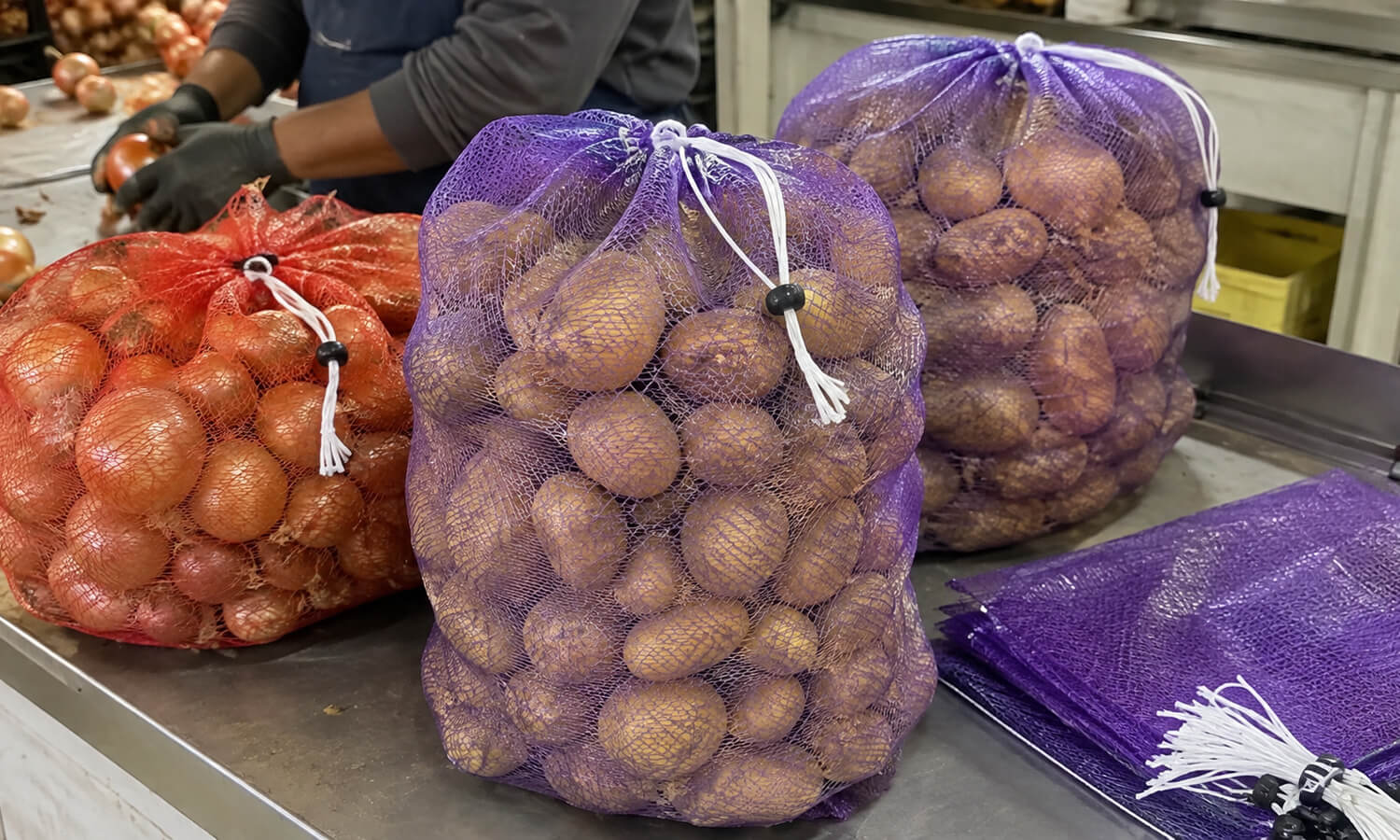
Raschel mesh bags are lightweight, warp-knitted net bags commonly used to pack onions, potatoes, garlic, citrus fruit, vegetables, firewood, and other products that benefit from ventilation. Their open structure allows air to move around the packed goods while giving buyers and retailers good product visibility. For commercial users, they also combine low packaging weight, flexible sizing, color customization, and efficient bulk handling.
For an importer, however, simply asking for a “mesh bag” isn’t enough.
Two bags with the same dimensions may have very different yarn thicknesses, mesh structures, loading performance, closures, and raw materials. One may work well for 5 kg of onions. Another may be designed for 25 kg of potatoes. A third may look almost identical but stretch too much during pallet loading.
That is why professional sourcing should start with the product being packed rather than the bag itself.
The Food and Agriculture Organization of the United Nations notes that open-mesh nets are particularly suitable for relatively hard produce such as potatoes, onions, yams, and coconuts. (FAOHome)
From a manufacturer’s point of view, the best specification balances ventilation, load strength, packaging cost, product visibility, and packing-line efficiency. The following guide explains how to build that specification.
What Are Raschel Mesh Bags? A Complete Guide in One Definition
The simplest definition is this: a Raschel bag is a flexible net package produced with a warp-knitting process. Instead of forming a solid plastic film, yarns are knitted into an open structure. This creates visible holes throughout the package.
Raschel technology belongs to the warp-knitting family. Industrial machine producers such as KARL MAYER classify Raschel equipment within warp-knitting and net-production systems.
For packaging buyers, the manufacturing terminology matters less than the performance it creates.
A typical bag gives you:
- High airflow around the packed product
- Clear visibility of the contents
- Low empty-bag weight
- Flexible and slightly elastic construction
- Multiple color choices
- Different load capacities
- Drawstring or alternative closure options
- Compact shipment before filling
- Custom dimensions for different produce
Commercial suppliers commonly manufacture these nets from polyethylene-based materials. Some product ranges also include polypropylene options. Available configurations vary significantly between factories.
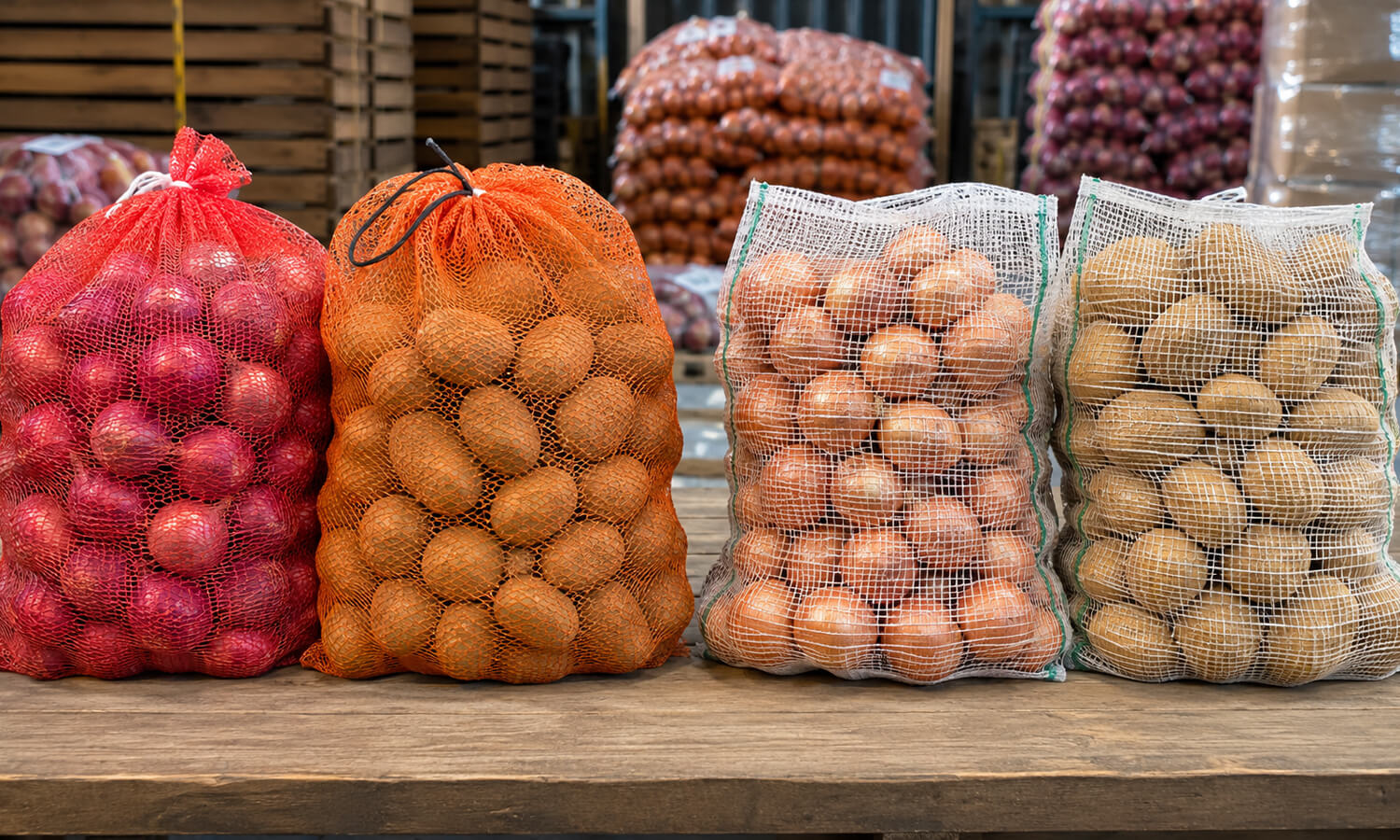
Their familiar red, orange, green, yellow, or purple appearance also serves a marketing purpose.
For example, red netting can make certain onions or potatoes visually prominent. Orange mesh may complement citrus fruit. Green can suit vegetables or firewood packaging. The correct choice depends on your brand and retail market.
For a B2B purchaser, however, color should come after performance.
You first need to define what goes inside, how much the bag carries, how it will be filled, and how it will move through your supply chain. Those four questions influence almost every technical specification that follows.
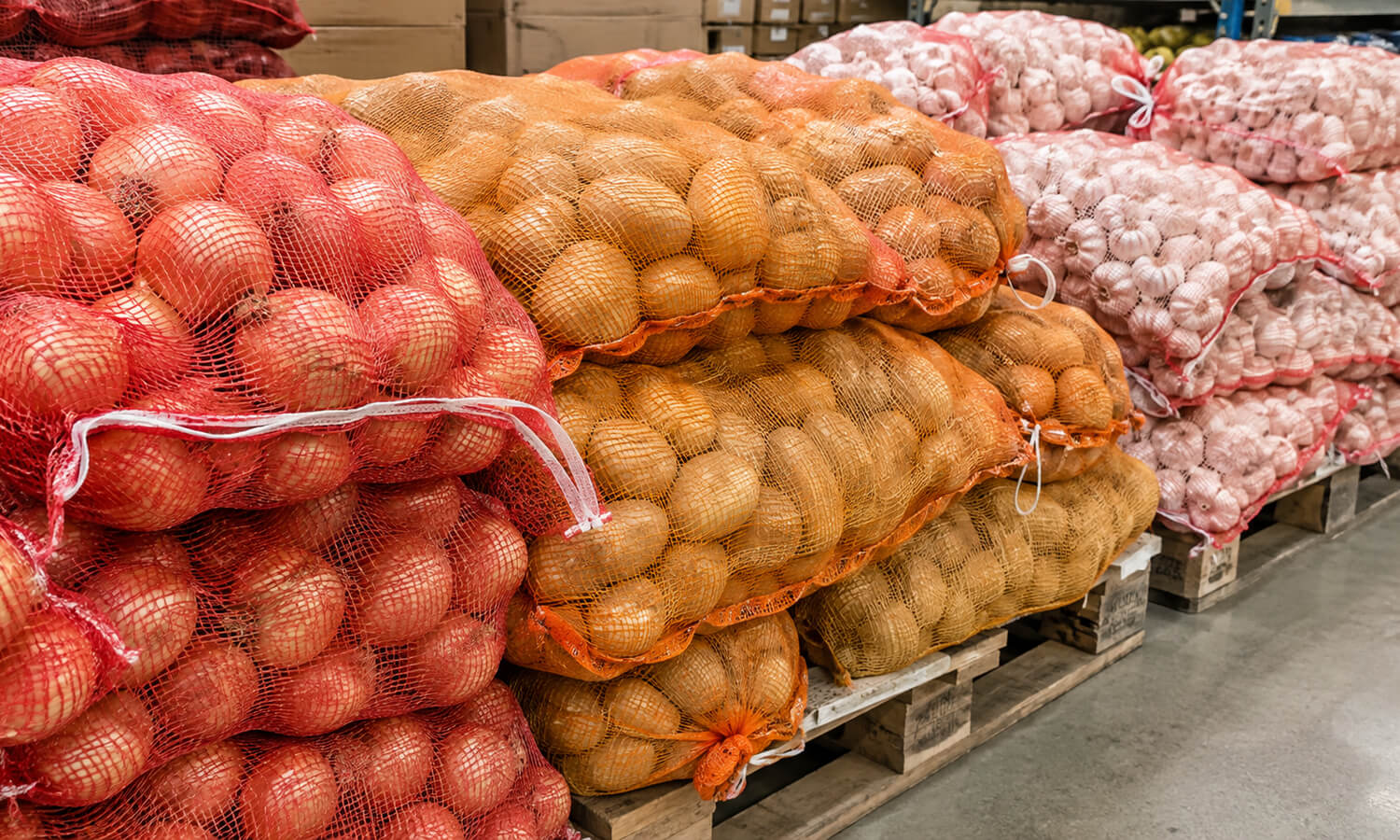
How Warp-Knitted Mesh Packaging Is Manufactured
Understanding production helps you evaluate quotations more effectively.
The process normally begins with thermoplastic resin. Depending on the required design, polyethylene or another suitable polymer is processed into yarn or filament. Color masterbatch and other approved additives may also be introduced according to the specification.
The yarn is then supplied to the knitting system.
Unlike a simple woven sack, the strands are interconnected through a warp-knitted structure. Industrial Raschel equipment is specifically used for producing different net and technical textile constructions.
A simplified production flow looks like this:
Raw Material → Yarn Preparation → Warp Knitting → Bag Forming → Cutting → Closure/Drawstring → Inspection → Baling
The exact workflow varies with the factory and bag design.
From a purchasing standpoint, several production stages deserve special attention.
First, yarn consistency affects both appearance and performance. Unstable yarn thickness may create weak areas.
Second, knitting consistency matters. Uneven mesh openings can make one section stretch more than another.
Third, the bottom seam or closure area must tolerate the actual filled load. Buyers sometimes focus heavily on the body mesh while overlooking the seam.
Finally, cutting and finishing should be controlled. Poorly finished edges can cause loose yarn, inconsistent dimensions, or problems on automatic packing lines.
A useful factory sampling practice is therefore to test the complete finished bag, not just raw mesh fabric.
Fill it with a product that represents the real application. Lift it. Stack it. Handle it several times. Observe the seam, stretch, opening, and drawstring.
That simple test often tells a procurement team more than an impressive specification sheet alone.
HDPE and PE Produce Net Bag Materials and Specifications
Material is only one part of the specification.
Commercial Raschel-style produce bags are commonly offered in PE or HDPE constructions. Some manufacturers also list PP options. One supplier, for example, specifies HDPE products with capacities from approximately 3 to 40 kg, while other commercial ranges extend from small retail packs to roughly 50 kg. These figures are supplier offerings, not universal industry standards.
For an RFQ, consider the following parameters.
| Specification | Typical Buyer Choices | Why It Matters |
|---|---|---|
| المواد | PE, HDPE, selected PP constructions | Influences feel, stretch, weight, and processing |
| Capacity | Small retail packs to large produce sacks | Determines required structure and strength |
| Width × Length | Standard or customized | Must match fill volume and packing equipment |
| Mesh Pattern | Different opening and knit structures | Changes ventilation, appearance, and stretch |
| Bag Weight / GSM | Supplier-specific | Influences material consumption and performance |
| اللون | Red, orange, green, yellow, white, others | Supports identification and merchandising |
| Closure | Drawstring, sewn, open top, other designs | Affects filling and handling speed |
| UV Treatment | Optional where appropriate | Useful when bags face outdoor exposure |
| Label | Printed tag, band, or customized identification | Supports branding and traceability |
Some commercial suppliers advertise material weights ranging around 55–180 g/m², but GSM should never be treated as a universal quality grade.
A heavier bag isn’t automatically better.
The right construction is the one that survives your real filling, lifting, palletizing, transport, and retail conditions without unnecessary resin consumption.
Common Applications for Onion, Potato, Fruit, and Firewood Packaging
Open knitted packaging works best when the packed product can tolerate direct contact with mesh and benefits from airflow.
This is why agricultural products represent one of its largest application areas.
Common examples include:
- Onions
- Potatoes
- Garlic
- Carrots
- Cabbage
- Citrus fruit
- Lemons
- Oranges
- Some firm vegetables
- Selected shellfish products
- Firewood and kindling
FAO post-harvest guidance specifically identifies nets as suitable for hard produce such as potatoes, onions, yams, and coconuts. It also stresses that packaging choice must reflect product protection and post-harvest conditions. (FAOHome)
This distinction is important.
A mesh sack may be excellent for onions, yet unsuitable for a soft fruit that bruises easily. Airflow alone doesn’t make a package appropriate.
For potatoes, ventilation helps prevent a sealed, moisture-trapping environment. However, open mesh doesn’t protect the contents from light. Storage conditions still matter.
For onions and garlic, the open structure works well because airflow is important during handling and storage.
For citrus, the package provides product visibility while keeping packaging weight relatively low.
Firewood presents another use case. Here, food-contact requirements may disappear, while strength, abrasion resistance, closure, and carrying weight become more important.
As a B2B buyer, send the manufacturer more than a target bag size.
Provide:
Product + fill weight + approximate product dimensions + packing method + transport method + destination market.
For example:
“Red mesh bag for 10 kg onions, manual filling, drawstring closure, palletized export shipment.”
That description gives the supplier far more useful information than:
“Please quote 45 × 75 cm net bags.”
Why Ventilated Produce Packaging Offers Important B2B Benefits
The main commercial advantage is obvious: air can pass through the package.
Fresh agricultural products continue undergoing biological processes after harvest. Packaging and storage conditions therefore influence marketable quality. FAO post-harvest guidance emphasizes the relationship between produce characteristics, ventilation, temperature, handling, and storage life.
For wholesalers and packers, open mesh can provide several practical advantages.
Buyer Benefit Chart
Relative commercial assessment only; actual performance depends on the design and application.
| Benefit | Relative Advantage |
|---|---|
| Ventilation | █████ 5/5 |
| Product visibility | █████ 5/5 |
| Empty-package weight | ████☆ 4/5 |
| Flexible sizing | ████☆ 4/5 |
| Retail presentation | ████☆ 4/5 |
| Impact protection | ██☆☆☆ 2/5 |
| Light protection | █☆☆☆☆ 1/5 |
The last two points shouldn’t be ignored.
Mesh isn’t rigid packaging. It cannot give delicate products the same impact protection as a crate or box. It also offers little protection from sunlight.
For suitable products, though, its lightweight construction creates an efficient balance between packaging and visibility.
Retailers can inspect the contents without opening the bag. Packers can stock large quantities of empty bags without using the space required by rigid containers. Produce remains visible to customers.
Colors can also help distinguish product types, grades, brands, or pack sizes.
Before placing a bulk order, request a complete sample set covering your target dimensions, colors, closures, and load capacities. Test those samples with your real products rather than approving them from photos alone.
That small step can prevent a much larger packaging problem after shipment.
Raschel Mesh Bags vs Leno Bags, Extruded Nets, and Woven Sacks
Different net packages may look similar in a product photograph. Their structures aren’t the same.
For procurement teams, understanding the basic differences helps avoid specification mistakes.
| Packaging Type | Structure | Ventilation | المرونة | Product Visibility | Common Use |
|---|---|---|---|---|---|
| Raschel knitted net | Warp-knitted yarn structure | High | High | High | Onions, potatoes, produce, firewood |
| Leno mesh sack | Woven structure with crossing yarns | High | Medium | High | Produce and agricultural packaging |
| Extruded net | Polymer extruded into continuous mesh | High | Medium-High | High | Fruit, vegetables, consumer packs |
| Woven PP sack | Closely woven tapes | Lower | Medium | Low | Grain, fertilizer, feed, bulk products |
| Solid plastic bag | Continuous film | Low unless perforated | High | High | Various retail products |
These ratings are general comparisons. Final properties depend on each specification.
A knitted net is often selected when buyers want a softer and more flexible package. A Leno sack has a woven structure and may feel different during filling and lifting.
Extruded netting isn’t created by knitting individual yarns. Its network is produced during extrusion, giving it another type of geometry and feel.
A conventional woven PP sack provides much more surface coverage. That can be useful for products that shouldn’t escape through open mesh. However, visibility and free airflow are reduced.
The correct question, then, isn’t:
“Which mesh bag is the best?”
Instead ask:
“Which structure produces the lowest total packaging risk for my product and supply chain?”
That means considering damage rates, filling speed, transport, product respiration, branding, storage, material consumption, and unit cost together.
Quality Control, Food Contact, and Export Packaging Requirements
B2B quality control should convert your expectations into measurable inspection points.
“Good quality” isn’t measurable.
A specification such as approved width, length, bag weight, color reference, closure design, and minimum loading performance is much easier for both sides to control.
A practical QC checklist can include:
- Raw material identification
- Bag dimensions
- Unit weight or fabric weight
- Mesh consistency
- Yarn appearance
- Color consistency
- Drawstring position
- Bottom seam quality
- Finished load test
- Quantity per bale
- Label and packaging accuracy
- Visual contamination inspection
- Lot identification
For food packaging, documentation deserves extra attention.
In the European Union, Regulation (EU) No 10/2011 establishes specific requirements for plastic materials and articles intended to come into contact with food. Buyers should determine which declarations, migration testing, and supporting documents apply to their exact product and market rather than accepting a generic “food grade” statement. (EUR-Lex)
For broader post-harvest packaging principles, the FAO Post-Harvest Handling Guide is a useful technical reference.
European packaging requirements are also evolving. Regulation (EU) 2025/40 creates a wider framework covering packaging sustainability and waste across the packaging life cycle. Companies exporting into the EU should review the requirements that apply to their packaging format and market.
Don’t ask only, “Do you have certificates?”
Ask the supplier to provide the specific document, testing scope, product identification, issuing laboratory, and validity information relevant to your order.
That approach creates much stronger supply-chain control.
How to Choose a Custom Mesh Bag Manufacturer for Bulk Orders
Price per thousand bags matters, but it shouldn’t be your only comparison point.
An apparently small saving can disappear quickly if bags break during filling, dimensions vary between batches, closures slow down workers, or your printing doesn’t match approved artwork.
A strong sourcing process starts with a detailed RFQ.
Send your potential supplier:
- Application
- Product being packed
- Target filling weight
- Required width and length
- Preferred material
- Preferred color
- Closure method
- Required label or branding
- UV requirement, if any
- Food-contact requirement
- Packing quantity per bale
- Estimated annual volume
- Destination country
- Required delivery schedule
Then request samples.
From a factory-production perspective, sample approval should cover more than appearance. Put the bag through a realistic packing cycle.
Check how easily it opens. Fill it to the target weight. Lift it several times. Observe the bottom seam. Stack filled bags. Test your closure. Confirm how the color looks when the real product is inside.
After sample approval, ask how the manufacturer controls repeat production.
Useful questions include:
What raw material parameters are controlled?
How are dimensions checked?
How is color consistency maintained?
Is load performance tested by batch?
Can finished lots be traced to production records?
How are non-conforming products isolated?
Commercial supplier ranges show just how much customization is possible in dimensions, colors, weights, capacities, and closures.
That flexibility is useful, but only when specifications are clearly documented.
For OEM business, your approved sample should therefore become part of the purchasing standard rather than remaining only a sales sample.
FAQs About Agricultural Mesh Packaging
What materials are normally used for these net bags?
PE and HDPE are widely used in commercial knitted produce-net applications, while some manufacturers also offer PP constructions. The correct resin depends on the required flexibility, strength, bag weight, production method, food-contact needs, and price target.
What products can be packed in them?
They are commonly used for onions, potatoes, garlic, citrus, root vegetables, and other relatively firm products. They can also package products such as firewood when ventilation and product visibility are useful.
What load capacities are available?
Commercial products range from small retail formats to large produce sacks. Some suppliers offer capacities up to roughly 40–50 kg. Capacity isn’t standardized, so buyers should verify actual load performance for the selected construction.
Are Raschel mesh bags suitable for food packaging?
They can be manufactured for food-packaging applications, but material type alone doesn’t prove compliance. Importers should request market-specific food-contact documentation, test reports, declarations, and traceability information for the exact material and finished product.
Can mesh produce bags be customized?
Yes. Depending on manufacturing capability, buyers may specify dimensions, colors, mesh structures, drawstrings, labels, pack quantities, UV treatment, and other features. Always approve physical samples before confirming mass production.
Are heavier mesh bags always stronger?
Not necessarily. Material weight is only one variable. Yarn properties, knit geometry, seam design, dimensions, resin formulation, and manufacturing consistency can also influence finished-bag performance.
What is the difference between knitted and Leno produce bags?
The primary difference is construction. One uses a knitted structure, while Leno sacks use woven yarns. This changes the feel, stretch behavior, appearance, and handling characteristics of the final package.
How should an importer test samples before ordering?
Fill samples with the actual product to the intended weight. Test lifting, closing, stacking, and normal handling. Measure dimensions and weight as well. Keep an approved reference sample for later production comparison.
Conclusion: Building a Better Bulk Packaging Specification
For agricultural packaging, a simple net can have a surprisingly large impact on handling, product presentation, packing speed, and logistics.
The key lesson isn’t simply to choose Raschel Mesh Bags because they are lightweight and ventilated. You need to match their construction to the actual product and supply chain.
Start with your application.
Define the product, filling weight, bag size, material, mesh structure, closure, color, labeling, packing method, destination market, and expected order volume.
Then move from specification to testing.
A professional purchasing process should follow a simple path:
Requirement → Technical Specification → Sample → Real Load Test → Approval → Mass Production → Pre-Shipment Inspection
This process is especially valuable for distributors, agricultural packers, produce exporters, supermarket suppliers, firewood businesses, and private-label packaging companies.
It also gives manufacturers clearer targets. Instead of trying to interpret a vague request for a “strong red net bag,” the factory has measurable parameters to reproduce.
For recurring orders, retain the approved sample and specification as your quality benchmark. When you change the packed product or load weight, review the specification again.
If you’re sourcing customized produce net bags in bulk, send our packaging team your product type, filling weight, required size, color, closure, destination market, and annual quantity. We can use those details to prepare a more accurate specification, sample recommendation, and quotation for your project.


 Arabic
  English
  Russian
  Spanish
  Portuguese
  French
  Indonesian