
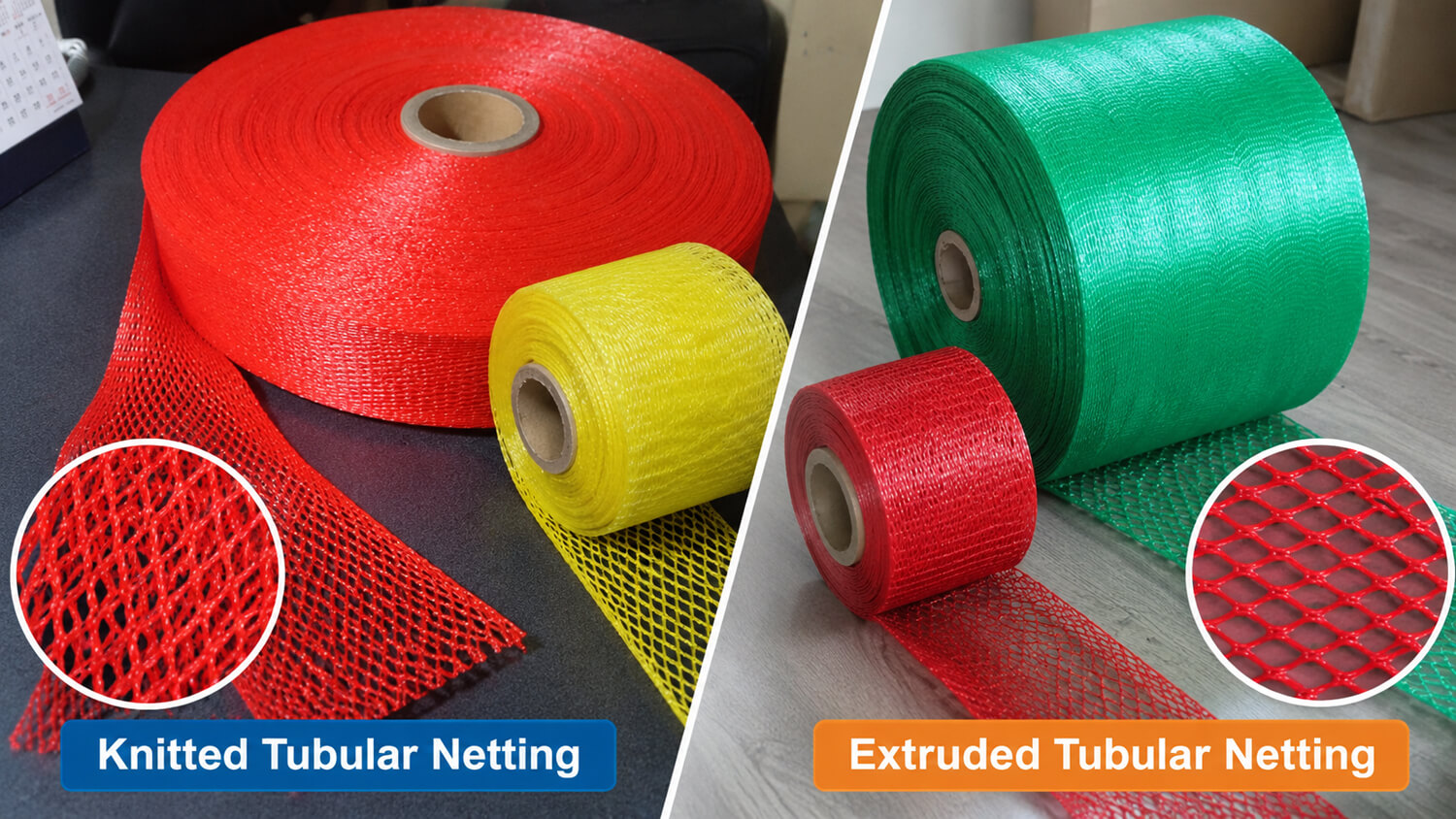
Knitted tubular netting is made by interlocking plastic yarns into flexible loops. Extruded tubular netting is formed by pushing molten plastic through a special die to create a connected mesh tube. Knitted netting is generally softer and easier to fold. Extruded netting often offers stronger shape recovery and a more defined mesh structure. The right choice depends on your product, packing machine, and required performance.
For produce packers, distributors, and purchasing managers, that difference affects much more than appearance.
Your packaging needs to protect products, run smoothly through equipment, and stay within budget. A small change in mesh structure can influence all three.
For example, you may need soft packaging for citrus fruit sold in supermarkets. Another customer may need a net tube that holds a tight shape around garlic bulbs. Both buyers use tubular netting, but their requirements are different.
It’s also important to understand that no single construction is always stronger or more elastic. Polymer selection, strand design, production settings, and finished net weight all affect performance.
Quick Buying Recommendation
- Choose knitted tubular netting when softness, flexibility, low bulk, and packing comfort are priorities.
- Choose extruded tubular netting when defined mesh geometry, shape recovery, or particular compression behavior matters.
- Test both types when packing delicate produce or using automatic clipping equipment.
For large orders, compare samples under real production conditions. A net that looks excellent on a sample table may behave differently on your packaging line.
The following guide explains the key differences and shows how to make a practical purchasing decision.
What Is Tubular Netting?
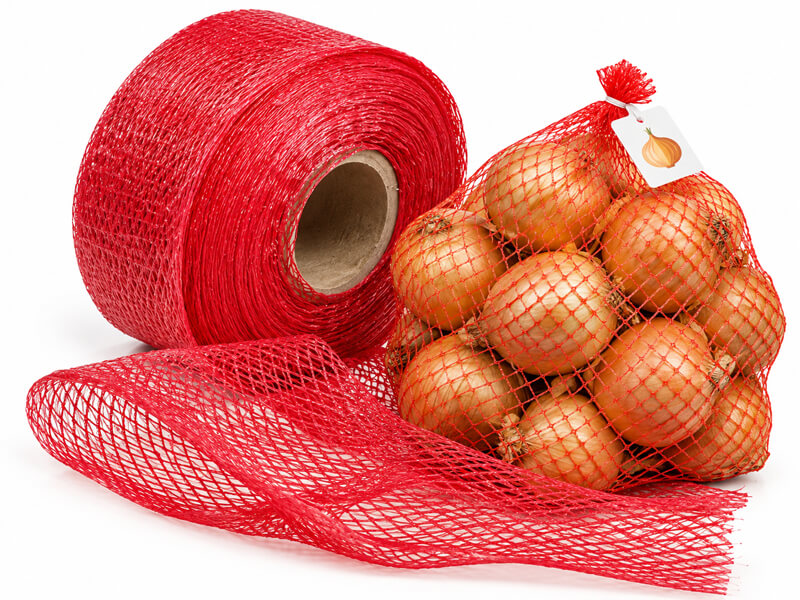
Knitted mesh tube — flexible interlocking yarn construction
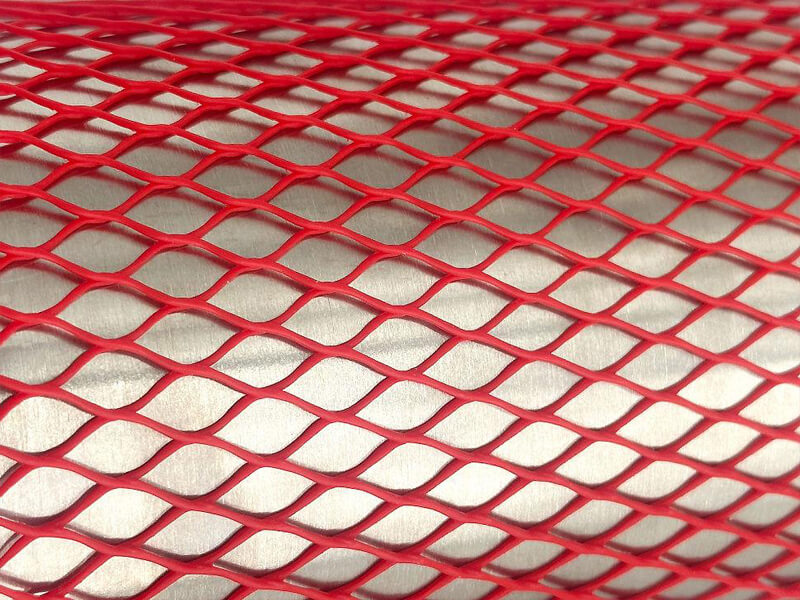
Extruded mesh tube — continuous plastic strand structure.
Tubular netting is an open-mesh packaging material produced in the shape of a continuous tube. It can be cut into bags, clipped around products, or supplied on rolls for packaging machines.
Because the material contains many openings, air can move through the package. Customers can also see the products inside.
These features make tubular mesh a common choice for fresh produce and other goods that need ventilation.
Common Packaging Applications
Tubular packaging nets are widely used for:
- Onions, garlic, and shallots
- Oranges, lemons, and other citrus fruits
- Potatoes and selected root vegetables
- Avocados and other fresh produce
- Protective sleeves for suitable industrial products
- Retail multipacks and promotional bundles
Not every application uses the same net structure. Some products need a flexible surface. Others need stronger compression or more stable dimensions.
Available Packaging Formats
Manufacturers may supply tubular netting as continuous rolls, compressed sleeves, or ready-to-fill bags.
Continuous rolls are useful for automated packaging lines. Pre-cut bags may suit manual or semi-automatic operations. Compressed sleeves can help reduce loading time on compatible equipment.
The right format depends on your machinery and the finished package design.
For B2B buyers, this confirms an important point: tubular netting is not one standard product.
When requesting a quotation, describe the finished package you need. Providing only the words “plastic net tube” may result in samples that don’t match your equipment or product.
A detailed specification helps your manufacturer recommend the right construction from the beginning.
How Knitted Tubular Netting Is Manufactured
Knitted tubular netting is produced by forming loops from plastic yarns, tapes, or monofilaments.
These loops connect to create an open mesh structure. The resulting material forms a flexible tube that can be expanded, gathered, and cut to size.
The process shares basic principles with textile knitting, although the materials and machines are designed for industrial packaging.
عملية الحياكة
Production typically follows several stages.
- Raw material preparation: Suitable plastic resin is selected for the final application.
- Yarn or tape production: Plastic is converted into strands, tapes, or monofilaments.
- Knitting: Specialized machinery forms the material into a tubular mesh.
- Inspection: Operators check mesh consistency, dimensions, and visible defects.
- Packing: Finished netting is wound, compressed, or converted into bags.
The interlocking loops give knitted netting much of its flexibility.
When pressure is applied, the loops can change shape. This allows the net to follow the surface of the packed product.
For buyers handling fruit, that flexibility can be valuable. A suitable soft knitted structure may reduce harsh contact points compared with a stiffer net design.
Why Mesh Construction Matters
Not all knitted nets feel or perform the same.
Yarn thickness, loop pattern, tube size, and material grade influence the finished product. A lightweight net made for small garlic packs should not be assumed suitable for heavier potatoes.
Knitted netting can also be designed with different mesh appearances. Diamond, rectangular, and other structures are possible, depending on the knitting equipment.
A manufacturer should check loop consistency and the finished tube’s ability to withstand handling.
During sample approval, buyers should examine the net under both empty and filled conditions.
A tube may look loose before packing but become tight once loaded.
For this reason, experienced purchasing teams test knitted netting using the actual produce, target weight, and closure method.
The goal is simple: obtain reliable packaging without using more material than necessary.
How Extruded Tubular Netting Is Manufactured
Extruded tubular netting is produced directly from molten plastic.
Unlike knitted netting, the plastic does not first need to become separate yarns that are knitted together.
Instead, an extrusion system creates a continuous mesh structure as the polymer passes through a specialized die.
The Extrusion Process
A typical production process includes polymer feeding, melting, mesh formation, cooling, and finishing.
The extrusion die creates plastic strands that intersect and connect. Depending on the equipment, the mesh is formed using moving die parts or other specialized extrusion technology.
The material then cools and becomes a finished net.
Some products undergo additional stretching or orientation to change their properties.
Polymer producer LyondellBasell explains that directly extruded netting can use counter-rotating die components. It also notes that stretching and cooling conditions affect the finished net’s behavior.
Why Bonded Intersections Matter
The crossing points in conventional extruded mesh are integrated into the plastic structure.
These points don’t move like knitted loops.
As a result, the net can respond differently when expanded around a product.
Certain extruded constructions provide useful compression and diameter recovery. This may help the mesh hold products together in a compact retail pack.
However, extrusion alone doesn’t guarantee stronger netting.
The actual strength depends on strand dimensions, polymer properties, joint quality, and any stretching process.
Manufacturing Controls
For export orders, important checks include strand thickness, mesh uniformity, tube diameter, and the condition of the intersections.
Uneven strands or weak junctions may cause failures during filling or handling.
The manufacturer should also verify that the finished net meets the required flexibility and extension range.
If the net is too rigid, it may be difficult to open or may put too much pressure on delicate goods.
If it’s too loose, the packed products may move excessively.
Good extrusion control helps maintain consistency from one production lot to the next. For wholesale buyers, that consistency is often more important than appearance alone.
Key Differences in Structure and Performance
The differences between knitted and extruded tubular netting become clearer when you compare them under the same packing conditions.
Both constructions can provide reliable packaging. However, they handle expansion, compression, product contact, and repeated movement differently.
Understanding these features helps buyers avoid choosing a material based only on price.
Tubular Netting Comparison Table
| Feature | Knitted Tubular Netting | Extruded Tubular Netting |
|---|---|---|
| Manufacturing method | Interlocking plastic loops | Direct extrusion of connected strands |
| Mesh intersections | Flexible loop connections | Integral bonded junctions |
| المرونة | Generally high | Depends on polymer and design |
| Surface feel | Often soft and flexible | Can feel firmer at intersections |
| Diameter recovery | Depends on knitted design | Often strong in compression-oriented designs |
| Mesh appearance | Various knitted patterns | Commonly diamond-shaped or similar die-defined structures |
| Product conformity | Good around irregular shapes | Good when controlled compression is needed |
| Material weight | Lightweight designs available | Lightweight designs available |
| Mechanical strength | Depends on yarn and loop structure | Depends on strands and junctions |
| Automated packing | Suitable with compatible equipment | Suitable with compatible equipment |
| التكلفة | Depends on yarn, weight, and knitting efficiency | Depends on resin, tooling, and production volume |
| Common uses | Produce bags, soft retail packs | Produce bundles, compression nets, protective sleeves |
These are general construction differences, not guaranteed performance ratings. Final properties require product-specific testing.
Flexibility and Product Protection
Knitted netting often offers a soft, flexible surface because its loops can move.
This can be useful when packaging products with uneven shapes or delicate surfaces.
Extruded netting may provide more defined contact points, especially when the intersections are relatively thick.
However, specially formulated extruded products can also be soft.
Elasticity and Shape Recovery
Flexibility and elasticity aren’t the same.
A flexible net bends easily. An elastic net stretches and returns toward its original shape.
Traditional knitted netting may offer excellent flexibility without strong recovery. Some extruded designs offer more noticeable compressive recovery.
Elastic knitted constructions are also available, so buyers shouldn’t judge performance by construction alone.
Strength and Weight
A heavier net is not automatically stronger.
Material selection and strand design have a major influence on breaking strength.
For an accurate comparison, test both nets at a similar finished weight and intended tube size.
Measure how they perform when filled, lifted, clipped, and transported.
For wholesale buyers, the ideal material provides enough strength for the intended load without unnecessary plastic consumption.
Material Selection for Tubular Packaging Nets
The polymer used in tubular netting influences its softness, strength, appearance, and cost.
Polyethylene and polypropylene are common choices for plastic mesh products.
However, the exact resin grade and formulation should match the application.
Polyethylene Tubular Netting
Polyethylene, or PE, is widely used in produce packaging.
Different PE grades offer different combinations of flexibility, stiffness, and toughness.
High-density polyethylene (HDPE) can be used for lightweight netting strands. Low-density polyethylene (LDPE) and linear low-density polyethylene (LLDPE) may be selected for specific flexibility or processing requirements.
These materials can also be blended where appropriate.
A buyer should not assume that every PE tubular net has the same properties.
Polypropylene Tubular Netting
Polypropylene, or PP, is another material used for plastic netting.
It can offer relatively high stiffness and good mechanical performance in suitable designs.
However, the polymer alone does not determine the finished product’s strength.
Strand orientation, thickness, intersection design, and production conditions remain important.
Material Comparison Chart
Qualitative material-selection guide. These are general tendencies, not measured product ratings.
HDPE
Common for lightweight mesh; relatively high stiffness
LDPE / LLDPE
Useful where greater softness or flexibility is required
PP
Useful for selected mesh designs needing stiffness or strength
Food-Contact Requirements
If you’re buying netting for food packaging, request evidence that the finished formulation is suitable for its intended use.
This includes reviewing applicable rules for the polymer, colorants, and additives.
For the United States, 21 CFR § 177.1520 addresses certain olefin polymers used in food-contact applications. Compliance depends on the actual material and conditions of use.
Export buyers should also review requirements in their destination market.
Don’t rely on a general statement such as “food-grade plastic” without suitable supporting documentation.
A professional manufacturer should be able to identify the polymer type, relevant specifications, and available compliance evidence.
This helps distributors reduce regulatory risk and builds confidence with downstream customers.
Which Tubular Netting Is Better for Produce Packaging?
Fresh produce is one of the largest application areas for tubular mesh packaging.
But the best material for onions may not be the best material for avocados.
Buyers need to consider product shape, skin sensitivity, pack weight, and the handling process.
Application Comparison
| Product | Suggested starting point | Main consideration |
|---|---|---|
| Onions | Knitted or extruded | Ventilation, reliable closures, pack stability |
| Garlic | Extruded or elastic knitted | Compact bundles and diameter recovery |
| Potatoes | Knitted or extruded | Load strength and abrasion resistance |
| Oranges | Soft knitted or suitable soft extruded | Surface protection and retail presentation |
| Lemons | Soft knitted | Flexible fit and gentle product contact |
| Avocados | Soft knitted | Minimize pressure and surface marking |
| Industrial components | Application-specific extruded mesh | Geometry, contact pressure, abrasion |
These recommendations are starting points. Actual suitability should be confirmed through trials.
Onions and Garlic
Onions and garlic need packaging that allows air movement and supports handling.
For retail onion packs, both knitted and extruded netting may work well.
A flexible knitted tube can adapt to mixed bulb sizes. An extruded tube with suitable recovery may form a compact bundle.
For garlic packaging, tight product grouping is often desirable.
However, excessive compression can damage products or affect presentation.
Citrus Fruits and Avocados
Citrus and avocados require careful attention to surface contact.
Soft netting can help reduce harsh pressure points, especially during handling.
Buyers should test for marks after filling, stacking, and transport.
The net should also allow sufficient air circulation.
Keep in mind that ventilation alone does not prevent spoilage. Temperature, humidity, produce condition, and transport time remain essential factors.
Potatoes and Other Root Vegetables
Potato packaging often requires careful attention to load strength.
The filled bags may experience repeated lifting, stacking, and movement.
Choose a net that can handle the intended pack weight and transport conditions.
Inspect closure strength as well as the net body.
For heavy products, a failure at the clipped or sealed end may be more important than the strength of an individual mesh strand.
For distributors serving multiple markets, it’s useful to carry several constructions rather than treating all produce packaging as interchangeable.
Packaging Machine Compatibility and Production Efficiency
Tubular netting must work with the packaging machine, not just the product inside it.
This is particularly important for automated produce packing lines.
A mismatch can lead to poor feeding, broken strands, weak closures, or frequent machine stops.
Automatic Clipping Machines
Some tubular netting is designed for clipping equipment that forms individual retail packs.
The machine pulls a section of net, fills it with produce, and closes the ends with clips or another suitable closure.
For smooth operation, the tube must open consistently and move through the machine without excessive friction.
Both knitted and extruded structures can work with suitable equipment.
The correct choice depends on the machine design and net specification.
Packing-Line Compatibility Checklist
Before ordering, confirm:
- Machine manufacturer and model
- Net tube diameter and usable expansion
- Required roll or sleeve presentation
- Tube loading capacity
- Product filling weight
- Clip, staple, or sealing method
- Target production speed
- Acceptable breakage and reject rates
For example, a net may perform well at a low packing speed but become unstable when the line runs faster.
The material may snag during feeding, or the closure may become inconsistent.
Why Line Testing Matters
A short production trial can reveal problems that a visual inspection cannot identify.
Use the actual product and intended packaging weight.
Observe how easily the tube opens, feeds, and closes.
Measure downtime caused by net-related problems. Also record rejected packs and damaged products.
A suitable net can reduce unnecessary adjustments and improve packaging consistency.
For large import orders, request production samples made to the proposed specification.
It may also help to test more than one roll or sleeve.
This confirms whether the material performs consistently rather than simply passing one successful trial.
A reliable manufacturer should welcome clear feedback from your packaging team. That information supports better specifications and fewer problems during repeat orders.
Technical Specifications and Quality Testing
A clear technical specification is one of the most effective ways to prevent packaging problems.
Terms such as “strong mesh” or “high-quality netting” aren’t precise enough for industrial purchasing.
Instead, buyers should request measurable requirements.
Important Technical Parameters
| Parameter | Measurement | Why it matters |
|---|---|---|
| Polymer composition | Resin type and grade | Influences flexibility, stiffness, and processing |
| Tube size | Lay-flat width or diameter, mm | Determines compatibility with the product and machine |
| Mesh opening | Width and length, mm | Affects visibility, airflow, and retention |
| Strand dimensions | Diameter or thickness, mm | Influences weight and strength |
| Linear weight | g/m | Helps compare material consumption |
| Elongation | % under a defined test | Indicates extension behavior |
| Recovery | % after a defined loading cycle | Indicates how well the tube returns toward its original size |
| Breaking force | N under a specified method | Helps assess mechanical performance |
| Package load | kg per finished pack | Defines the intended application |
| اللون | Approved color standard | Supports consistent retail presentation |
| Roll length | m per roll | Helps calculate output and ordering quantities |
The specification must also define how measurements are taken. An unstretched tube may have different dimensions from the same tube when opened.
How to Calculate Net Weight per Package
For continuous tubular netting, a simple material estimate is:

For example, suppose the net weighs 8 g/m and each package needs 400 mm of tubing.
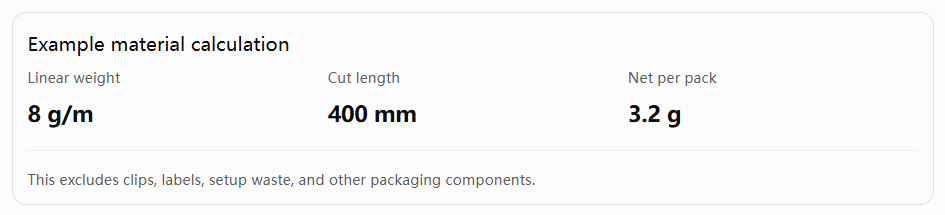
This calculation is useful when comparing quotations based on different roll specifications.
Recommended Quality Control Tests
For incoming inspections and supplier qualification, consider:
- Visual checks for broken strands and uneven mesh
- Tube dimension measurements
- Linear-weight verification
- Extension and recovery testing
- Tensile or breaking-force testing
- Closure and filled-package load testing
- Simulated handling and transport trials
Testing should use agreed methods and acceptance criteria.
For example, a supplier might test filled packs by lifting them repeatedly under defined conditions.
The test result becomes useful only when the product weight, closure, number of cycles, and failure criteria are recorded.
In B2B purchasing, consistent testing creates a shared quality standard.
It reduces arguments over subjective descriptions and gives both the manufacturer and buyer clear expectations.
Cost Comparison and Total Packaging Value
Price is important, especially for high-volume produce packaging.
However, the lowest roll price does not always produce the lowest packaging cost.
You need to consider how much netting each pack uses and how efficiently it performs during production.
Cost Factors for Knitted and Extruded Netting
Knitted netting costs can be influenced by yarn production, knitting speed, material consumption, and finished tube design.
Extruded netting costs depend on resin, tooling, extrusion efficiency, cooling, and any additional processing.
For both materials, order volume, color, packaging format, and quality requirements influence pricing.
Neither construction is automatically the less expensive option.
Illustrative Cost Comparison
Consider two hypothetical netting quotations.
| Cost item | شبك محبوك | شبكة شبك مقذوف |
|---|---|---|
| Net weight per pack | 3.2 g | 3.8 g |
| Example material price | $3.00/kg | $2.70/kg |
| Net cost per pack | $0.0096 | $0.0103 |
| Net cost per 100,000 packs | $960 | $1,026 |
| Difference | — | $66 higher |
These figures are illustrative calculations, not current market quotations. They exclude freight, clips, wastage, and production costs.
Even with a lower price per kilogram, the heavier net costs more per finished pack.
This is why purchasing managers should compare material consumption rather than unit price alone.
Interactive Packaging Material Cost Calculator
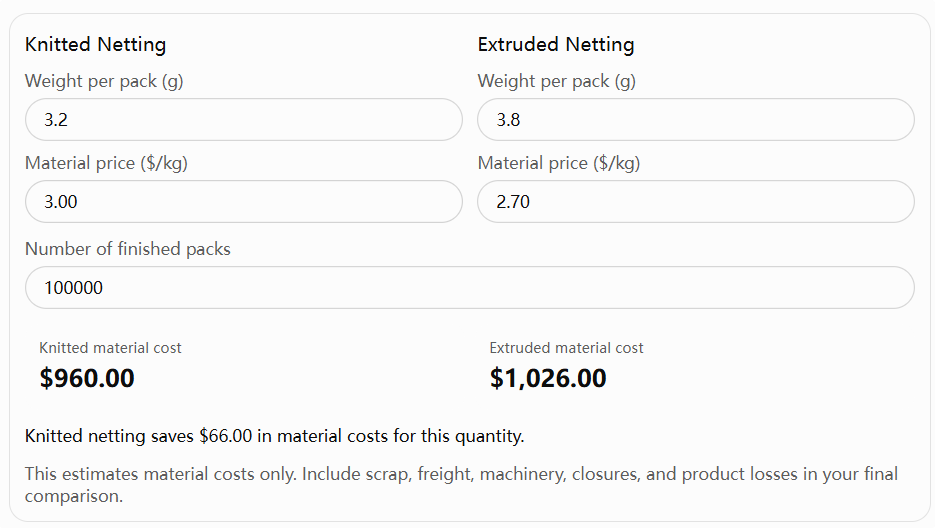
Evaluate Total Packaging Cost
A more complete calculation is:
\[ \text{Total Cost per Pack} = \text{Material} + \text{Closure} + \text{Labor} + \text{Waste} + \text{Allocated Machine Cost} \]
Freight and product-damage costs may also need to be added.
Suppose one net is slightly more expensive but causes fewer machine stops.
The extra material expense may be offset by higher production output.
Similarly, softer netting may reduce damage to products that are sensitive to pressure.
The financial benefit depends on actual rejection rates and product value.
For long-term orders, request quotations based on consistent specifications and expected annual volumes.
Then run a small production trial before changing materials.
This approach helps you find better value without introducing unnecessary risk.
How to Choose a Reliable Tubular Netting Manufacturer
Selecting the right manufacturer is as important as selecting the net construction.
A reliable supplier should understand your application and provide consistent products across repeat orders.
For importers and distributors, the sourcing process should focus on technical fit, quality control, and communication.
Start With a Complete RFQ
Your request for quotation should include:
- Product type and application
- Knitted or extruded construction preference
- Polymer requirements
- Tube dimensions and expansion range
- Mesh opening and approximate material weight
- Packaging machine details
- Target weight per finished pack
- Required color and packaging format
- Expected order volume and destination market
- Compliance documents and test requirements
If you’re unsure about the best construction, provide a finished packaging sample or photographs with measurements.
Ask for Production Samples
A representative sample should match the intended production specification.
Check its flexibility, mesh structure, color, and dimensions.
If you use automated machinery, test it on the actual packaging line.
Record problems and share them with the supplier.
A clear feedback report makes technical adjustments easier.
Evaluate Quality Consistency
For repeat purchasing, ask how the manufacturer manages raw materials and production changes.
You should also understand how inspection results are recorded.
Important questions include whether resin substitutions require approval and how rejected production lots are handled.
A documented specification helps ensure that future orders remain consistent.
OEM and Wholesale Packaging Requirements
Distributors may need custom colors, roll lengths, private labels, or export carton markings.
Discuss these requirements before production.
Also confirm minimum order quantities, packing methods, production lead time, and shipping terms.
For international orders, accurate carton dimensions and weights support freight planning.
A strong supplier relationship is built through clear specifications, practical sample testing, and reliable communication.
الأسئلة الشائعة
Is knitted tubular netting stronger than extruded tubular netting?
Not necessarily. Strength depends on polymer grade, strand thickness, mesh design, and production quality. Knitted netting can offer a useful strength-to-weight ratio, while extruded netting can provide strong integral junctions. Buyers should compare breaking-force results and filled-package performance under identical test conditions.
Which type of tubular netting is better for onions and garlic?
Both constructions can be suitable. Knitted netting is useful when flexibility and a soft fit are priorities. Extruded netting may be preferred when controlled compression and diameter recovery are important. The final decision should consider bulb size, pack weight, closure method, and packing equipment.
Can knitted tubular netting be used on automatic packaging machines?
Yes. Many knitted tubular netting products are designed for automatic or semi-automatic equipment. However, compatibility depends on tube dimensions, presentation, material extension, and machine requirements. Always test the selected netting on your actual machine before committing to large-volume purchases.
Is extruded tubular netting more expensive than knitted netting?
Not always. Extruded netting may have a lower price per kilogram in some applications, but the finished package could consume more material. Knitted netting may offer material savings in certain designs. Compare cost per finished pack, machinery performance, waste, and freight rather than relying on unit prices.
Can tubular netting be customized for different packaging requirements?
Yes. Depending on the manufacturer’s production capabilities, customization may include polymer grade, mesh dimensions, tube size, color, roll length, and packaging presentation. Buyers should provide their target application and performance requirements. Custom specifications may affect minimum order quantity, tooling, and production lead time.
Is polyethylene tubular netting safe for food packaging?
Polyethylene can be suitable for food-contact packaging when the finished material meets applicable regulatory requirements. Compliance depends on the resin, additives, colorants, and intended conditions of use. Buyers should request relevant documentation and avoid assuming that all polyethylene netting automatically qualifies for direct food contact.
Which tubular netting offers better ventilation for fresh produce?
Ventilation depends mainly on the finished mesh openings, net coverage, and package design rather than whether the net is knitted or extruded. Both can provide substantial airflow. However, real storage performance also depends on produce type, temperature, humidity, and the way packages are stacked.
Can tubular netting be recycled?
Some plastic tubular netting can be recycled where suitable collection and processing facilities exist. Recycling depends on material composition, contamination, and local infrastructure. Mono-material construction may simplify sorting, but acceptance is not guaranteed. Buyers should verify regional recycling arrangements before making environmental claims.
What information should I provide when requesting a wholesale quotation?
Provide the product being packaged, expected pack weight, desired tube size, net material, color, mesh structure, and estimated order quantity. Include packaging machine details and any regulatory requirements. A physical sample or technical drawing can help the manufacturer prepare a more accurate quotation.
الخاتمة
Choosing between knitted and extruded tubular netting requires more than comparing appearance or price.
Both materials offer advantages for agricultural packaging and other industrial applications.
Knitted netting is often a good starting point when softness, flexibility, and lightweight construction are important.
Extruded netting is worth considering when mesh geometry, compression, and shape recovery matter more.
However, modern material formulations and production methods can change these general characteristics.
That is why technical specifications and practical testing are essential.
For B2B buyers, the most reliable selection process focuses on three questions: Does the net protect your product? Does it work efficiently with your packaging equipment? Does it offer an acceptable total packaging cost?
A material that satisfies all three requirements is usually a better long-term choice than one selected only by its unit price.
Looking for a tubular netting manufacturer for your packaging business?
اتصل بنا CANBON with your application details, required dimensions, packaging method, and estimated order volume. Request suitable material specifications and samples to evaluate before bulk purchasing.
 Arabic
 English
 Russian
 Spanish
 Portuguese
 French
 Indonesian