
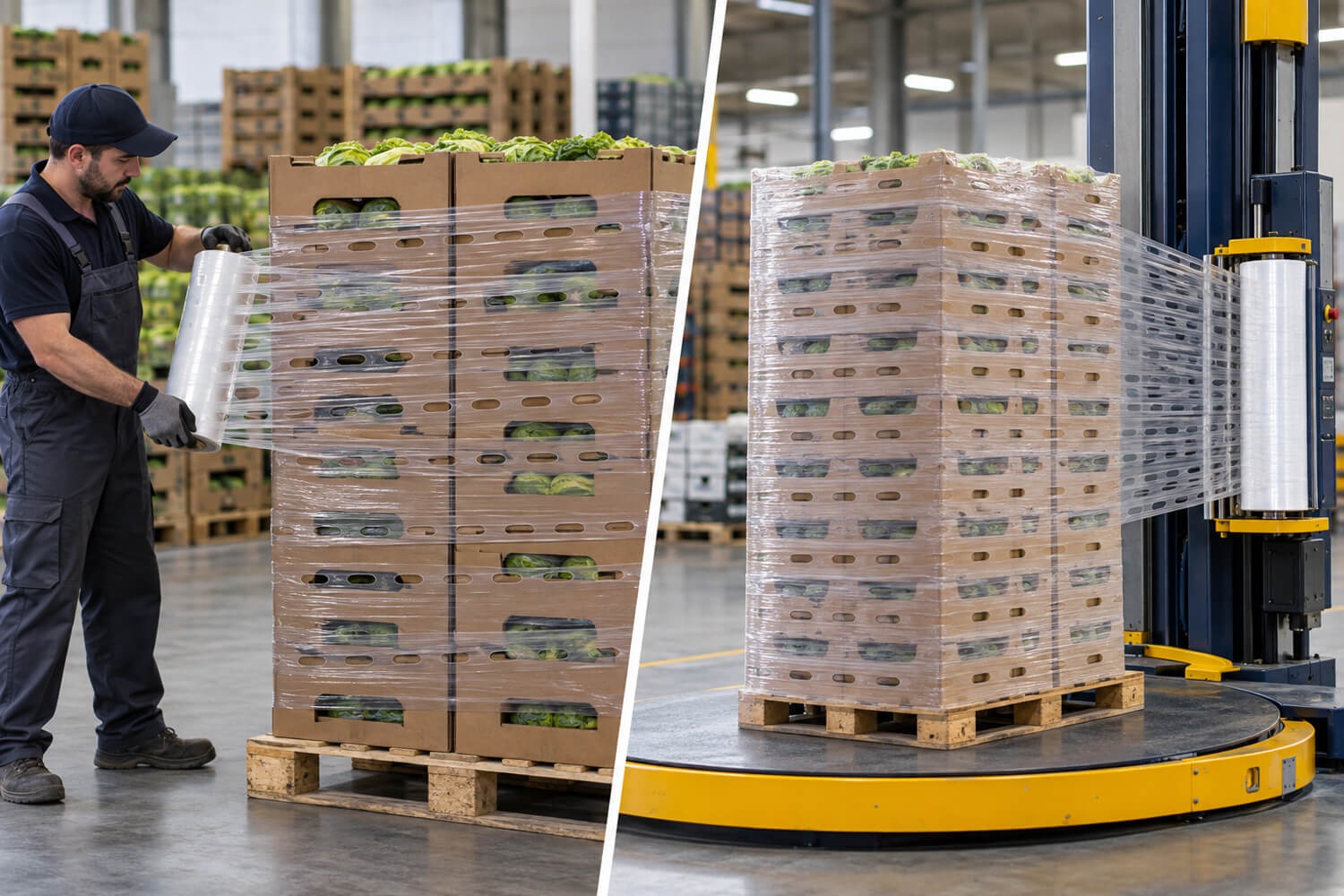
Hand and machine vented stretch film serve the same purpose: securing pallet loads while allowing air to circulate. Hand film works well for low-volume operations, irregular loads, and flexible warehouse tasks. Machine film suits high-volume packaging lines that need controlled tension and consistent wrapping. For buyers, the right choice depends on pallet volume, equipment compatibility, load stability, labor costs, and ventilation requirements.
Packaging fresh products presents a special challenge. You need to keep goods secure without trapping unnecessary heat or moisture around them.
Traditional plastic wrapping can restrict airflow. This may create problems for certain agricultural goods, chilled products, and other breathable loads.
Ventilated wrapping offers an alternative. Its openings allow air to move through the wrapping structure while the remaining film helps hold products together.
However, not all ventilated films behave alike.
A roll designed for hand application may not perform well on an automated machine. Similarly, a machine-grade film may be difficult to apply consistently by hand.
Understanding these differences helps you avoid wasted materials, unexpected downtime, and shipping damage.
This guide compares the two options from a manufacturer’s technical and purchasing perspective. You’ll learn how to evaluate film performance, estimate operating costs, and choose suitable packaging specifications for your business.
Vented Stretch Film: What Buyers Should Know
Vented Stretch Film is a stretchable plastic packaging material with openings that allow air to pass through a wrapped pallet.
Unlike conventional stretch wrap, which forms a mostly continuous plastic barrier, ventilated film has holes or an open structure.
These openings can help reduce airflow restrictions around goods during storage and transportation.
Why Does Pallet Ventilation Matter?
Some products continue to release heat or moisture after packaging. Others need cold air to reach the contents of a pallet.
For example, produce exporters may need to move packed vegetables through cooling facilities before shipment.
A tightly wrapped pallet with ordinary film can limit airflow between cartons.
Ventilated packaging can support cooling when the cartons, stacking pattern, and airflow paths are also suitable.
This is particularly useful for products such as:
- Fresh potatoes, onions, and other vegetables
- Certain fruits and agricultural products
- Flowers and nursery plants
- Products undergoing forced-air cooling
- Selected chilled or moisture-sensitive goods
However, ventilation alone doesn’t guarantee longer shelf life.
Product temperature, humidity, hygiene, carton design, and transport conditions still matter.
How Is Breathable Stretch Film Manufactured?
Many ventilated stretch films begin with polyethylene-based film.
Manufacturers create openings through a perforation process or produce an open wrapping structure, depending on the product design.
The remaining material must maintain enough mechanical strength to hold the load.
This creates an important design balance.
Larger openings can improve the available airflow area, but they may reduce the amount of material carrying the wrapping force.
Smaller openings may preserve more film structure, but provide less open area.
Manufacturers therefore need to consider both ventilation and containment.
For purchasers, appearance isn’t enough to judge quality.
Two films with similar hole patterns may have different performance because of their polymer formulation, film thickness, production process, and stretching behavior.
The practical solution is to request samples and test the film on your actual products.
Hand vs Machine Vented Stretch Film
The biggest difference between manual and machine wrapping is how the film is applied and controlled.
Hand wrapping depends on an operator using a handheld dispenser or similar tool. Machine wrapping uses equipment to apply the film with controlled settings.
Both approaches can secure breathable pallet loads. However, their performance, operating requirements, and costs differ.
Seven Essential Differences
| Feature | Hand Vented Film | Machine Vented Film |
|---|---|---|
| Application | Manual wrapping | Semi-automatic or automatic equipment |
| Roll format | Usually smaller and lighter | Usually larger rolls |
| Tension control | Depends on operator and dispenser | Controlled by machine settings |
| Wrapping consistency | May vary between operators | Generally more repeatable |
| Pallet throughput | Better suited to lower volumes | Better suited to higher volumes |
| Initial equipment cost | Low | Higher |
| Labor requirements | More direct operator involvement | Less direct wrapping labor per pallet |
Which Option Offers Better Load Stability?
Neither option is automatically stronger.
Load stability depends on film strength, application tension, overlap, wrapping pattern, and the weight and shape of the cargo.
A well-applied hand film can secure a suitable pallet effectively.
Likewise, a poorly adjusted machine can tear film, crush cartons, or leave a load unstable.
Machine wrapping usually makes tension and cycle settings easier to repeat. This can be valuable when your warehouse processes the same pallet type throughout the day.
Hand application offers flexibility when pallet dimensions frequently change.
Which One Is Easier to Operate?
Hand wrapping requires relatively little equipment. It can be introduced quickly in a small warehouse.
However, operators need training to control tension and cover each pallet properly.
Machine wrapping requires equipment setup, maintenance, and compatible consumables.
Once correctly configured, it can reduce variation between shifts.
For importers and distributors, the important point is that these films aren’t simply interchangeable.
You should match the product to the wrapping method rather than buying solely by roll price.
How Does Hand Vented Pallet Wrap Work?
Hand-applied ventilated pallet wrap is designed for workers who secure individual pallets without relying on automatic wrapping equipment.
It is commonly used in smaller warehouses, agricultural packing facilities, distribution centers, and operations with changing load requirements.
The operator walks around the pallet while applying the film through a dispenser.
The film stretches as it is pulled around the load. This creates tension that helps hold the packaged goods together.
Manual Wrapping Process
A typical hand-wrapping procedure includes:
- Inspecting the load and checking pallet stability.
- Securing the film near the pallet base.
- Applying controlled tension around the lower section.
- Moving upward with consistent overlap.
- Reinforcing areas that need additional containment.
- Securing the film tail without blocking important ventilation areas.
The exact wrap cycle should be validated for the load. Extra wraps aren’t always better.
Too much tension can damage lightweight boxes or deform sensitive products.
Too little tension may allow cartons to shift during transport.
Advantages of Manual Application
One important advantage is flexibility.
Operators can wrap pallets of different heights, shapes, and product combinations without changing a machine program.
A manual operation also requires less capital investment.
This can benefit smaller distributors and seasonal agricultural businesses.
For example, a produce exporter may handle relatively few pallets during one part of the year and much larger volumes during harvest.
Hand wrapping can accommodate changing production needs without requiring a dedicated wrapping line.
Limitations Buyers Should Consider
Manual application becomes less attractive as volume increases.
Workers must repeatedly move around pallets while managing roll weight and film tension.
This can create fatigue and inconsistent wrapping.
The U.S. Occupational Safety and Health Administration identifies bending and handling risks associated with manual pallet wrapping. It recommends measures such as lighter rolls, suitable handles, and mechanized wrapping where appropriate.
You can review the guidance through the OSHA warehouse packaging resource.
For low-volume and irregular operations, manual packaging remains a practical choice when workers have appropriate training and equipment.
How Does Machine Vented Stretch Wrap Work?
Machine-applied ventilated film is designed for pallet wrapping equipment.
It is commonly used in packaging facilities that handle repeated pallet loads and require steady production output.
A wrapping machine rotates the pallet or moves a film carriage around a stationary load.
The machine applies film according to programmed settings. Depending on the equipment, these may include film tension, pre-stretch, carriage speed, and wrapping cycles.
Machine Wrapping Equipment
Two common wrapping systems are:
Turntable Wrapping Machines
These systems rotate the loaded pallet while a film carriage moves vertically.
Turntable machines are frequently used for stable pallet loads with standard dimensions.
They can offer a practical entry point into semi-automatic wrapping.
Rotary Arm Wrapping Machines
These systems move a wrapping arm around a stationary pallet.
They may be suitable for heavy, unstable, or tall loads that should not rotate during wrapping.
The correct machine design depends on the load, facility layout, and required production speed.
Understanding Pre-Stretch Compatibility
Pre-stretch refers to elongating the film before or during application.
On compatible machines, a powered pre-stretch system uses rollers moving at different speeds.
This can help control film delivery and reduce material consumption.
However, perforated film behaves differently from ordinary solid film.
Its openings concentrate stress around the remaining material.
Excessive stretching may enlarge holes, cause tearing, or reduce the desired holding force.
Some ventilated film designs support substantial elongation. Others have limited stretch capability.
For this reason, buyers should never assume that machine film will tolerate a particular pre-stretch percentage.
Always use manufacturer-tested values for the specific product.
Benefits for High-Volume Businesses
Automated wrapping can provide:
- More repeatable film tension and overlap
- Consistent packaging cycles
- Lower direct labor requirements per pallet
- Better integration with warehouse production lines
- Easier tracking of film consumption
Machine wrapping may also improve workplace ergonomics by reducing repetitive manual wrapping tasks.
Still, automation only adds value when the equipment matches actual production needs.
For a facility wrapping a handful of pallets daily, machine investment might be difficult to justify.
For a large exporter handling hundreds of similar pallets, controlled wrapping can provide meaningful operational benefits.
Technical Specifications and Film Performance
Technical specifications matter more than product names when comparing wholesale packaging materials.
Buyers often focus on thickness and price. Yet these two factors don’t explain how a ventilated wrapping material performs.
The polymer formulation, opening geometry, elongation behavior, roll design, and application method all affect performance.
Key Parameters to Check
| Parameter | What Buyers Should Request | Why It Matters |
|---|---|---|
| Film material | Polymer grade or formulation | Influences strength and stretching behavior |
| Film thickness | Nominal micron value and tolerance | Affects material use and performance |
| Roll width | Usable film width in millimeters | Determines coverage and equipment compatibility |
| Roll length | Confirmed length per roll | Supports cost and inventory calculations |
| Opening design | Hole diameter, pattern, and spacing | Influences available ventilation area |
| Open-area percentage | Measured or calculated value | Helps compare film ventilation designs |
| Elongation | Tested values under stated conditions | Indicates stretching capability |
| Puncture resistance | Test result and method | Helps assess handling durability |
| Roll weight | Net film weight and gross weight | Supports handling and shipping plans |
| Core dimensions | Internal diameter and core length | Determines dispenser or machine compatibility |
Values should come from a product-specific technical data sheet.
Thickness and Opening Structure
Film thickness is usually measured in microns.
Thicker material isn’t automatically the better choice.
A thicker film may use more raw material, while a well-designed thinner film can sometimes meet the same application needs.
Opening structure is equally important.
The edges around perforations must tolerate stretching without excessive tearing.
An open-area percentage also needs careful interpretation.
A film with a high open area may allow more airflow, but actual pallet ventilation depends on several other factors.
These include wrapping overlap, carton openings, stacking orientation, and airflow direction.
Film Strength and Load Containment
There are several useful performance measures:
- Tensile strength
- Elongation at break
- Tear resistance
- Puncture resistance
- Holding force under applied tension
- Load stability after wrapping
A material can perform well in a tensile test yet fail in actual pallet handling.
This is why film testing and completed-load testing should be considered separately.
For example, ASTM D4649-20(2025) provides guidance on selecting and applying stretch films for load unitization. Its scope focuses on indoor storage and transport applications.
ASTM D5414-95(2025) addresses horizontal impact performance for stretch-wrapped loads. It is useful for comparing film and wrap-cycle performance under controlled test conditions.
A manufacturer should explain which tests were actually performed, rather than suggesting that every film automatically meets these standards.
Hand vs Machine Wrapping Costs: Which Is More Economical?
Choosing packaging solely by the purchase price per roll can be misleading.
For buyers, the important measure is the total cost of producing one properly secured pallet.
This includes consumable materials, labor, equipment, waste, maintenance, and potential shipping damage.
Compare Total Packaging Costs
| Cost Factor | Manual Wrapping | Machine Wrapping |
|---|---|---|
| Equipment investment | Low | Medium to high |
| Direct wrapping labor | Higher for repeated wrapping | Usually lower per pallet |
| Roll handling | More frequent roll changes | Fewer changes with larger rolls |
| Film consumption | Depends strongly on operator | Easier to control through settings |
| Maintenance expense | Minimal dispenser maintenance | Scheduled machine maintenance |
| Training | Manual handling and technique | Equipment operation and safety |
| Best cost fit | Low or variable volumes | High or consistent volumes |
These are general operating characteristics, not fixed savings guarantees.
Example: Comparing Cost Per Pallet
Consider a hypothetical warehouse comparing two packaging methods.
The following figures are illustrative assumptions, not measured factory performance.
| Cost Metric | Hand Wrapping | Machine Wrapping |
|---|---|---|
| Film cost per pallet | $0.90 | $0.72 |
| Direct labor cost per pallet | $1.20 | $0.30 |
| Equipment and maintenance allocation | $0.05 | $0.35 |
| Total estimated cost per pallet | $2.15 | $1.37 |
Illustrative cost per pallet
Film
Labor
Equipment / maintenance
$0$0.6$1.2$1.8$2.4HandMachine
USD per pallet. Hypothetical figures, not supplier quotations.
Under these assumptions, machine wrapping costs $0.78 less per pallet.
At 10,000 pallets, this represents an illustrative operating cost difference of $7,800.
However, actual results may differ significantly.
The film price, wage rates, machine financing, productivity, and packaging requirements will affect the calculation.
How to Estimate Your Own Packaging Budget
Use this formula:
Total wrapping cost per pallet = Film cost + Direct labor + Equipment allocation + Maintenance + Waste
The most reliable comparison uses the same pallet dimensions, product weight, and load stability requirements.
Measure film consumption instead of assuming the machine will always use less material.
Also compare damaged loads after shipping.
A lower packaging cost offers little value if it increases product damage or customer complaints.
The goal is a lower total delivered cost without compromising load security.
Best Applications for Breathable Pallet Packaging
Ventilated stretch wrapping is particularly valuable when products require airflow during handling, cooling, or storage.
However, the choice between hand and machine application depends on the operating environment.
Different industries place different demands on packaging materials.
Fresh Vegetable and Fruit Exports
Agricultural products are an important application.
Onions, potatoes, citrus, and other produce may require airflow to support suitable storage or cooling conditions.
A ventilated film can allow air to move through parts of a pallet that ordinary stretch wrapping would cover.
For smaller packing facilities, hand wrapping may offer enough flexibility.
Large export operations may prefer machine wrapping for repeatable pallet preparation.
The correct solution also depends on whether the produce is packed in ventilated cartons, crates, or other containers.
A film with holes cannot compensate for packaging that blocks airflow internally.
Flowers and Nursery Products
Flowers and plants can be sensitive to changes in temperature and moisture.
Ventilated wrapping may be useful in selected transport systems where air circulation is important.
Hand wrapping allows operators to accommodate unusual load shapes.
Machine wrapping can be considered when products are placed in consistent transport containers.
Careful tension control is essential because delicate packaging can be damaged by excessive compression.
Cooling and Refrigerated Logistics
Cold-chain operators may require packaged loads to reach a target temperature.
In some systems, ventilated wrap helps reduce airflow blockage around the pallet.
However, cooling performance must be verified within the complete packaging system.
Consider carton ventilation, pallet layout, airflow direction, and product temperature.
Neither hand nor machine application automatically guarantees faster cooling.
Industrial and Warehouse Distribution
Some non-food products may also benefit from breathable wrapping.
Examples include goods that need air circulation during specific manufacturing, conditioning, or storage processes.
Manual wrapping may suit mixed pallets and irregular loads.
Automated wrapping may suit uniform production lines.
Buyers should avoid assuming that perforated film protects goods from rain, dust, or contamination in the same way as solid film.
Its openings provide ventilation but also reduce the barrier against external contaminants.
This trade-off must be assessed before selecting a packaging solution.
How to Choose the Right Vented Stretch Film for Your Business
Selecting the right film requires more than comparing specifications on a quotation.
You need to consider your packaging process, the products being shipped, and the conditions they will face.
A reliable supplier should help you identify appropriate specifications before you place a large order.
Start With Your Daily Pallet Volume
Packaging volume is an important starting point.
For example, a warehouse wrapping 10 pallets daily has different needs from a facility preparing 500 pallets.
Manual wrapping may remain economical for low-volume applications.
A machine system becomes more attractive as labor requirements and pallet volumes increase.
However, there is no universal daily pallet threshold that makes automation financially worthwhile.
You should calculate your own costs and expected equipment utilization.
Check Your Wrapping Equipment
Before buying machine-grade film, confirm your machine requirements.
Important questions include:
- What core diameter does your machine require?
- Which film widths can the carriage accept?
- Does the machine use powered pre-stretch?
- Can film tension be adjusted?
- Does the supplier recommend a maximum operating elongation?
- Can the equipment accommodate the film’s perforation pattern?
These checks are particularly important when replacing conventional stretch wrap with ventilated material.
Some machines may need tension adjustments or alternative film settings.
Evaluate the Products and Shipping Conditions
Think about what happens after the pallet leaves your warehouse.
Will it travel by truck, sea freight, or refrigerated container?
Will the pallets be double-stacked?
Will your cartons experience vibration or sudden movement?
Does the cargo need continuous airflow?
These factors affect your selection.
A lightweight pallet of rigid cartons may need a different wrapping pattern from a tall pallet containing delicate fresh produce.
For export shipments, you should evaluate both load containment and product ventilation.
Use a Practical Supplier Evaluation Checklist
| Purchasing Question | Recommended Action |
|---|---|
| Is the film suitable for hand or machine use? | Confirm the product grade |
| Is the film compatible with our dispenser? | Check width, core, and roll format |
| Are technical test results available? | Request a technical data sheet |
| Can we test the product? | Request production samples |
| Is the perforation pattern consistent? | Inspect multiple areas of the roll |
| Are custom dimensions available? | Confirm OEM manufacturing options |
| Can specifications remain consistent across batches? | Ask about production quality control |
| Can the supplier support export orders? | Confirm packaging, logistics, and delivery terms |
A structured buying process reduces the risk of ordering unsuitable materials.
It also makes supplier quotations easier to compare.
Common Pallet Wrapping Problems and Solutions
Even high-quality packaging materials can fail when applied incorrectly.
Understanding common problems helps buyers separate film defects from equipment and operating issues.
This can reduce unnecessary material changes and improve packaging consistency.
Film Tearing During Application
Tearing may occur when the film is stretched beyond its operating capability.
On ventilated film, perforation edges can act as stress concentration points.
Machine settings that work with ordinary solid stretch film may be too aggressive for a perforated product.
Possible causes include:
- Excessive pre-stretch
- High application tension
- Sharp pallet corners
- Damaged film rolls
- Incompatible wrapping equipment
- Irregular perforation quality
Recommended solution: Reduce tension, inspect the film, and review the manufacturer’s recommended operating range.
If tearing continues, test another film specification.
Poor Load Stability
An unstable pallet can result from inadequate wrapping force or an unsuitable wrapping pattern.
However, simply applying more layers isn’t always the right solution.
Too many layers can reduce the open area available for ventilation.
Poor stacking patterns can also create instability that film alone cannot correct.
Recommended solution: Improve pallet stacking, establish a suitable wrap cycle, and verify containment during handling.
Use additional reinforcement only where needed.
Insufficient Ventilation
Buyers sometimes expect perforated wrapping to solve every cooling problem.
In reality, airflow depends on the entire packaging system.
Ventilation can be restricted by overlapping film layers, closed cartons, tightly packed goods, and blocked airflow paths.
For example, wrapping several layers across the same openings can reduce the effective ventilation area.
Recommended solution: Review the hole pattern, film overlap, carton design, and pallet configuration together.
Where cooling performance is critical, conduct temperature measurements under real operating conditions.
Inconsistent Packaging Between Shifts
Manual operations may produce different results when several workers use different wrapping techniques.
Even automated equipment can become inconsistent after unauthorized setting changes or poor maintenance.
Recommended solution: Create a documented wrapping procedure.
Record important settings, train operators, and inspect finished pallets regularly.
A repeatable process is often more valuable than changing film thickness without understanding the underlying problem.
What Buyers Should Ask a Vented Film Manufacturer
Working directly with a manufacturer can provide advantages when you need consistent product specifications, wholesale quantities, or customized packaging.
However, buyers should evaluate manufacturing capabilities carefully.
A supplier’s product catalog alone doesn’t prove that every requested specification can be produced consistently.
Ask About Manufacturing and Quality Control
A useful supplier discussion should cover the complete production process.
Ask how film thickness, perforation pattern, roll dimensions, and winding quality are controlled.
Manufacturers should be able to explain their inspection procedures and available testing methods.
For perforated products, consistency across the roll is particularly important.
Irregular openings or unstable winding may cause problems during machine application.
Buyers can request inspection records or samples representing normal production.
Discuss OEM and Wholesale Requirements
Packaging distributors often need products adapted to local customers.
Possible customization requirements include:
- Film width and roll length
- Thickness and polymer formulation
- Perforation size and pattern
- Roll core dimensions
- Packaging cartons and pallet configuration
- Private-label packaging
- Distributor-specific product identification
Availability depends on the manufacturer’s actual equipment and production capabilities.
Not every supplier supports every specification.
Confirm customization options, minimum order quantities, tooling requirements, and pricing before ordering.
Request a Sample Validation Process
A sample program should help buyers test more than film appearance.
Test the product with your actual pallet loads and wrapping equipment.
Check how easily the film unwinds, whether it tears during application, and how securely the completed pallet holds together.
If your products require airflow, compare temperature or airflow results under relevant conditions.
Where possible, run multiple pallets to check repeatability.
What Information Should You Include in an RFQ?
A clear request for quotation makes supplier discussions faster and more productive.
Include your intended application, average pallet dimensions, pallet weight, wrapping method, roll requirements, and estimated purchase volume.
For machine applications, include the machine model and available pre-stretch settings.
Also mention your destination market, packaging preferences, and required delivery terms.
A technically complete inquiry allows manufacturers to propose a suitable film rather than quoting a generic product that may not meet your needs.
Frequently Asked Questions
What Is the Main Difference Between Hand and Machine Vented Stretch Film?
Hand film is applied manually, while machine film is designed for wrapping equipment. Machine application generally offers more repeatable tension and higher throughput. Hand application provides flexibility for smaller operations and irregular pallet loads.
Can Hand Vented Film Be Used on a Stretch Wrapping Machine?
Not necessarily. Hand-grade rolls may have incompatible dimensions or insufficient strength for machine tension. You should check the film’s technical specifications and machine requirements before attempting to use a manual-grade product.
Is Machine Vented Stretch Wrap Stronger Than Hand Wrap?
Not always. Strength depends on material formulation, thickness, perforation design, and stretching characteristics. Machine-grade products are designed for specific application conditions, but actual load stability must be confirmed through suitable testing.
Does Ventilated Stretch Wrap Help Keep Fresh Produce Cool?
It can support cooling by allowing air to pass through openings in the wrapping material. However, cooling results also depend on cartons, pallet stacking, refrigeration equipment, and airflow conditions. Film alone cannot guarantee temperature control.
Is Perforated Stretch Film Suitable for Export Pallets?
Yes, when the film and wrapping method provide adequate load containment for the shipment. Buyers should evaluate handling conditions, transport duration, and pallet stability. Ventilation must not come at the expense of cargo security.
How Do I Choose the Correct Film Thickness?
Start with pallet weight, product shape, wrapping tension, and shipping conditions. Request manufacturer specifications and samples. The most suitable thickness is the one that provides reliable performance without unnecessary material consumption.
Can Machine Wrapping Reduce Packaging Costs?
It may reduce direct labor costs and improve material consistency in high-volume operations. However, equipment investment and maintenance must also be considered. Compare the total cost per secured pallet rather than the film price alone.
Can I Order Custom Ventilated Stretch Film From a Manufacturer?
Many manufacturers offer customization, but capabilities vary. Common requests include roll dimensions, material formulation, perforation designs, and private-label packaging. Confirm minimum order quantities, testing requirements, and production feasibility before placing an order.
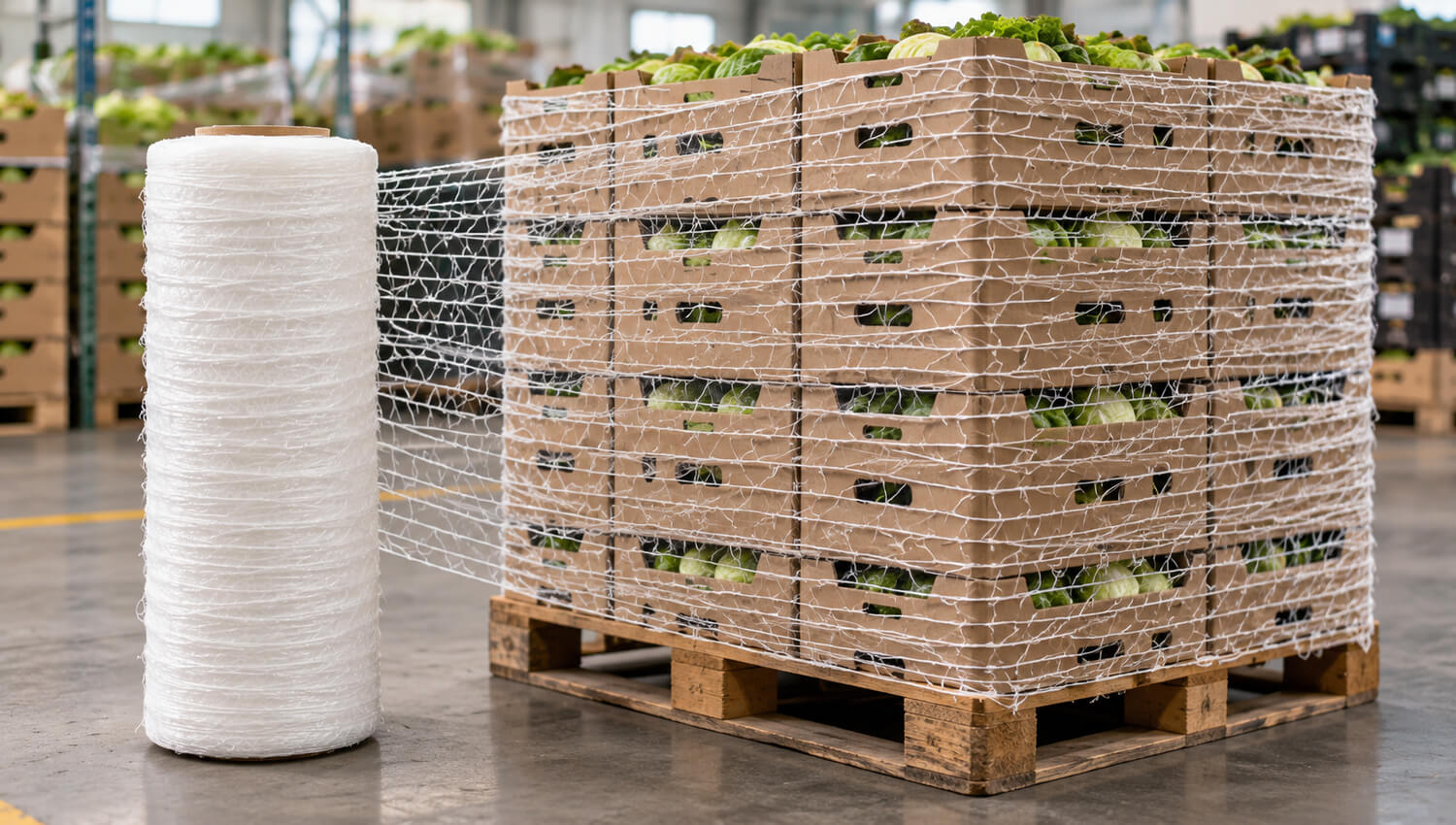
Does Vented Film Replace Pallet Netting?
Not in every application. Both can support airflow, but their structures and load-holding characteristics differ. The right material depends on ventilation needs, wrapping equipment, cargo weight, and the required containment performance.
What Should I Test Before Placing a Bulk Order?
Test unwinding, tear resistance, wrapping tension, film usage, finished pallet stability, and ventilation performance. For machine applications, include compatibility testing. Conduct trials with actual products and shipping conditions whenever possible.
Conclusion
Choosing between hand and machine ventilated pallet wrapping is an important packaging decision for manufacturers, distributors, and agricultural exporters.
Hand application offers flexibility, low initial investment, and straightforward operation. It is often suitable for small warehouses and businesses handling irregular pallet loads.
Machine application provides repeatable wrapping settings and can support higher production volumes. It may also reduce direct labor requirements and improve operational consistency.
However, neither option is universally superior.
The right solution must balance airflow, load containment, material consumption, equipment compatibility, and total packaging cost.
The most reliable approach is to compare detailed specifications and validate performance through practical samples.

 Indonesian
 English
 Russian
 Spanish
 Portuguese
 Arabic
 French