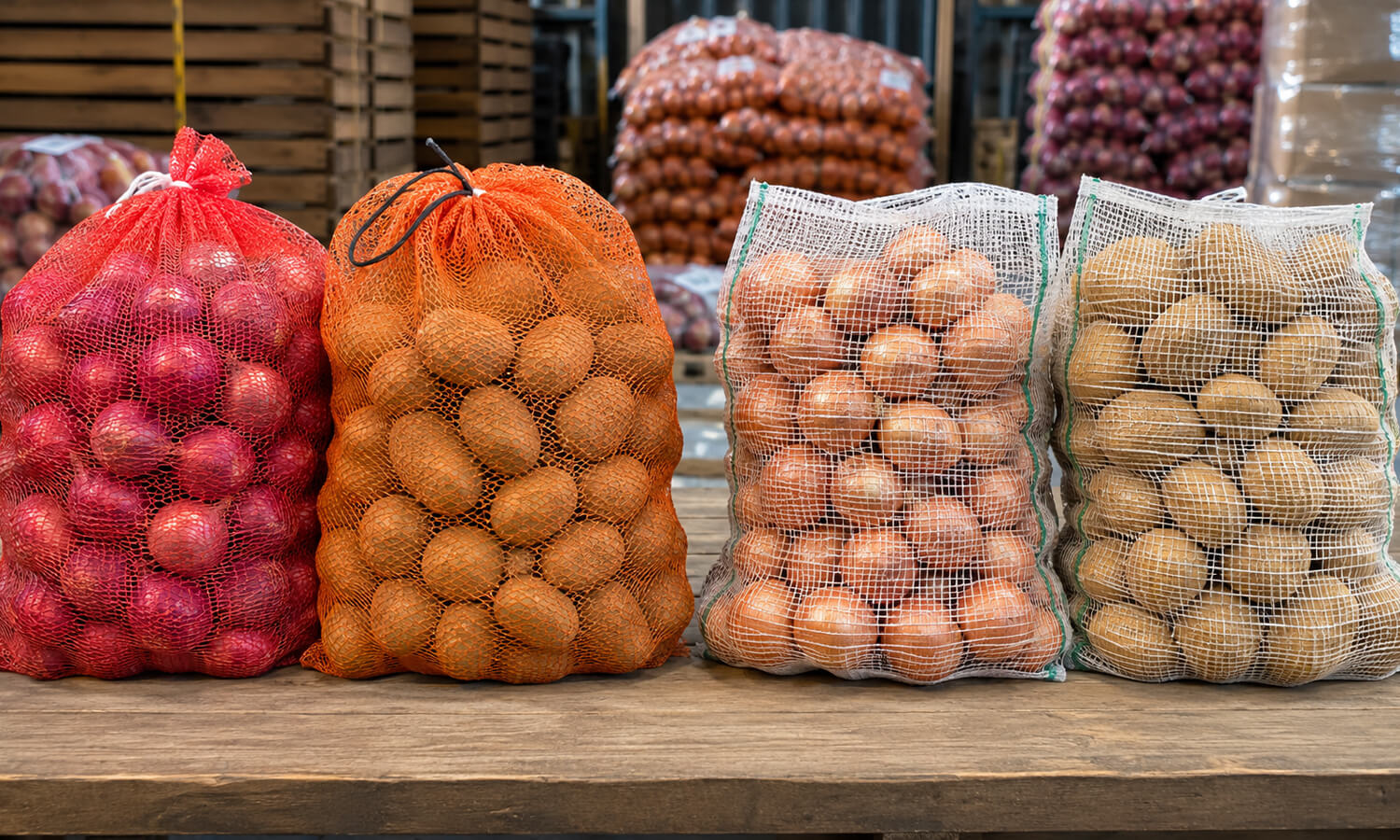
Raschel mesh bags are generally made with a knitted open-mesh structure, while Leno mesh bags use an open woven structure. Raschel bags tend to be flexible and able to conform closely around produce. Leno bags usually offer stronger dimensional stability and a more structured feel. Both provide excellent ventilation and product visibility. Therefore, the right choice depends on your packed product, load weight, packing method, transportation conditions, and required presentation.
That is the short answer. For a B2B buyer, however, there’s a little more to it.
An onion exporter packing 25 kg bags doesn’t have the same requirements as a supermarket supplier packing 2 kg citrus fruit. A firewood distributor may focus heavily on bag strength. Meanwhile, an automated vegetable packing company may care more about roll format, bag opening consistency, and machine compatibility.
This is why comparing the two products only by price can lead you down the wrong road.
From a manufacturer’s point of view, we usually recommend that buyers define several conditions first:
- What product will go inside?
- What is the target filling weight?
- How large is each piece of produce?
- Is filling manual or automatic?
- Will bags be palletized?
- How rough is transportation?
- Does the product need strong retail visibility?
- Is a drawstring, label, handle, or printed band required?
Raschel bags are widely used for potatoes, onions, leeks, citrus and firewood. Some commercial specifications range from small consumer packs to bags with capacities around 50 kg. Leno bags are also commonly produced for onions, citrus, nuts, shellfish and firewood.
So, neither construction is automatically “better.” The better bag is the one engineered around your supply chain.
How Raschel and Leno Mesh Bag Construction Differs
The biggest technical difference starts before a finished bag even exists.
A Raschel net is produced through a knitting process. Its strands form interconnected loops and mesh openings. Conventional Raschel netting is recognized as a knitted structure, and its geometry allows the mesh to change shape when tension is applied. Technical literature on Raschel netting also shows how tension and knitting pattern can influence its width and elongation behavior.
This helps explain the flexible feel you notice when holding a Raschel produce bag.
Raschel bags can be produced from polyethylene-based materials such as PE or HDPE, although specifications vary between factories and applications. One commercial Raschel specification, for example, uses knitted polyethylene and offers different knit patterns, colors, weights and mesh openings.
Leno mesh is different.
A Leno structure is woven rather than conventionally knitted. In a Leno-type fabric, warp elements interact in a way that helps hold the open structure together. This gives the material a relatively stable open mesh. Academic textile literature describes Leno as an open fabric structure in which warp yarns secure the structure.
Commercial produce Leno bags are commonly manufactured from polypropylene. A typical production process can include:
- PP resin extrusion
- Tape or yarn formation
- Mesh weaving
- Label attachment
- Corte
- Sewing
- Final inspection
One established Leno manufacturer describes essentially this resin-to-woven-fabric-to-finished-bag process.
For you as a buyer, these production differences matter because structure controls performance.
Knitted Raschel mesh generally gives you more flexibility. Woven Leno mesh generally gives you more form stability. Yet resin quality, tape thickness, fabric weight, mesh design and seam construction can significantly change the final result.
That’s why a professional quotation should never contain only “Raschel bag” or “Leno bag.” It needs measurable specifications.
Raschel vs Leno Mesh Bag Performance Comparison
Importers often ask one simple question: “Which one is stronger?”
Unfortunately, there’s no responsible answer without knowing the specifications.
Two mesh bags of the same dimensions may perform very differently if they use different resin grades, strand thicknesses, fabric weights, mesh openings or stitching methods.
Still, the construction gives each type some general characteristics.
| Característica | Raschel Mesh Bag | Leno Mesh Bag |
|---|---|---|
| Construction | Knitted open mesh | Woven open mesh |
| Common resin | PE/HDPE; specifications vary | PP is very common |
| Flexibilidad | Usually higher | Usually more structured |
| Shape conformity | Very good | Good |
| Dimensional stability | Moderate to good | Usually very good |
| Ventilation | Excellent | Excellent |
| Product visibility | Excellent | Excellent |
| Typical applications | Produce, citrus, potatoes, onions, firewood | Onions, potatoes, citrus, nuts, shellfish, firewood |
| Drawstring option | Common | Common |
| Printed/label options | Available | Available |
| Suitability for heavy loads | Depends on specification | Often selected when structure is important |
| Automatic packing | Available in suitable formats | Depends on bag and machine configuration |
Raschel shouldn’t automatically be treated as a “weak” bag. Commercial versions can be manufactured across a wide capacity range. One producer lists Raschel options from approximately 0.5 kg to 50 kg.
Likewise, a Leno bag isn’t automatically stronger just because it’s woven.
The seam can still fail. A drawstring can pull out. Incorrect tape thickness can reduce strength. Bag dimensions can also affect stress distribution.
That’s why buyers should ask their manufacturer for actual performance targets rather than relying on product names.
For plastic materials, tensile behavior can be evaluated under controlled test conditions. ISO 527-1:2019 provides general principles for determining tensile properties of plastics and plastic composites. (ISO) However, your finished-bag inspection should go further and evaluate the complete package, including seams and actual filling conditions.
For B2B procurement, tested bag performance matters more than the name of the mesh structure.
Which Mesh Bag Is Better for Onions, Potatoes and Fresh Produce?
Both Raschel and Leno mesh bags are widely used for fresh produce because they provide strong ventilation, good visibility, and easy handling. The better choice depends on the product, packing weight, transport conditions, and presentation requirements.
For onions and garlic, both options work well. Raschel bags offer more flexibility and fit closely around irregular produce. Leno bags provide a more stable structure, which can help during stacking and transportation.
For potatoes, buyers usually focus on load strength, seam quality, ventilation, and pallet stability. A well-made Raschel bag can perform reliably, while a Leno bag may be preferred when a firmer structure is required.
For citrus and retail produce, appearance also matters. Mesh color, opening size, labels, and printed bands can improve shelf presentation and product identification.
When choosing a bag, consider:
- Product size and shape
- Filled weight
- Mesh opening
- Ventilation needs
- Handling and transport
- Retail presentation
- Manual or automatic packing
For B2B purchasing, do not select only by product name. Test actual samples with your produce and target load weight. This gives a more accurate picture of strength, appearance, and handling performance before placing a large order.
How Bag Structure Affects Packing, Palletizing and Transportation
Bag performance doesn’t stop at the filling station.
Think about what happens next.
The filled bag may be lifted manually, dropped onto a conveyor, weighed, closed, stacked, compressed against other bags, palletized, wrapped, loaded into a container and transported hundreds or thousands of kilometers.
Each step places different stress on the packaging.
Raschel mesh can deform more easily because of its knitted structure. That flexibility can help the bag conform around irregular vegetables. However, the final dimensions and stretch behavior should match your packing process.
Technical references on conventional Raschel netting show that knitted mesh geometry can narrow when tension is applied lengthwise. (Google Patents) For produce packaging, that doesn’t mean every bag will experience a serious problem. It simply shows why knit pattern and tension control matter during manufacturing.
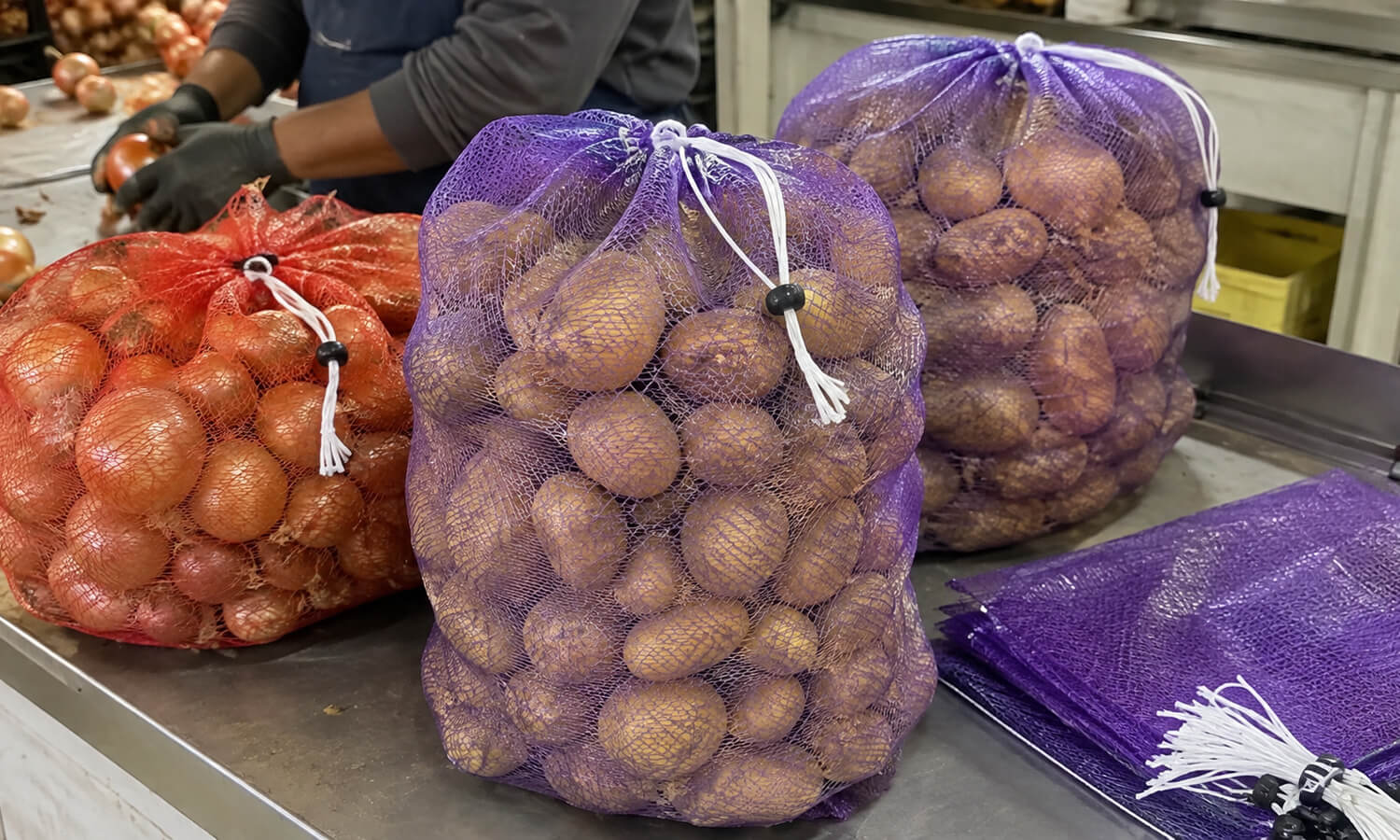
Some Raschel bags are supplied individually for manual packing. Others are manufactured in rolls for automatic packing systems. One commercial range provides roll-packed bags specifically for automatic machinery, along with customizable labels.
For Leno bags, the more stable woven construction may support predictable handling and stacking. Commercial Leno packaging is specifically promoted for transportation where breathability and form stability are important.
Before placing a bulk order, tell your supplier about your packing line.
Useful information includes:
- Filling machine brand and model
- Manual or automatic feeding
- Closure method
- Desired bags per roll or bale
- Core diameter if roll packed
- Maximum line speed
- Bag opening dimensions
- Label position
- Filled bag weight
- Pallet pattern
This can prevent an expensive mistake.
Saving two cents on a bag doesn’t help if operators have to stop the packing line every few minutes.
For export buyers, packaging efficiency should therefore be included in the purchasing calculation from day one.
Raschel and Leno Mesh Bag Cost Comparison
Unit price matters. Of course it does.
But professional procurement teams should look at total packaging cost, not only the quotation column marked “FOB price per piece.”
The cost of either mesh bag depends on many variables:
- Resin type
- Virgin or approved recycled material requirements
- Bag dimensions
- Material weight
- Strand or tape structure
- Mesh opening
- Color
- UV additive requirements
- Drawstring
- Mango
- Label
- Printing
- Stitching
- Packing quantity
- Order volume
- Quality inspection requirements
A lighter bag may cost less per piece. Yet reducing material too far can increase breakage.
A stronger bag may cost slightly more, but it could reduce repacking labor and product loss.
That changes the real calculation.
A Simple B2B Cost Model
| Cost Element | Supplier A | Supplier B |
|---|---|---|
| Bag price | $0.080 | $0.085 |
| Bags purchased | 100,000 | 100,000 |
| Packaging cost | $8,000 | $8,500 |
| Example failure/repacking cost | Higher | Lower |
| Packing-line interruptions | More frequent | Less frequent |
| Total practical cost | Potentially higher | Potentially lower |
The figures above are illustrative only, not market quotations.
This is why we advise buyers to compare samples under real loading conditions before negotiating the final specification.
Don’t remove five grams of material simply because it reduces price.
First ask what those five grams are doing.
Do they contribute to load strength? Do they stabilize the mesh? Does a different design provide the same performance with lower material use?
Then you can optimize.
A good manufacturer should be willing to discuss cost engineering, not simply offer thinner packaging.
For annual programs, even a small optimization can become meaningful across hundreds of thousands or millions of bags.
The goal isn’t the cheapest mesh sack.
The goal is a specification that achieves the required packaging performance with the lowest practical total cost.
Mesh Size, Bag Weight, Color and Customization Options
For OEM and private-label buyers, bag construction is only the starting point.
A mesh bag can be customized around your crop, filling weight, brand and sales channel.
The first specification is usually size.
Don’t copy another buyer’s dimensions blindly. A bag designed for 10 kg of large onions may not work properly for 10 kg of smaller onions.
You should provide the manufacturer with both product weight and approximate product dimensions.
Next comes the mesh.
Commercial Raschel bags can be produced with different mesh openings. For example, one manufacturer lists 8 mm and 12 mm options alongside multiple bag dimensions. Your supplier may offer different specifications.
Common customization items include:
- Custom width and length
- Different mesh openings
- Material weight
- Red, orange, yellow, green, purple or other colors
- Drawstring closure
- Mango
- Reinforced opening
- Printed label
- Brand strip
- Barcode
- Product information
- Country-specific labeling
- Individual or roll packing
- Custom bundle quantities
Color deserves more attention than it usually receives.
It isn’t only decorative.
A mesh color changes how the product appears from a distance. Retail buyers should evaluate a filled sample under actual store lighting whenever visual merchandising matters.
Labels also need careful planning.
Don’t focus only on logo size. Make sure the label has enough room for your legally required product information, barcode, weight declaration or importer information where applicable.
For automatic packing, label position and bag repeat length may become technical parameters rather than branding choices.
If you’re sourcing custom mesh packaging, send your current bag sample or specification sheet to the manufacturer before requesting a final price. A physical sample often eliminates misunderstandings that aren’t obvious in an email.
Customization should make the packaging more functional first and more attractive second.
When it does both, you’ve got a much stronger B2B packaging program.
Quality Control Tests B2B Buyers Should Request
A beautiful mesh bag doesn’t necessarily mean a reliable mesh bag.
This is where factory quality control becomes important.
Before a shipment leaves the factory, buyers should define what will actually be inspected.
Begin with dimensions.
Measure:
- Bag width
- Bag length
- Mesh opening
- Label dimensions
- Drawstring length
- Seam position
Next, look at material consistency.
Bag weight is one useful process-control indicator. Large differences between samples may suggest inconsistent material distribution or manufacturing settings.
Then test mechanical performance.
Useful checks can include:
- Filled-bag lifting test
- Static load test
- Drop test
- Seam strength check
- Drawstring pull test
- Mesh tear evaluation
- Tensile testing where relevant
- Pallet stacking trial
ISO 527-1 provides internationally recognized general principles for evaluating tensile properties of plastics under defined conditions. (ISO) Finished mesh bags, however, also require application-specific testing because the weakest point could be a seam, closure or local mesh area rather than the polymer itself.
In practical production, we recommend testing with the real product weight whenever possible.
If you purchase a 25 kg onion bag, test it at 25 kg and consider an agreed safety margin.
Don’t test only one perfect sample selected by the production team.
Use random finished bags.
For large orders, your purchase specification can define:
| QC Item | Example Requirement |
|---|---|
| Dimensions | According to approved specification |
| Bag weight | Within agreed tolerance |
| Color | Matches approved reference |
| Mesh structure | Consistent |
| Stitching | Continuous and secure |
| Drawstring | Correct length and attachment |
| Label | Correct artwork and position |
| Load test | Pass agreed filled-weight test |
| Embalaje | Correct quantity per bundle/bale |
Specifications turn “good quality” into something measurable.
And measurable quality is far easier for both buyer and manufacturer to manage.
How to Choose Between Raschel and Leno Bags
By this point, the decision becomes much easier.
Don’t ask which mesh bag is universally better.
Ask which construction fits your packaging priorities.
Here is a practical decision chart.
Buyer Priority Chart
| Buyer Priority | Raschel | Leno |
|---|---|---|
| Flexible fit around produce | ★★★★★ | ★★★ |
| Open ventilation | ★★★★★ | ★★★★★ |
| Product visibility | ★★★★★ | ★★★★★ |
| Structural stability | ★★★ | ★★★★★ |
| Multiple consumer-size formats | ★★★★★ | ★★★★ |
| Heavy-duty specification potential | ★★★★ | ★★★★★ |
| Branding customization | ★★★★★ | ★★★★★ |
| Agricultural applications | ★★★★★ | ★★★★★ |
Ratings are general selection guidance. Actual performance depends on material and manufacturing specifications.
Choose a Raschel net bag when flexibility, lightweight packaging and close conformity around the product are major priorities.
Consider a Leno woven bag when dimensional stability, structured handling and robust transportation performance are especially important.
For onions or potatoes, either option can work.
Therefore, don’t make the choice based only on the crop name.
A 2 kg supermarket onion pack and a 25 kg wholesale onion sack have completely different demands.
Use this five-step selection method:
- Define the product.
- Define the filled weight.
- Define the logistics environment.
- Compare physical samples.
- Run an actual packing and handling test.
For high-volume annual contracts, we often recommend testing two or three specifications.
For example:
Sample A: Standard Raschel design
Sample B: Higher-weight Raschel design
Sample C: Leno construction
Fill all samples with the same product.
Then compare packaging speed, handling, appearance, stacking and breakage.
That small trial can tell you more than ten pages of product descriptions.
In B2B packaging, the final decision should be based on measured performance, not assumptions.
What Should You Tell a Mesh Bag Manufacturer Before Ordering?
A vague RFQ usually receives a vague quotation.
“Please quote 100,000 onion mesh bags” isn’t enough information for an accurate comparison.
Different suppliers may assume different weights, sizes or construction. You could receive three prices that appear comparable but represent three completely different products.
Instead, prepare a structured RFQ.
Recommended Mesh Bag RFQ Checklist
Send your manufacturer:
- Product to be packed
- Filled weight per bag
- Preferred construction
- Bag width × length
- Material preference
- Target bag weight if known
- Mesh opening or reference sample
- Color
- Drawstring requirement
- Handle requirement
- Label size
- Printing artwork
- Packing method
- Bags per bundle/bale/roll
- Annual purchasing quantity
- Quantity per shipment
- Destination port
- Packing machine information
- Required product tests
- Required food-contact or destination-market documents
- Target delivery schedule
If you don’t know the technical specification, that’s fine.
Send an existing sample.
You can also give the manufacturer your product and filling weight and ask for two recommended specifications.
For example:
Product: Fresh onions
Filled weight: 20 kg
Packing: Manual
Destination: European market
Quantity: 300,000 bags per order
Requirement: Red mesh, drawstring, custom label
That is already far more useful than asking only for a price.
For repeat orders, request an approved “golden sample.” Both sides can use it as a visual and dimensional reference.
You should also confirm whether the manufacturer controls critical stages internally or outsources them. Leno production, for example, can involve resin extrusion, tape formation, weaving, label attachment, cutting and sewing.
A clear RFQ helps your manufacturer quote more accurately.
It also helps you compare quotations fairly.
Preguntas frecuentes
Are Raschel mesh bags stronger than Leno mesh bags?
Not necessarily. Strength depends on resin, strand thickness, fabric weight, mesh design, seams and bag dimensions. Instead of selecting by name alone, request filled-load, seam and drop testing using your actual target packing weight.
Which mesh bag provides better ventilation for onions?
Both constructions offer excellent open ventilation when correctly designed. Mesh opening, bag filling density, pallet arrangement and storage conditions also affect airflow. For onions, evaluate the entire packed pallet rather than only the empty bag.
Can Raschel bags be used for 25 kg or 50 kg packaging?
Yes, suitable Raschel constructions can be designed for larger loads. Some commercial ranges list capacities extending to approximately 50 kg. Always confirm the exact specification through load and handling tests before bulk purchasing.
Are Leno mesh bags only suitable for heavy products?
No. Leno bags are used for many agricultural and commercial products, including onions, citrus, nuts, shellfish and firewood. Their structured woven design is useful in many packaging formats, not only heavy-duty applications.
Can mesh produce bags be customized with our company logo?
Yes. Depending on the production method, manufacturers can offer custom labels, bands, colors, drawstrings and other branding options. Provide final artwork, label dimensions, barcode requirements and expected annual volume when requesting your quotation.
Which mesh bag is better for automatic packing machines?
Machine compatibility depends more on the finished bag format than the name alone. Raschel bags can be supplied on rolls for automatic packing. Always provide your packing machine model and technical requirements before production.
What mesh size should I use for onions or potatoes?
There is no universal mesh size. The correct opening depends on produce diameter, bag weight, presentation and strength requirements. Testing several openings with actual produce is safer than selecting a mesh size from a generic specification sheet.
How can I compare quotations from different mesh bag suppliers?
Compare identical dimensions, material weight, construction, resin requirements, closure, label, packaging and testing standards. If specifications aren’t identical, the lowest unit price doesn’t tell you which supplier actually offers better value.
Should we request samples before placing a bulk order?
Yes. Samples allow you to test filling, lifting, stacking, ventilation, product appearance and packing-line compatibility. For a large annual purchasing program, a small pre-production trial can prevent costly specification problems after shipment.
Conclusion: Which Mesh Bag Should Your Business Buy?
The choice between these two mesh packaging structures isn’t simply about finding a winner.
Raschel bags use a knitted construction that gives them excellent flexibility, ventilation and product visibility. Leno bags use an open woven structure that generally provides greater dimensional stability while maintaining excellent airflow.
Both can work for onions, potatoes, citrus and many other agricultural products.
Your real decision should be based on:
- Product type
- Filled weight
- Mesh opening
- Required strength
- Packing method
- Logistics conditions
- Retail presentation
- Customization requirements
- Total packaging cost
For most B2B buyers, the safest approach is simple: compare specifications, not names.
Request samples of the most suitable Raschel and Leno constructions. Fill them with your actual product. Test the seams. Lift them. Drop them. Stack them. Run them through your packing process.
Then compare the results.
The Food and Agriculture Organization’s post-harvest guidance also highlights how heat, vapor retention and inadequate gas exchange can contribute to fresh-produce deterioration, reinforcing why appropriate ventilation is an important packaging consideration.
A mesh bag is a small component of your total product cost, but a packaging failure can become a large logistics problem.
If you’re sourcing Raschel or Leno mesh bags in bulk, send us your required bag size, filling weight, product type, annual quantity and current sample or specification. Our team can recommend a suitable mesh structure and prepare an OEM specification for quotation.


 Spanish
  English
  Russian
  Portuguese
  Arabic
  French
  Indonesian