
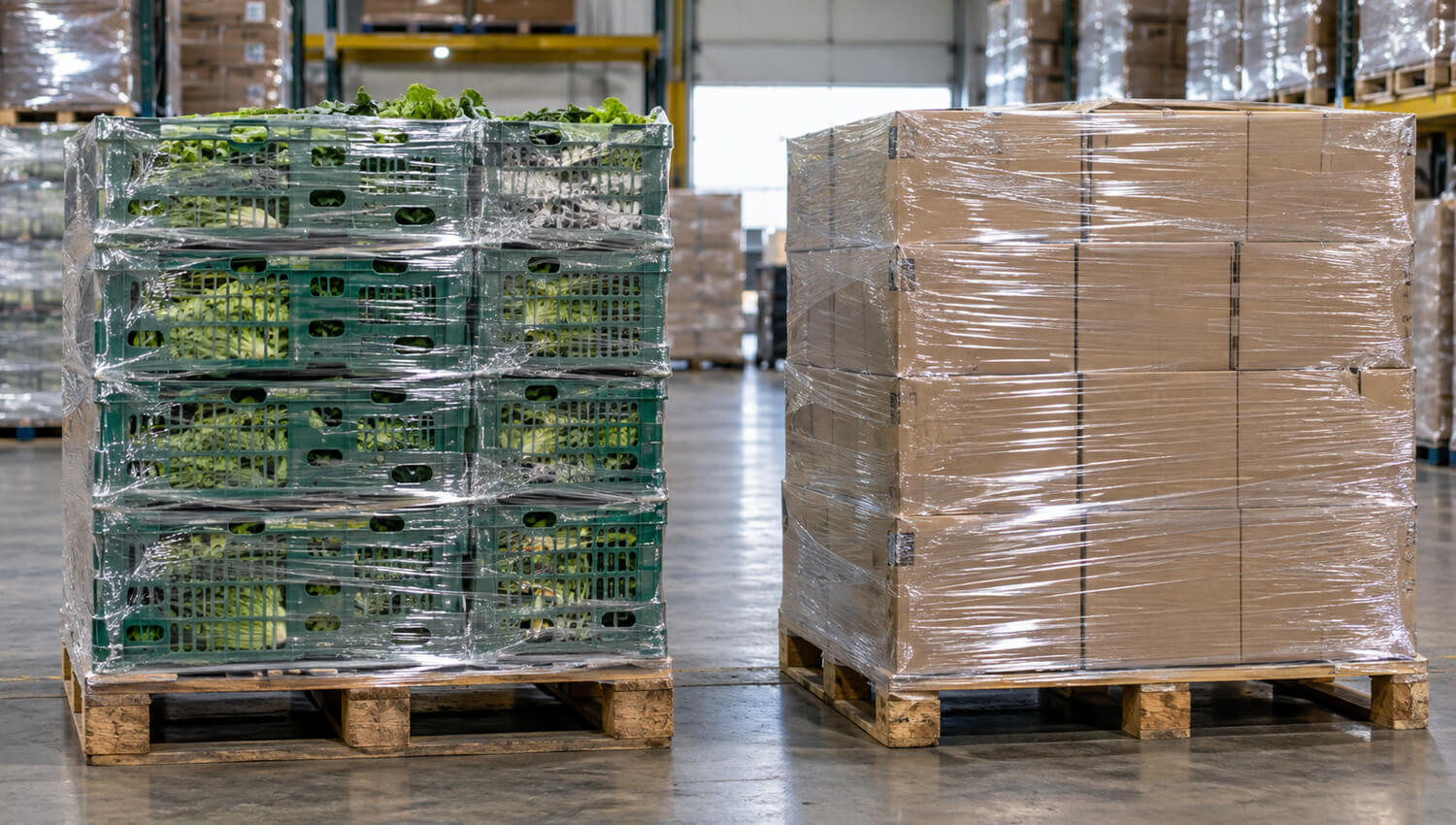
Vented stretch film has openings that allow air, heat, and moisture vapor to move through a wrapped pallet. Regular stretch film forms a more continuous plastic barrier. Both products secure goods during storage and transportation, but they serve different needs. Vented wrap is often suitable for fresh produce and temperature-sensitive goods. Regular wrap is often better for dry products that need broader surface coverage.
Choosing the wrong packaging film can create costly problems.
Fresh vegetables may arrive with unwanted moisture. Hot products may cool too slowly. Poorly wrapped pallets may shift during transportation.
For purchasing managers and packaging distributors, these problems affect more than product quality. They can increase customer complaints, replacement costs, and operating expenses.
The right wrapping film must do two jobs. It needs to hold products securely and protect their condition during shipping.
This guide explains the main differences between ventilated and conventional pallet wrap. You’ll also learn how to compare specifications, evaluate suppliers, and make better purchasing decisions.
Vented Stretch Film: What Makes It Different?
Vented stretch film is a plastic wrapping material with specially designed openings. These openings allow air to pass through the film while the remaining plastic holds the pallet together.
It is also called perforated stretch wrap, breathable pallet film, or ventilated pallet wrapping film.
Why Does Ventilation Matter?
Standard stretch wrap covers most of the pallet surface with plastic. This helps protect goods from dust and light contact with water.
However, the same coverage can restrict air movement.
That becomes a problem when products release heat or moisture. Warm products may develop condensation as temperatures change. Some fresh fruits and vegetables also need ventilation during storage and transportation.
Ventilated film allows more air exchange around the packaged products.
Its main advantages include:
- Better airflow around suitable pallet loads.
- Less trapped heat when cooling conditions allow.
- Reduced risk of moisture accumulation in some applications.
- Improved ventilation for selected agricultural products.
- Better access to cooling air in temperature-controlled environments.
These benefits depend on the product, wrapping pattern, and storage conditions.
Perforations alone cannot prevent spoilage or control temperature. Proper refrigeration, airflow, and handling remain essential.
What Is Regular Stretch Film?
Regular stretch film is generally made from stretchable polyethylene, often linear low-density polyethylene (LLDPE).
It is wrapped around cartons, bags, bottles, and other palletized goods.
The film stretches during application. Its elastic recovery helps keep the load together.
Common applications include:
- Cartons of consumer products.
- Industrial components.
- Building materials.
- Packaged household goods.
- General warehouse shipments.
Regular film remains a practical choice for many businesses. It offers continuous surface coverage and is widely available in different grades.
The choice between the two materials should begin with your products, not the price of a roll.
Vented Stretch Film vs Regular Stretch Film
The main difference is ventilation. Perforated film allows more air exchange, while standard film provides a more continuous covering.
However, the difference goes beyond a few holes.
Each material affects pallet wrapping performance, storage conditions, and packaging costs.
Feature Comparison Table
| Feature | Vented Stretch Film | Regular Stretch Film |
|---|---|---|
| Film structure | Perforated or open-pattern design | Continuous plastic sheet |
| Air circulation | Allows more air exchange | Restricts airflow |
| Heat release | Supports cooling under suitable conditions | Can slow heat exchange |
| Moisture control | May reduce trapped condensation | May trap humid air |
| Load containment | Depends strongly on film and hole design | Wide range of proven load-containment grades |
| Dust protection | Limited by openings | Better continuous surface coverage |
| Water protection | Water may pass through openings | More coverage, but not waterproof |
| Fresh produce | Often suitable | May be unsuitable without ventilation |
| Dry cartons | Suitable in selected cases | Usually preferred |
| Application | Hand or compatible machine grades | Hand and machine grades widely available |
| Initial cost | Often higher for specialty grades | Often more economical |
| Customization | Hole design, width, thickness, packaging | Width, thickness, color, printing, packaging |
Which Film Holds Pallets More Securely?
There isn’t one answer for every load.
A well-designed conventional film can provide strong containment. Its continuous structure helps spread wrapping forces across the pallet.
Perforated film has openings that reduce the amount of material in the wrapped area. The shape and position of those openings influence its strength.
However, a properly engineered ventilated film can still secure many commercial loads.
You should compare actual containment performance rather than judge products by thickness alone.
Which Film Provides Better Product Protection?
The answer depends on what you need to protect against.
For dry cartons, dust and surface dirt may be the main concern. Conventional wrap is often suitable.
For warm produce or chilled goods, trapped moisture may present a greater concern.
Breathable wrap can support air movement, but it also leaves parts of the load exposed.
Neither material replaces proper pallet design, corner protection, or secure transportation practices.
How Perforated and Conventional Stretch Wrap Work
Understanding film construction helps you evaluate suppliers.
Both products may use polyethylene-based materials, but their final structures differ.
How Conventional Stretch Film Is Made
Many commercial stretch films are produced using a cast extrusion process.
Polyethylene resin is heated until it melts. The material then passes through an extrusion die.
The thin plastic sheet is cooled, wound, and converted into finished rolls.
Manufacturers can adjust the resin blend and production settings to obtain different properties.
These may include:
- Stretch capability.
- Puncture resistance.
- Cling.
- Tear behavior.
- Optical clarity.
- Load containment performance.
Some films use several coextruded layers to balance these properties.
How Ventilated Film Is Produced
Ventilated wrapping material may be produced by adding perforations to a film web or by using another engineered open structure.
In a perforated product, the openings must remain consistent.
Their size, shape, and spacing affect both airflow and mechanical performance.
Large openings can allow more air to pass through. However, excessive open area may weaken the film or increase tearing risk.
Small openings can preserve more material, but they may provide less ventilation.
There is no universal hole pattern that suits every product.
Why Film Design Matters
Imagine wrapping two pallets of fresh vegetables.
One uses a film with carefully distributed ventilation openings. The other uses a film with fewer openings.
Both may look similar from a distance.
However, their airflow and containment performance could differ significantly.
This is why buyers should request samples before placing a large order.
A good supplier should explain the film’s intended application and provide measurable product specifications.
For large-volume purchases, consistent manufacturing matters as much as the original design.
Seven Essential Performance Differences
A good comparison should focus on actual packaging results. Roll appearance alone tells you very little.
The following seven factors can help you determine which material offers better value.
Air Circulation
Breathable pallet wrap provides openings for air movement.
This makes it useful for products that need cooling or ventilation. However, airflow still depends on the way cartons or products are stacked.
Even highly perforated film cannot ventilate a completely sealed inner carton.
Condensation Control
Condensation can develop when humid air meets a colder surface.
Conventional film may restrict the escape of humid air. As a result, moisture can accumulate in certain storage conditions.
Open-pattern film can reduce this risk by supporting air exchange.
Still, ventilation does not guarantee a dry pallet. Temperature control and product moisture levels remain important.
Cooling Performance
Freshly processed products may need cooling before shipment.
Ventilated wrap can help cooling air reach exposed areas of the load. This is particularly useful when pallets enter a refrigerated area.
Regular film may slow this process because it covers more of the outer surface.
The actual cooling rate depends on airflow, package design, product temperature, and stacking.
Load Stability
Regular film often offers a wider continuous contact area around the pallet.
This can be helpful for heavy cartons and mixed industrial shipments.
Perforated film must achieve sufficient containment despite its openings.
For either material, proper wrapping tension, overlap, and pallet attachment are essential.
Puncture and Tear Resistance
Perforations create potential stress points.
If the film is stretched too far, tears may begin around an opening.
However, film formulation and hole geometry also influence performance.
A thicker perforated film isn’t automatically stronger than a thinner conventional film.
Protection From External Contamination
Solid stretch wrap generally offers better continuous coverage against dust and surface dirt.
Perforated film leaves openings that expose parts of the load.
This may be acceptable for ventilated crates. It may be less suitable for sensitive goods in open or dusty environments.
Packaging Cost
Specialty ventilated film may cost more per roll.
However, purchase price is only one part of the calculation.
Better ventilation may help reduce quality problems for suitable products. Efficient film designs may also lower the weight of packaging used per pallet.
These savings are not guaranteed. They must be checked through packaging trials and actual shipping results.
Performance comparison at a glance
Qualitative guide to typical design advantages, not laboratory test results. Actual performance varies by film and load.
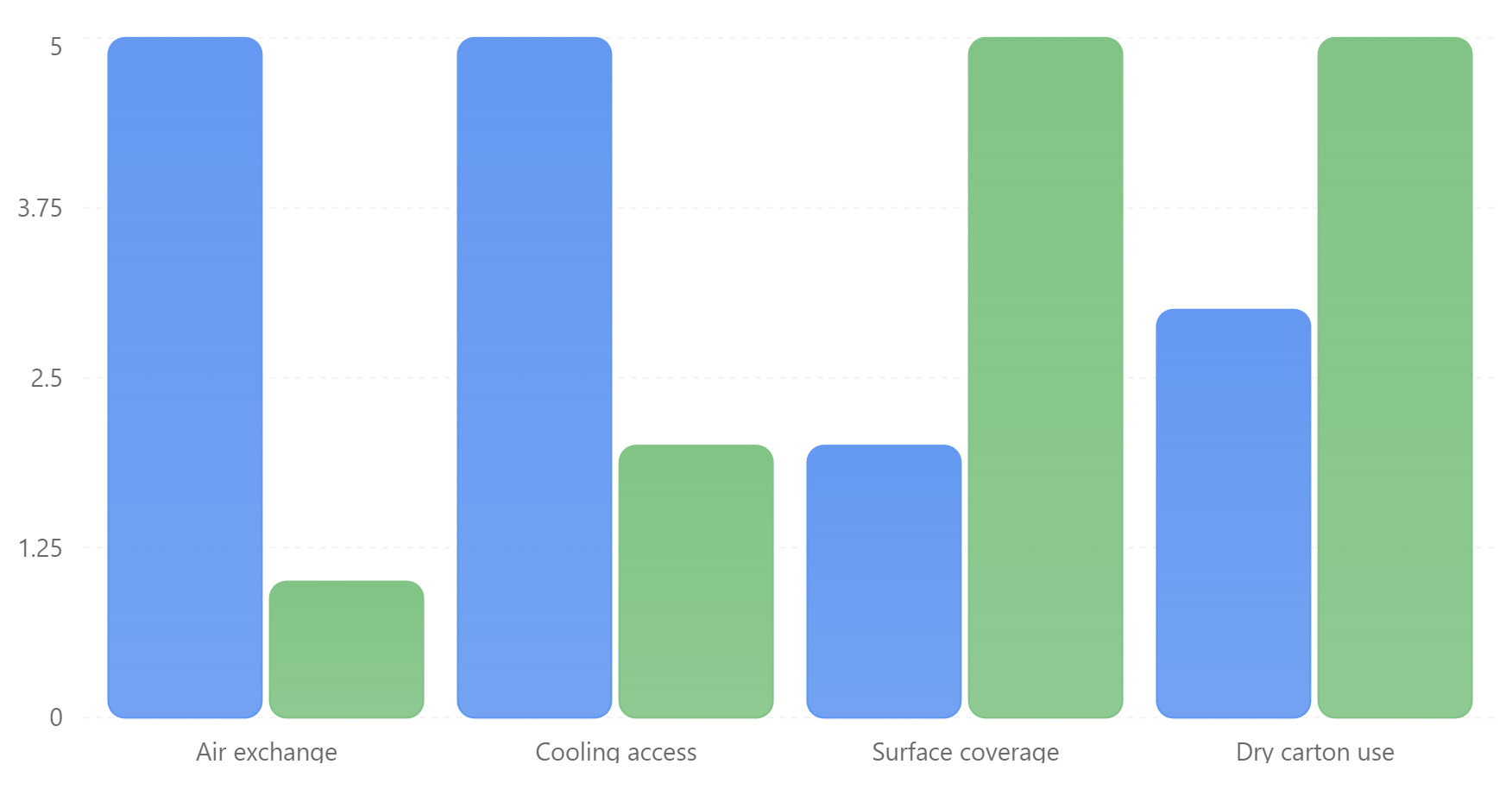
Illustrative suitability scores only; 5 indicates a stronger typical advantage.
Best Applications for Breathable Pallet Wrap
The right application is where ventilated pallet film delivers its greatest value.
Not every pallet needs airflow. However, some products benefit from a packaging system that allows heat and moisture to escape.
Fresh Fruits and Vegetables
Agricultural exporters often need to move produce across long distances.
Fresh products continue to respire after harvest. They may produce heat, release moisture, and exchange gases with their surroundings.
Poor temperature management can shorten shelf life.
Ventilated film helps maintain openings around the pallet. It can also support refrigerated airflow when used with suitable crates.
Common applications include:
- Potatoes and onions.
- Citrus fruit in ventilated cartons.
- Fresh vegetables in plastic crates.
- Other produce with defined ventilation requirements.
The correct packing method depends on the crop. Some produce requires controlled humidity or special atmospheric conditions.
Perforated film should not be used without considering those requirements.
Cold-Chain Distribution
Temperature-sensitive shipments often move between different environments.
For example, products may move from a packing area to a cooler, then into a refrigerated vehicle.
Ventilated wrap can support airflow during these stages.
However, it doesn’t maintain refrigeration by itself. Cold-chain temperature control must come from the transport and storage system.
Flowers and Horticultural Products
Cut flowers and living plants may require ventilation.
Breathable film can help airflow reach suitably packed products.
It also reduces the amount of continuous plastic covering around the load.
However, delicate flowers still need suitable protective packaging.
Warm Products and Beverages
Some goods are packed while still warm. Others need cooling after production.
Open-pattern wrap may allow heat to escape more easily.
This can be useful for beverage trays or certain processed products. Yet product stability and hygiene requirements must come first.
For buyers, application testing is essential before switching materials.
When Regular Stretch Film Is the Better Choice
Ventilation offers useful benefits, but more airflow is not always desirable.
Many products need secure wrapping without intentional openings.
For these shipments, standard stretch wrap can provide excellent value.
Dry Cartons and Consumer Goods
Cartons containing household products, clothing, toys, and packaged accessories often need stable transportation.
Their main risks include shifting, dust, and physical damage.
These products generally do not require airflow through the outer pallet wrap.
A conventional film can provide continuous coverage while helping secure the cartons.
Industrial Parts and Hardware
Metal parts, automotive accessories, and construction products often travel on heavy pallets.
Load stability can be the primary concern.
A suitable conventional machine film may offer efficient wrapping for these shipments.
However, the pallet configuration must be considered.
Sharp edges may require corner boards or additional protection.
Long-Term Warehouse Storage
Products stored in dry warehouses may benefit from greater surface coverage.
Regular film can reduce direct exposure to warehouse dust.
It also helps hold cartons together during internal movements.
That said, regular stretch film is not a complete moisture barrier.
Air can still enter through gaps, seams, and the open ends of the pallet.
When Should You Avoid Perforated Film?
Avoid choosing breathable film based only on its appearance or marketing claims.
It may not be the right material when:
- Products require continuous surface coverage.
- Loads contain sharp or irregular edges.
- Dust contamination is a major concern.
- Ventilation provides no measurable benefit.
- Your wrapping machine cannot handle the selected film.
The most economical choice is often the material that meets the required performance with the least unnecessary cost.
Technical Specifications Buyers Should Compare
Technical details are essential when buying pallet wrap in bulk.
Two rolls may have the same nominal thickness but behave differently during application.
For this reason, manufacturers and buyers should agree on a clear specification before production.
Important Technical Parameters
| Parameter | What Buyers Should Check | Why It Matters |
|---|---|---|
| Material | Resin composition and film grade | Influences film properties |
| Film thickness | Nominal microns and tolerance | Affects consistency and material use |
| Film width | Total film width in millimeters | Determines pallet coverage |
| Roll length | Length per roll | Affects purchasing and wrapping efficiency |
| Net film weight | Film weight excluding core | Helps compare supply quantities |
| Perforation geometry | Opening size, shape, and spacing | Influences ventilation and tearing |
| Open-area percentage | Approximate share of open space | Helps describe the ventilation design |
| Stretch performance | Elongation and working stretch range | Affects film application |
| Puncture resistance | Relevant test results | Helps assess film durability |
| Load containment | Results from actual wrapped-load tests | Measures pallet security |
| Application grade | Hand or machine film | Determines equipment compatibility |
| Core dimensions | Inner diameter and core length | Helps confirm dispenser compatibility |
Typical Specification Examples
The following figures are illustrative purchasing specifications, not universal product standards.
| Specification | Example Purchase Requirement |
|---|---|
| Material | LLDPE-based film |
| Thickness | 20 microns, subject to design |
| Width | 500 mm |
| Roll length | 300 m |
| Color | Transparent |
| Application | Hand wrapping |
| Perforation pattern | Supplier drawing required |
| Core diameter | 76 mm internal diameter |
| Packaging | Export cartons or palletized rolls |
For machine wrapping, the required specifications may differ substantially.
You should confirm maximum working stretch and film delivery conditions with the machine supplier.
Why Thickness Alone Is Not Enough
A thicker film isn’t always the most economical solution.
What matters is the amount of usable containment performance obtained from the film consumed.
Consider two films with different formulations.
One may stretch efficiently and maintain suitable tension. Another may break frequently or lose holding force.
The first could deliver better results despite having a lower nominal thickness.
With perforated grades, buyers must also consider the remaining film structure around each opening.
Relevant Testing Standards
ASTM provides recognized methods for evaluating stretch wrap.
For example, ASTM D4649 covers guidance for selecting and using stretch films.
Other relevant methods include ASTM D5414 for horizontal impact evaluation and ASTM D5415 for vibration-related load containment testing.
These standards provide a useful framework for comparing packaging performance.
However, laboratory tests cannot fully predict every transport condition.
Always evaluate representative loads under actual operating conditions.
Cost Comparison and Total Packaging Value
Price is important in purchasing. However, selecting pallet wrap based only on the lowest quotation can be misleading.
The real cost includes film consumption, application labor, damaged goods, and operational delays.
Understanding Cost per Pallet
Consider the following illustrative packaging comparison.
| Cost Factor | Vented Film | Regular Film |
|---|---|---|
| Film cost per pallet | $1.80 | $1.40 |
| Estimated damage-related cost | $0.15 | $0.70 |
| Wrapping labor per pallet | $0.40 | $0.40 |
| Total estimated cost | $2.35 | $2.50 |
These figures are hypothetical and demonstrate the calculation only.
The ventilated option costs more in film, but the total estimated expense is lower in this example.
This result would only occur if ventilation reduced product losses enough to justify the extra film cost.
For dry industrial goods, the conventional film might have the lower total cost.
Calculate Your Own Packaging Cost
A practical formula is:
Total Packaging Cost per Pallet = Film Cost + Labor Cost + Equipment Cost + Expected Product Damage Cost
For large-volume operations, even a small saving per pallet may matter.
Suppose your company wraps 10,000 pallets each month.
Reducing total packaging costs by $0.10 per pallet would save $1,000 monthly.
However, you should also measure film breaks, rewrapping, and customer returns.
Evaluate More Than Unit Price
When requesting supplier quotations, compare the same measurement basis.
Ask for:
- Price per roll and price per kilogram.
- Actual net film weight.
- Roll dimensions and length.
- Thickness tolerance.
- Number of rolls per carton or pallet.
- Minimum order quantity.
- Packaging and freight terms.
- Quality inspection requirements.
A roll with a lower price may contain less film.
Likewise, the lowest cost per kilogram does not always produce the lowest cost per wrapped pallet.
A controlled packaging trial can reveal these differences before you place a container order.
How to Choose the Right Pallet Wrapping Film
A good purchasing decision begins with your product and shipping conditions.
The goal isn’t to find one film for every application. It is to find a suitable film for each type of load.
Identify Your Product Requirements
Start by asking a few practical questions.
Does the product release heat or moisture?
Does it need cooling during transportation?
Is it sensitive to dust or outside contamination?
Are cartons stacked evenly, or is the pallet irregular?
Your answers will help determine whether ventilation is useful.
Understand Your Shipping Conditions
A short warehouse transfer is different from a long international shipment.
Long-distance goods may face vibration, handling impacts, and temperature changes.
You need to consider these conditions before selecting a film grade.
For agricultural exports, product cooling and storage temperature can be critical.
For industrial shipments, containment force may be the higher priority.
Check Equipment Compatibility
Hand wrapping and machine wrapping have different operating needs.
Hand film must work with the operator’s application method.
Machine film must match the wrapping equipment and its settings.
Check the roll width, core, tension, and working stretch requirements.
Using an unsuitable grade may cause tearing or machine stoppages.
Request a Production Sample
A sample gives your team a chance to examine the material.
However, a visual check is only the beginning.
Wrap a representative pallet using the proposed film. Then observe its behavior.
Measure film consumption, load stability, and wrapping time.
For ventilated grades, evaluate cooling or moisture outcomes under realistic conditions.
Make a Controlled Comparison
Use the same pallet configuration and handling procedure for both materials.
Compare at least these results:
- Film used per pallet.
- Wrapping time.
- Film breaks.
- Load movement.
- Visible condensation.
- Product condition after storage.
- Product condition after transportation.
Document your findings before approving a new supplier or material.
Quick film selection guide
Do your products need cooling or airflow?Yes, ventilation is importantNo, they are dry or stable goodsIs continuous coverage against dust important?YesNot a main requirementWrapping methodHand wrappingMachine wrapping
Preliminary recommendationVentilated stretch wrap is a good candidate. Validate its airflow and containment with a pallet trial.Build My Purchasing Specification
Manufacturer Quality Control and OEM Customization
For importers and distributors, consistency is essential.
A packaging material may perform well during sampling but create problems if later production batches vary.
This makes factory quality management an important part of supplier selection.
Raw Material and Film Control
Reliable production should begin with documented material specifications.
Manufacturers should control the resin grade, production settings, and film dimensions.
For perforated products, the hole design must also remain consistent.
A suitable inspection plan may include:
- Raw material identification.
- Film thickness checks.
- Width and roll-length verification.
- Visual inspection for film defects.
- Perforation alignment and consistency.
- Roll winding and core inspection.
- Application or mechanical performance testing.
These are recommended quality-control practices. Buyers should verify which tests a particular manufacturer actually performs.
OEM and Private-Label Options
Packaging distributors often need products under their own brands.
Depending on factory capabilities, customization may include:
| OEM Requirement | Possible Customization |
|---|---|
| Film dimensions | Width, thickness, and roll length |
| Ventilation design | Opening geometry and spacing |
| Product grade | Hand or machine application |
| Appearance | Transparent or selected colors |
| Labels | Private-label roll stickers |
| Outer cartons | Customer artwork and markings |
| Export packaging | Pallet configuration and carton quantities |
| Product documentation | Agreed specifications and inspection reports |
Custom perforation tooling or special formulations may affect minimum orders and lead times.
Always confirm these details before making commitments to your customers.
What Should You Ask a Manufacturer?
A professional factory quotation should answer more than the unit price.
Ask whether the manufacturer can provide a technical data sheet, representative samples, and agreed tolerance information.
For perforated grades, request a drawing or clear description of the opening pattern.
You should also ask about batch traceability, inspection procedures, and product claims.
If a supplier mentions ISO certification, verify the actual certificate and its scope.
Do not assume that every film meets a particular standard simply because the factory produces packaging materials.
Building a Long-Term Supply Relationship
Reliable supply reduces purchasing uncertainty.
For recurring orders, consistent product specifications are often more valuable than frequent changes to the lowest-priced supplier.
Establish written acceptance criteria, packaging requirements, and complaint procedures.
Keep an approved sample when practical.
This gives both parties a useful reference if quality questions arise later.
Common Pallet Wrapping Mistakes to Avoid
Even a suitable film can perform poorly when applied incorrectly.
Packaging problems often come from a combination of material choice, load design, and wrapping conditions.
Using Ventilated Film Without a Clear Need
Specialty packaging should solve a specific problem.
If your product does not need ventilation, perforated film may add cost without providing measurable benefits.
Before changing materials, identify the issue you want to solve.
It might be excess moisture, slow cooling, film consumption, or product damage.
Choose the material based on that issue.
Stretching Film Beyond Its Working Range
Stretching too aggressively can cause tearing or reduce reliable containment.
The problem can be more visible around perforations.
Follow the film supplier’s recommended application range. Adjust machine settings when necessary.
A perforated material should never be assumed to tolerate the same settings as an existing solid film.
Ignoring Pallet Overlap and Attachment
Stretch wrap must keep the load connected to the pallet.
Poor film overlap and weak attachment can allow cartons to shift.
The right wrapping pattern depends on load height, weight, and configuration.
Heavy pallets may also need corner boards, straps, or additional restraint.
Comparing Rolls by Gross Weight
Gross roll weight includes the cardboard or plastic core.
A heavy core can make a roll appear more substantial without providing more usable film.
Compare net film weight alongside roll length and thickness.
For perforated film, consider the mass removed by the openings as well.
Skipping Transport Testing
A wrapped pallet may look stable inside the factory.
However, road vibration and repeated handling can expose weaknesses.
ASTM D5415 provides a laboratory method for comparing stretch-wrapped loads under vibration. Test results should be treated as comparative evidence, not a promise of real-world performance.
For important shipments, trial loads should travel through representative distribution conditions.
Document the results and adjust the packaging system if needed.
Frequently Asked Questions
Is vented stretch film stronger than regular stretch film?
Not necessarily. Regular stretch film often benefits from its continuous structure. Perforated film can also provide effective containment when properly designed. Actual strength depends on the resin formulation, thickness, perforation pattern, and wrapping conditions. Compare tested performance rather than appearance.
Can ventilated stretch wrap prevent condensation?
It can help reduce trapped moisture by allowing more air exchange. However, it cannot completely prevent condensation. Humidity, product temperature, refrigeration, and airflow all affect moisture formation. Good temperature management remains essential for sensitive products.
Is perforated stretch film suitable for fresh vegetables?
Yes, it can be suitable for vegetables packed in ventilated crates or cartons. The openings help cooling air move through the load. However, each crop has different storage requirements. Always check the correct temperature, humidity, and ventilation conditions.
Can vented stretch film be used with automatic wrapping machines?
Yes, machine-compatible grades are available. However, not every perforated film works with every wrapping machine. The equipment’s tension and pre-stretch settings must match the material. Request a trial roll and confirm compatibility before ordering in bulk.
Why is vented stretch film sometimes more expensive?
Specialized production, perforation equipment, and additional processing can increase manufacturing costs. Prices also depend on film thickness, roll size, order quantity, and customization. Buyers should compare total packaging cost per pallet rather than the purchase price alone.
What thickness should I choose for pallet wrapping?
There is no single thickness suitable for every pallet. Load weight, corner shape, film formulation, and wrapping conditions all influence the choice. Ask your supplier for suitable samples and test them on representative loads before setting a final specification.
Can vented film be used for frozen products?
It may be suitable for certain frozen or refrigerated shipments, especially where airflow around the outer packaging is required. However, low temperatures can affect film performance. Confirm the film’s operating temperature range and validate the complete packaging system.
Can manufacturers supply custom vented stretch film for distributors?
Many specialized manufacturers can offer custom roll dimensions, perforation patterns, and private-label packaging. Available options depend on factory equipment and order volume. Before confirming a purchase, request technical specifications, samples, minimum order quantities, and documented quality requirements.
Conclusion: Which Stretch Film Should You Buy?
Choosing the right pallet wrapping film depends on your products, shipping conditions, and packaging priorities.
Vented stretch film is often suitable when airflow, cooling, and moisture management are important. Regular stretch film is usually the practical choice when continuous surface coverage and general-purpose pallet containment are the main requirements.
Neither option is automatically better for every shipment.
For purchasing managers, the most useful approach is to compare real packaging performance.
Begin with product requirements. Review technical specifications. Conduct wrapping trials. Then compare the total cost per pallet.
This process helps your business reduce unnecessary packaging expenses while protecting product quality.
 Indonesian
  English
  Russian
  Spanish
  Portuguese
  Arabic
  French