
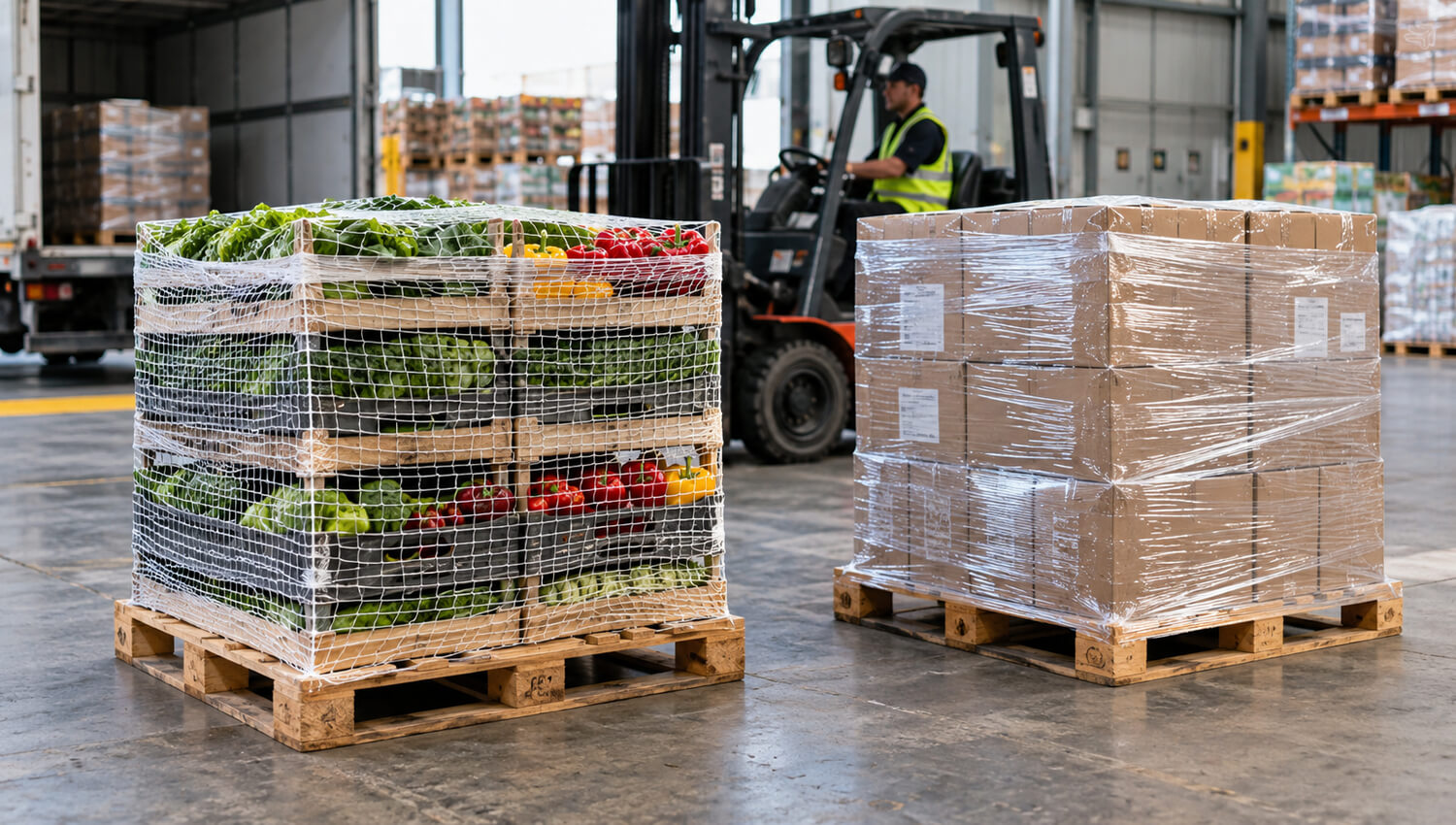
Pallet netting is generally better for products that need airflow, such as fresh produce, flowers, and ventilated agricultural goods. Regular stretch film is often better for dry cartons and products that need protection from dust and light moisture exposure. Neither material is better for every shipment. Your choice should depend on load stability, ventilation, wrapping cost, transport conditions, and product protection requirements.
For purchasing managers and packaging distributors, this decision affects more than the cost of wrapping materials. Poor packaging can cause shifting loads, damaged cartons, condensation, and rejected shipments.
A lower-priced roll may even become the more expensive option when you consider material use and product losses.
The challenge is finding the right balance between protection and operating cost.
For example, a fresh vegetable exporter may need continuous airflow during transportation. A warehouse shipping sealed electronics cartons may instead prioritize dust protection and secure pallet handling.
These two businesses need different packaging solutions.
In this guide, we’ll compare the materials from a practical B2B purchasing perspective. We’ll examine how each product performs, where it works best, and what buyers should check before placing a bulk order.
You’ll also learn how to compare supplier quotations, calculate packaging costs, and evaluate product specifications.
The goal is simple: help you choose packaging that protects your products while supporting efficient warehouse operations.
Pallet Netting
Pallet netting is an open-mesh wrapping material used to secure goods on pallets during storage and transportation. Unlike solid plastic film, its mesh structure allows air to pass through wrapped products.
This makes it useful for applications where ventilation matters.
What Is It Made From?
Many commercial pallet nets use knitted polyethylene structures. HDPE is common in some industrial netting products, while other designs use different polymer formulations.
Material selection depends on the strength, flexibility, and stretching performance required.
The mesh contains connected strands with open spaces between them. These openings allow airflow while the strands help restrain the load.
Important product characteristics include:
- Polymer type and material formulation
- Mesh opening size
- Roll width and usable length
- Net weight per running meter
- Elongation and elastic recovery
- Tensile strength and tear resistance
- Roll core dimensions
You should request actual test results rather than relying only on general product descriptions.
How Does Pallet Net Wrap Work?
When applied around stacked products, the net creates tension across the pallet.
This tension helps limit movement during handling and transportation.
Its open structure also allows heat and moisture vapor to escape more easily than a continuous plastic sheet.
However, the net isn’t a weatherproof cover. Water, dust, and small particles may pass through its openings.
Common Industrial Applications
Breathable pallet wrapping is frequently considered for:
- Fresh fruit and vegetable shipments
- Agricultural produce crates
- Flowers and nursery plants
- Ventilated food distribution
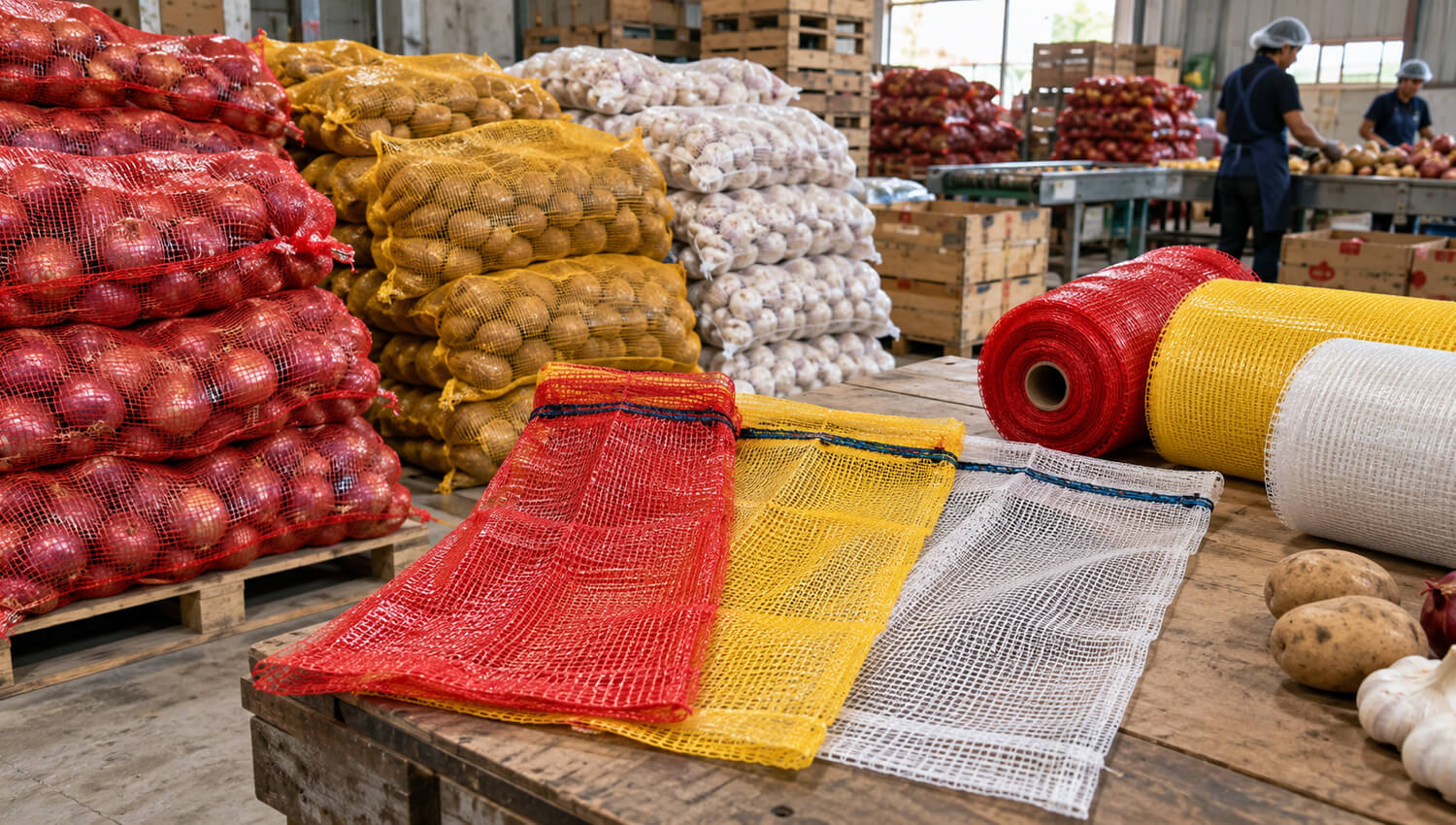
- Certain bagged agricultural products
- Goods requiring post-packaging cooling
For buyers sourcing packaging in large quantities, product consistency matters as much as the raw material.
Rolls should deliver predictable dimensions and stretching behavior from one production batch to another.
An inconsistent net may perform well during a small sample test but create problems when used across hundreds of pallets.
For this reason, reliable specifications and lot-level quality checks are important parts of the purchasing process.
Pallet Netting vs Stretch Film: Which Is Better?
Both products help secure palletized goods, but their structures create different advantages.
A knitted net uses connected plastic strands with open spaces. Conventional stretch film uses a continuous plastic sheet, commonly made from linear low-density polyethylene (LLDPE).
Stretch film can conform closely to stacked cartons and create a barrier against dust and some surface moisture.
A net allows much more airflow but does not provide the same surface coverage.
The following table summarizes the main differences.
Pallet Wrapping Material Comparison
| Característica | Pallet Net Wrap | Regular Stretch Film |
|---|---|---|
| Material structure | Open knitted mesh | Continuous plastic film |
| Common polymer | HDPE or other PE grades | LLDPE |
| Ventilation | High | Very limited |
| Moisture vapor escape | Easier | Restricted |
| Dust protection | Limited | Better |
| Water resistance | Open to water entry | Better surface barrier, not waterproof |
| Load containment | Depends on net strength and tension | Depends on film strength, stretch, and tension |
| Product visibility | Generally clear through openings | Depends on film transparency |
| Material consumption | Application-dependent | Application-dependent |
| Aplicación | Manual or compatible machine | Manual or machine |
| Suitable products | Ventilated or moisture-releasing goods | Dry goods and sealed cartons |
| Unit cost | Depends on mesh and specifications | Depends on gauge, grade, and quantity |
Understanding the Main Trade-Off
The key difference is ventilation versus surface coverage.
For fresh produce, airflow may protect product quality and support cooling. For packaged industrial goods, surface coverage may be more important.
Yet the material alone doesn’t determine safety.
A poorly wrapped netted pallet can fail during transport. The same is true for a pallet secured with insufficient stretch film.
Both materials must be tested under realistic loading conditions.
What About Vented Stretch Film?
There is also a third option: perforated stretch film.
This product combines a continuous film structure with ventilation holes.
It may offer a useful compromise when you need some airflow but want more surface coverage than an open mesh.
However, its breathability depends on hole size, spacing, film overlap, and wrapping pattern.
The choice should follow the product’s actual shipping requirements, not only the wrapping material’s appearance.
For most B2B buyers, a practical trial with representative pallets is the most reliable way to compare performance.
How Do Ventilation and Moisture Protection Compare?
Ventilation is one of the most important differences between breathable mesh wrapping and conventional plastic film.
This is especially relevant when shipping fresh agricultural products.
Fruits, vegetables, and flowers can continue releasing heat and moisture after harvesting. Their packaging needs depend on the product, temperature, and distribution process.
When airflow is restricted, warm and humid air may collect around the load.
If a surface becomes cooler than the surrounding air’s dew point, condensation can form.
Excess moisture may contribute to damaged cartons, wet labels, and conditions that encourage spoilage.
Why Airflow Matters for Fresh Produce
Open-mesh wrapping allows air to move through the pallet’s sides.
This can support refrigerated storage and forced-air cooling processes when the cartons and pallet arrangement also permit airflow.
Consider two pallets of freshly harvested vegetables.
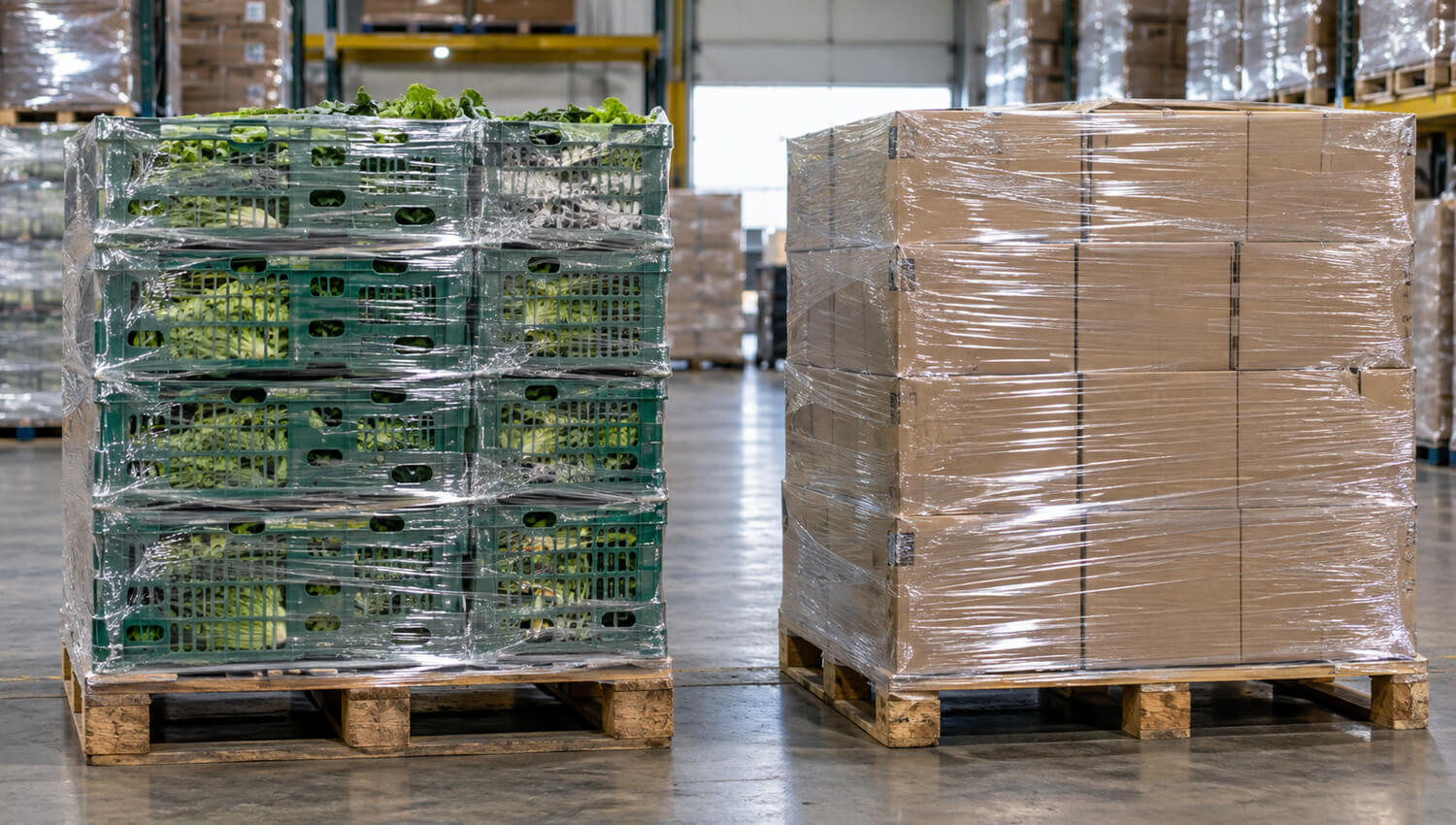
The first uses tightly overlapping conventional plastic film. The second uses breathable mesh wrap.
If both pallets have ventilation openings in their cartons, the second pallet may allow better lateral airflow.
However, cooling performance still depends on carton design, stacking patterns, air pressure, and refrigeration conditions.
A breathable outer wrap cannot correct poorly ventilated boxes.
When Stretch Film Offers Better Protection
Regular film has a clear advantage when surface protection matters.
It helps reduce direct dust contact and provides a barrier against some splashes.
This is useful for:
- Sealed retail cartons
- Printed packaging boxes
- Dry industrial components
- Finished consumer products
- Goods stored in relatively dusty warehouses
Film should not be treated as a complete waterproof system. Water can still enter through uncovered pallet surfaces, damaged film, or openings between layers.
Comparison of Moisture-Related Risks
Relative material characteristics

Illustrative qualitative comparison, not measured laboratory data. Actual performance depends on material construction and application.
Buyer recommendation: If your products release heat or moisture, evaluate ventilation first. If your goods are dry and sensitive to external contamination, prioritize surface protection.
When both properties are important, request samples of vented film as well as mesh wrapping.
Which Material Provides Better Pallet Load Stability?
Pallet load stability is a basic requirement for safe transportation.
Your wrapping material must help keep products together during forklift movements, loading, braking, and vibration.
However, the ability to hold a pallet securely depends on more than material thickness.
It also depends on tension, overlap, wrapping pattern, friction between products, and the pallet’s overall shape.
How Mesh Wrapping Holds a Load
A knitted net holds goods through tension carried by connected strands.
The strands can adjust around the pallet’s corners and sides.
Some netting products have good elastic recovery, allowing them to maintain tension after application.
Others have less recovery and may lose tension if the load settles.
You should therefore ask for measurable elongation and tension-retention data.
A net that stretches easily isn’t automatically stronger.
Its ability to restrain a shipment depends on the complete mesh design.
How Conventional Film Holds a Load
Stretch film uses overlapping layers of stretched plastic to create containment force.
When applied correctly, its elastic recovery helps keep cartons together.
The wrapping cycle normally includes stronger reinforcement near the pallet’s bottom.
The amount of film stretch must remain within the material’s recommended operating range.
Excessive stretching may weaken the film or increase the chance of breakage.
How Should Load Stability Be Tested?
For repeatable evaluation, buyers can consider recognized pallet testing methods.
The ASTM D5415 load-containment vibration test compares stretch-film performance under simulated transport vibration. The standard also states that laboratory results are not directly correlated with all field conditions.
For a practical comparison, test both materials on the same pallet design.
Record the following:
- Pallet dimensions and gross weight
- Package type and stacking pattern
- Applied wrapping tension
- Number of rotations or layers
- Material consumption
- Load displacement after testing
- Film breaks or net damage
The test should include representative handling and shipping conditions.
For heavy, unstable, or high-value goods, extra containment measures may also be necessary.
These can include edge protectors, strapping, anti-slip sheets, and improved pallet stacking.
The stronger material is not always the safer system. The safest choice is the one that maintains adequate containment on your actual load.
Pallet Wrapping Cost: Price per Roll vs Cost per Pallet
Purchasing departments often begin by comparing supplier quotations.
This makes sense, but the price per roll can be misleading.
Two rolls may differ in width, length, weight, usable material, and wrapping efficiency.
One supplier may offer a lower purchase price but require more material to secure each pallet.
Another product may cost more per roll yet reduce material consumption or product losses.
The better comparison is total packaging cost per shipped pallet.
How to Calculate Material Cost per Pallet
Use the following formula:
Material Cost per Pallet = Roll Purchase Price / Pallets Wrapped per Roll
Then include labor, waste, equipment, and damage-related expenses.
Total Cost per Pallet = Material + Labor + Waste + Equipment + Expected Damage Cost
Example: Comparing Packaging Costs
The following figures are hypothetical. They show how a purchasing manager can evaluate two options.
| Cost factor | Mesh Wrap | Stretch Film |
|---|---|---|
| Material purchase price per roll | $24.00 | $18.00 |
| Pallets wrapped per roll | 40 | 24 |
| Material cost per pallet | $0.60 | $0.75 |
| Labor cost per pallet | $0.20 | $0.25 |
| Estimated waste handling | $0.03 | $0.05 |
| Total before damage costs | $0.83 | $1.05 |
In this example, mesh wrapping costs $0.22 less per pallet.
For 10,000 pallets, that represents a potential operating difference of $2,200 before other costs.
But this is not a universal saving.
Your actual results may be very different.
What Else Should B2B Buyers Include?
Importers and distributors should consider landed cost rather than factory price alone.
This includes freight, customs charges, warehousing, and local delivery.
For machine-wrapping operations, consider equipment adjustments and downtime as well.
A product that performs poorly on your wrapping machine can erase any material savings.
The best purchasing approach is to run a controlled trial, record consumption, and compare the complete cost.
Ask your supplier to quote the same specifications and delivery terms so the comparison remains fair.
Which Industries Benefit Most From Each Packaging Material?
Different industries have different pallet protection requirements.
A refrigerated vegetable shipment does not face the same risks as a pallet of boxed electrical products.
Your choice should reflect the goods, packaging design, storage environment, and distribution route.
Agriculture and Fresh Produce
Fresh produce is one of the clearest applications for breathable pallet wrapping.
Fruits and vegetables may need continued ventilation during cooling, storage, and transport.
Open-mesh wrap can help avoid blocking ventilation holes in crates and cartons.
It is particularly worth evaluating for produce packed in ventilated plastic crates.
However, different crops have different temperature and humidity needs.
A solution suitable for potatoes may not be appropriate for delicate berries.
Always check the product’s recommended postharvest conditions.
Flowers and Nursery Products
Plants and flowers can be sensitive to heat buildup and poor air circulation.
Breathable wrapping may allow better ventilation around shipping containers.
Yet the wrap must not damage fragile stems, leaves, or flowers.
Suppliers should confirm that the net openings and applied tension suit the shipment.
Industrial and Manufacturing Goods
Industrial businesses frequently ship metal parts, plastic components, and packaged machinery accessories.
For sealed cartons, conventional film may offer useful surface protection.
For certain products that need cooling after production, breathable packaging may be worth considering.
The correct choice depends on the packaging, not simply the industry name.
Retail and E-Commerce Distribution
Retail distribution centers often handle uniform cartons with printed labels.
Regular stretch film can provide useful containment and reduce dust exposure.
Transparent film also allows many labels to remain visible.
For mixed-size cartons, either material may work if the load is properly stabilized.
Industry Selection Table
| Industry or shipment | Initial recommendation | Main reason |
|---|---|---|
| Fresh vegetables in ventilated crates | Mesh wrap | Air circulation |
| Cut flowers | Mesh wrap | Ventilation |
| Nursery plants | Mesh wrap | Reduced airflow restriction |
| Dry retail cartons | Regular film | Surface coverage |
| Boxed electronics | Regular film | Dust protection |
| Sealed industrial components | Regular film | General containment |
| Cooling-sensitive goods | Evaluate mesh or vented film | Airflow requirements |
| Heavy irregular equipment | Engineered containment system | Load safety |
These recommendations are starting points, not guaranteed outcomes.
For export shipments, conduct an application trial before changing materials across the entire operation.
How Do Manual and Machine Wrapping Methods Compare?
Application efficiency can have a major impact on packaging costs.
A product that works well during manual wrapping may not behave the same way on an automatic machine.
Before purchasing, you should check whether the material matches your current equipment and operating process.
Manual Pallet Wrapping
Manual wrapping is common in smaller warehouses and operations with changing pallet sizes.
Workers typically secure the wrapping material near the base, move around the pallet, and apply tension as they wrap upward.
Hand stretch film is widely available and familiar to most warehouse teams.
Mesh wrap can also be applied manually, but its handling properties depend on the net construction.
Some products are easy to stretch and secure. Others may require greater care to maintain consistent tension.
For either material, operators should avoid excessive strain and unsafe wrapping positions.
A suitable dispenser may improve consistency and reduce physical effort.
Machine Pallet Wrapping
Automatic and semi-automatic machines offer more repeatable wrapping cycles.
These systems are useful when businesses process hundreds of pallets each day.
However, not every machine designed for solid film can handle knitted mesh without adjustment.
Before changing materials, check:
- Roll width and outside diameter
- Core inside diameter
- Roll weight
- Film carriage compatibility
- Pre-stretch mechanism
- Tension control settings
- Material cutting and clamping systems
- Recommended operating speed
Some pallet nets work with specialized or modified wrapping equipment.
Do not assume universal machine compatibility.
Which Application Method Is More Efficient?
Efficiency depends on the complete operation.
For example, a warehouse wrapping 15 pallets per day may find manual application sufficient.
A distribution center handling 800 pallets daily may benefit from automated wrapping.
These are examples of operating volumes, not equipment selection limits.
Machine uptime, material changes, and operator training all affect productivity.
When comparing materials, conduct timed trials using the same pallet type.
Measure actual wrapping time, roll changes, material breaks, and rework.
A material that performs consistently at production speed may offer greater value than one with a slightly lower purchase price.
For manufacturers and wholesale buyers, machine compatibility should be confirmed during product development and sampling, not after the bulk shipment arrives.
Environmental Impact and Packaging Waste Management
Environmental performance is becoming an important purchasing consideration.
Many international buyers want to reduce unnecessary packaging while maintaining product protection.
Both conventional stretch film and plastic mesh wrapping can be made from polyethylene-based materials.
Their environmental impact depends on material consumption, production processes, transport, collection, and end-of-life treatment.
A breathable design does not automatically make a product more sustainable.
Can Open-Mesh Wrapping Reduce Plastic Consumption?
It may reduce material consumption in certain applications.
Because mesh wrap contains open spaces, it can provide a different material distribution across the pallet.
However, netting thickness, strand density, elongation, and wrapping requirements influence the final amount used.
A lightweight net requiring many turns may not outperform an optimized thin film.
The correct comparison is the actual mass of packaging used per successfully shipped pallet.
You should also consider whether one material results in more damaged products.
Product waste can carry significant environmental and financial costs.
Are Both Materials Recyclable?
Polyethylene materials can be mechanically recycled where suitable collection and processing systems exist.
However, recyclability in theory is not the same as recycling in practice.
Stretch film may be accepted by commercial film-recycling programs when clean and properly separated.
Used mesh can be more difficult to process in some recycling systems because strands may tangle in equipment.
Buyers should ask their local recycling provider whether the exact packaging format is accepted.
Avoid making broad claims such as “100% environmentally friendly” without supporting evidence.
What Should European Importers Consider?
The European Union’s Packaging and Packaging Waste Regulation, Regulation (EU) 2025/40, introduces packaging requirements with phased implementation.
Buyers should check obligations relevant to their packaging format, business role, and implementation date.
The European Commission’s packaging waste guidance provides current information on the regulation and related guidance, including provisions concerning pallet wrapping and straps.
Practical Sustainability Checklist
For wholesale procurement, request data on:
- Net or film weight per roll
- Material use per pallet
- Polymer identification
- Recycled content, if applicable
- Recyclability claims and supporting evidence
- Packaging of the finished rolls
- Scrap handling during manufacturing
Choose measurable results over general environmental marketing claims.
How to Choose a Reliable Pallet Wrapping Manufacturer?
For importers and distributors, choosing the correct material is only the first step.
The manufacturer must also deliver consistent quality, accurate specifications, and reliable shipments.
A sample that performs well is useful, but production consistency matters much more when ordering at scale.
What Technical Specifications Should You Request?
Ask suppliers for a written product specification before comparing quotations.
For mesh wrapping, this should include polymer type, roll dimensions, mesh structure, tensile properties, and intended use.
For conventional film, useful details include polymer formulation, nominal thickness, elongation, puncture resistance, and recommended wrapping conditions.
Sample Product Specification Checklist
| Parameter | What buyers should confirm |
|---|---|
| Raw material | Polymer grade and formulation |
| Roll width | Nominal width and tolerance |
| Roll length | Usable length and measurement method |
| Net weight | Weight per meter or roll |
| Film thickness | Nominal gauge and tolerance |
| Tensile properties | Test method and results |
| Elongation | Test conditions and performance |
| Roll core | Inner diameter and material |
| Embalaje | Rolls per carton or pallet |
| Control de calidad | Batch identification and inspection records |
| OEM service | Labels, core printing, carton branding |
| Shipping | MOQ, production lead time, and Incoterms |
Why Quality Control Matters
Packaging quality should be checked throughout manufacturing.
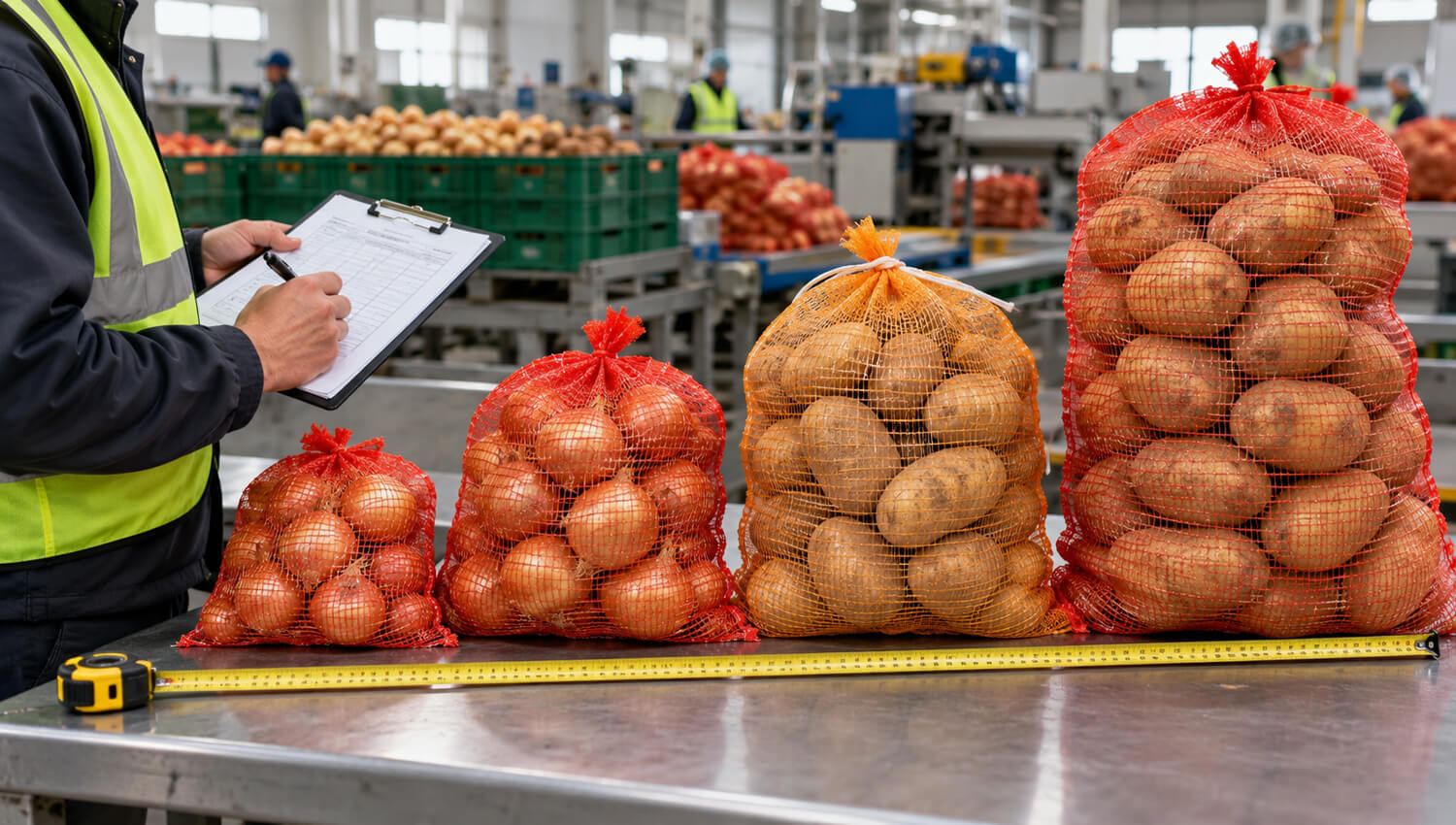
For knitted mesh products, manufacturers may inspect strand consistency, mesh dimensions, roll width, and roll winding quality.
For conventional stretch film, inspection may cover thickness variation, film defects, winding tension, and mechanical properties.
Buyers should ask which tests are conducted on every batch and which are performed periodically.
A supplier should also explain how rejected materials are identified and controlled.
ASTM D4649 provides guidance on selecting, specifying, and using stretch films for palletizing and unitizing. It can support discussions between buyers and sellers when developing product specifications.
OEM and Private Label Opportunities
Distributors may need products customized for their markets.
Possible requirements include:
- Custom roll dimensions
- Different material constructions
- Private-label packaging
- Carton label customization
- Barcode and product identification
- Market-specific packaging information
Not every manufacturer offers every option.
Confirm customization capabilities, minimum quantities, and any development costs before placing an order.
What Should You Ask Before Ordering?
A well-prepared inquiry helps the manufacturer recommend a suitable product.
Provide your pallet size, load weight, application method, shipping conditions, and expected order volume.
If possible, include photographs of the packaged products.
You can also share existing material specifications and explain why you want to change suppliers or packaging types.
B2B Buying Tip: Request a trial roll or production sample before committing to a large order. Compare performance under actual warehouse conditions and document the results.
A reliable manufacturer should help you select a material that matches your needs, even when that means recommending an alternative product.
Preguntas frecuentes
Is pallet mesh wrapping stronger than regular stretch film?
Not necessarily. Strength depends on material construction, tensile properties, wrapping tension, and pallet design. A quality mesh wrap can secure suitable loads effectively, but properly applied stretch film may perform better for other loads. Compare both using representative transport tests.
Can breathable pallet wrap prevent condensation?
It can reduce airflow restrictions and help moisture vapor escape. However, it cannot guarantee that condensation will not occur. Temperature changes, product moisture, carton ventilation, and refrigeration conditions still influence condensation risk during storage and shipping.
Can I use pallet net wrap on an automatic wrapping machine?
Some automatic machines can handle mesh material, while others need adjustments or specialized components. Check the roll dimensions, carriage design, tension settings, and cutting system. Ask the material manufacturer and equipment supplier to confirm compatibility before production trials.
Which material is more economical for large-volume packaging?
The answer depends on material consumption, cost per roll, labor, machine performance, and product damage rates. Calculate total cost per successfully shipped pallet. A more expensive roll may still offer savings when it wraps more pallets or reduces handling losses.
Is stretch film suitable for fresh fruit and vegetables?
Conventional film may restrict ventilation around produce pallets, especially when applied over crate openings. Breathable mesh or perforated film may be more suitable. However, the correct material depends on crop type, cooling requirements, packaging design, and shipping conditions.
Can pallet wrapping netting be recycled?
Many polyethylene-based net products are technically recyclable, but actual acceptance depends on local recycling facilities. Some processors may have difficulty handling loose mesh strands. Ask your recycler about the specific material and collection format before making recycling claims.
What specifications should I send to a pallet wrapping supplier?
Provide the pallet dimensions, shipment weight, product category, required ventilation, wrapping method, and estimated annual volume. Existing roll specifications and packaging photographs are also useful. These details help suppliers recommend suitable materials and prepare more accurate quotations.
Is HDPE or LLDPE better for pallet wrapping?
Neither polymer is universally better. HDPE is used in many knitted net structures, while LLDPE is widely used in stretch films. Final performance depends on polymer grade, material design, processing method, and application requirements, not the polymer name alone.
Can breathable mesh replace stretch film for every shipment?
No. Mesh is particularly useful when airflow is important, but it does not create a continuous protective surface. Products requiring dust protection or resistance to direct water exposure may benefit more from conventional film or another protective packaging system.
Conclusion: Choosing the Right Pallet Packaging Solution
Choosing between breathable mesh wrapping and conventional stretch film is not simply a matter of price.
Both materials offer useful benefits, but they solve different packaging problems.
For produce exporters and other businesses handling ventilation-sensitive products, open-mesh wrapping can help maintain airflow around palletized goods.
For dry packaged products, regular stretch film often offers practical containment and better surface protection.
The correct choice depends on your products and distribution process.
Before switching materials, compare seven essential factors: ventilation, moisture protection, load stability, packaging cost, industry suitability, application efficiency, and environmental impact.
Then test the shortlisted products on actual pallets.
A controlled comparison can reveal differences that are not obvious from supplier catalogs.
You may discover that a new wrapping material reduces consumption. You may also find that your current material already provides the best balance of cost and protection.
Both outcomes are useful because they support better purchasing decisions.
Request a Pallet Wrapping Quotation From a Manufacturer
Are you sourcing pallet net wrap or stretch film for wholesale distribution, agricultural packaging, or industrial shipping?
Send us your product requirements so we can review the suitable material and specifications.
For an efficient quotation, please include:
- Product application and destination market
- Required roll width and length
- Pallet dimensions and average load weight
- Manual or machine wrapping requirements
- Expected order quantity and purchasing frequency
- OEM or private-label requirements
Contact our sales team to discuss product specifications, sample availability, bulk pricing, and OEM packaging options.
 Spanish
  English
  Russian
  Portuguese
  Arabic
  French
  Indonesian