
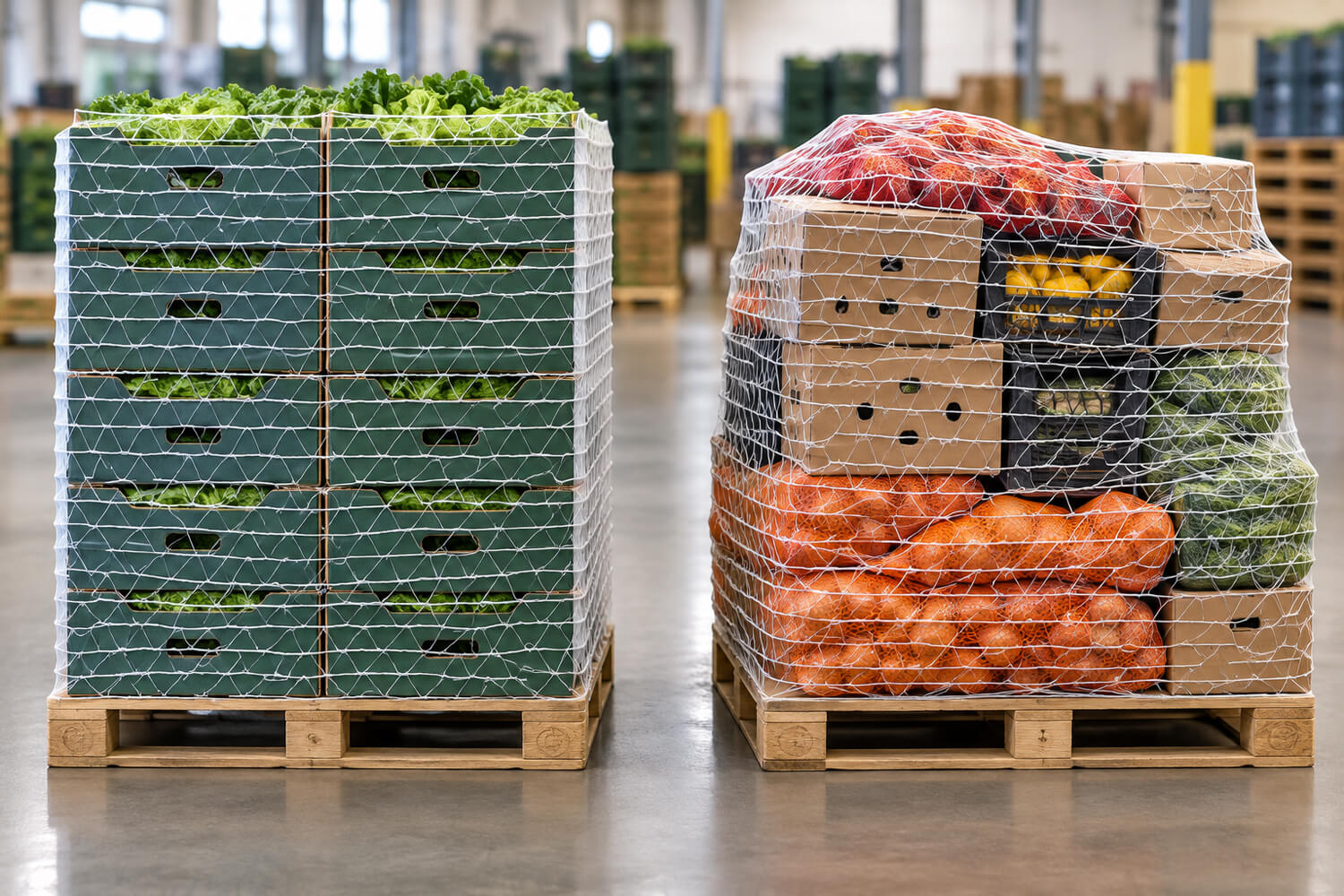
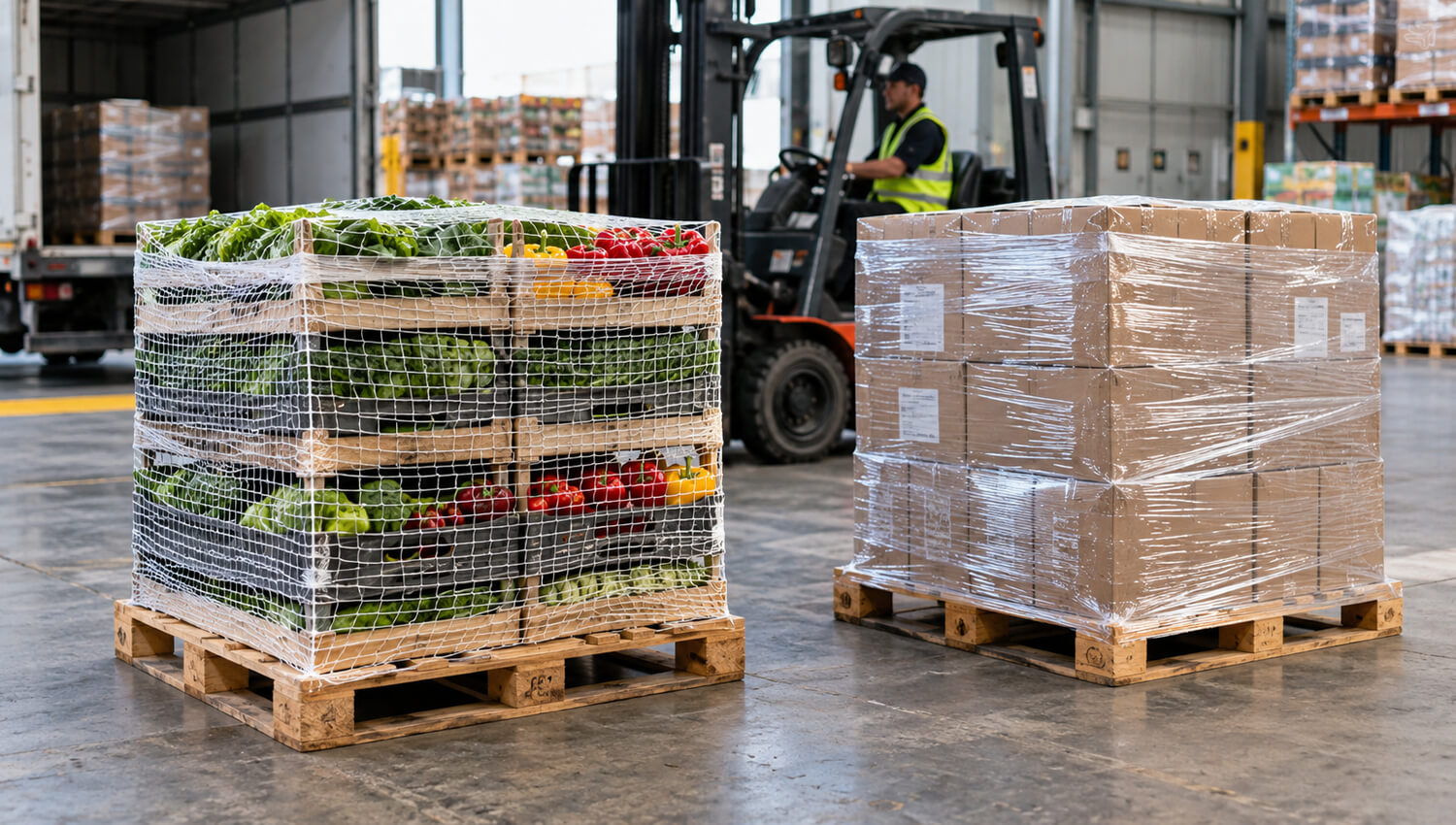
Standard pallet netting provides breathable load containment with limited stretch, while elastic pallet netting stretches around products and recovers to maintain tension. Both allow airflow around palletized goods. The main difference is how they respond to load movement. Standard netting suits stable, uniform loads. Elastic netting often suits irregular or settling loads that need flexible containment during storage and transportation.
For buyers, choosing the right pallet wrap affects more than the packaging budget. It can influence damaged shipments, warehouse productivity, wrapping efficiency, and customer satisfaction.
Imagine preparing hundreds of pallets of fresh vegetables for export. The goods need airflow, but the stacked boxes must also remain secure. Traditional plastic stretch film may restrict ventilation. An unsuitable mesh wrap may leave too little holding tension.
This is where choosing the correct pallet net becomes important.
Both standard and stretchable netting can solve common ventilation problems. However, their mechanical behavior is different. That difference becomes important when pallets contain uneven cartons, loose packages, or products that settle during delivery.
This guide explains seven essential differences between these products. You’ll also learn about raw materials, technical specifications, packaging costs, and supplier selection.
Whether you purchase pallet net wrap for your own operations or distribute it to customers, the goal is simple: choose a product that works reliably and delivers measurable value.
Elastic Pallet Netting: What Is It and How Does It Work?
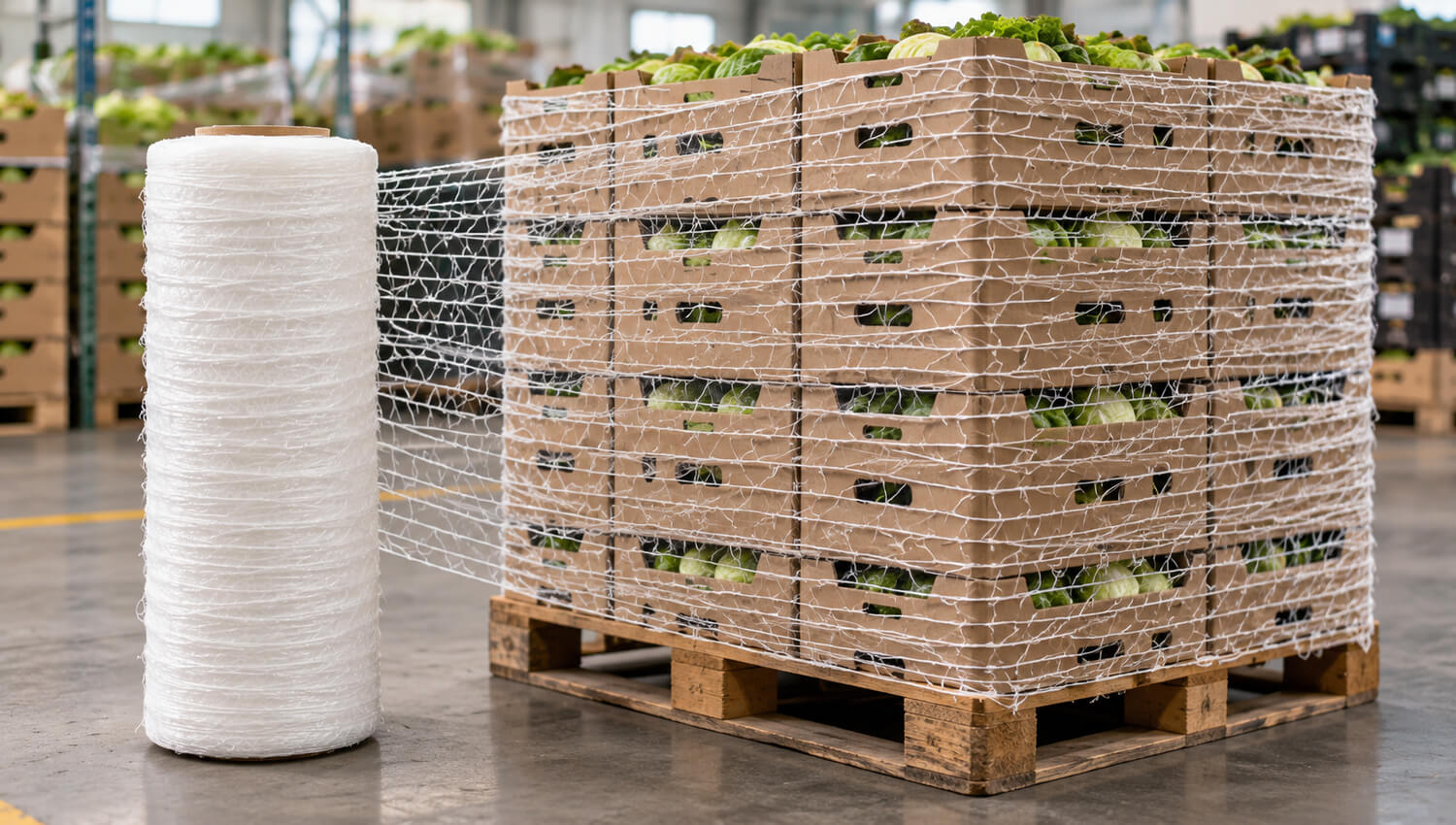
Elastic pallet netting is an open-mesh packaging material designed to stretch around palletized products. Its structure allows air to move through the wrapping while helping hold goods together.
Unlike a solid plastic film, pallet net wrap contains many open spaces between its strands. This makes it suitable for products that require ventilation during handling, storage, or transportation.
The elastic version has an additional property: it can extend under tension and recover part of its original shape when that tension decreases.
How Does the Stretching Mechanism Work?
When you pull stretchable netting around a pallet, the material elongates. This creates tension around the load.
After wrapping, the net attempts to recover. That recovery helps maintain pressure against cartons, crates, and other packages.
The actual holding force depends on several factors:
- The material formulation and net construction.
- The amount of stretch applied during wrapping.
- The size, weight, and shape of the pallet load.
- The number of wrapping passes and their overlap.
- The level of tension retained after application.
An important distinction is that elongation and recovery are not the same measurement.
A material may stretch considerably but retain less holding force than expected. That’s why buyers should request more than a simple stretch percentage.
What Makes It Different from Ordinary Pallet Wrap?
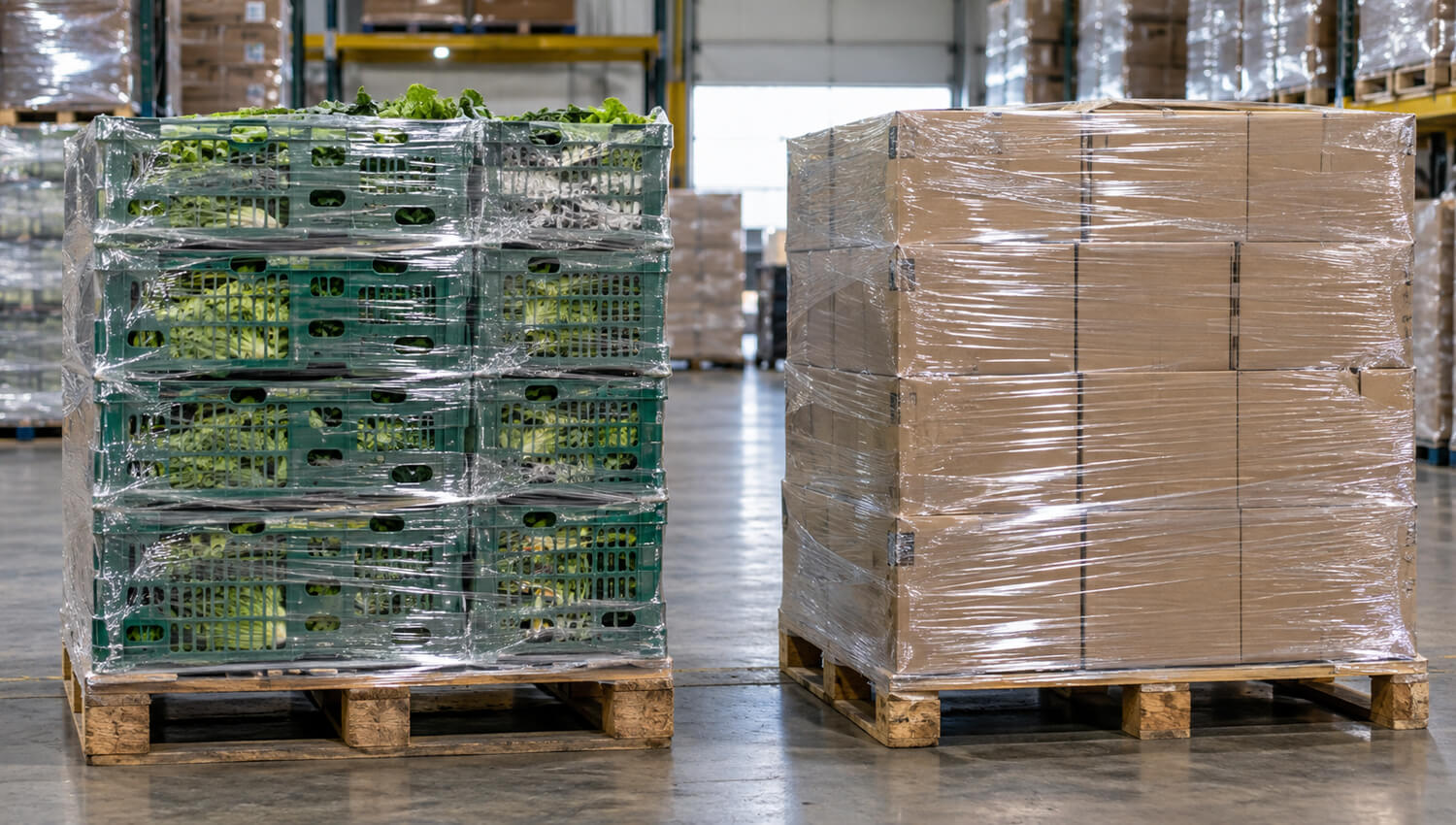
Ordinary stretch film forms a mostly continuous plastic layer. It can protect goods from dust and incidental surface moisture.
Open-mesh netting serves a different purpose. It provides containment while leaving much of the load exposed to surrounding air.
This design can be useful for:
- Fresh vegetables and fruit packed in ventilated crates.
- Nursery plants and flowers.
- Goods packed while warm.
- Agricultural products that release moisture.
- Industrial loads requiring airflow or easy inspection.
However, open mesh doesn’t protect against rainfall or dust in the same way as solid film.
The choice depends on your application.
Why Does Elastic Recovery Matter?
Some pallet loads change shape during handling.
Cartons may settle slightly. Irregular packages may move closer together. Vibration can also change the distribution of tension.
An elastic material can respond to some of these changes by recovering part of its stretched length.
That doesn’t guarantee the load will remain stable in every situation. Still, it offers a useful advantage when correctly matched to the pallet and applied with suitable tension.
For commercial buyers, the key is to evaluate stretch performance together with actual pallet stability.
Standard vs Elastic Pallet Netting
Although these products look similar, their behavior during wrapping and transportation can differ considerably.
Standard pallet netting is generally designed for fixed-dimension containment. It has limited elastic recovery compared with specially engineered stretchable products.
The elastic version is designed to extend and recover under tension.
Both are available in different materials, constructions, mesh patterns, and roll formats.
Seven Essential Differences at a Glance
| Feature | Standard Pallet Netting | Elastic Pallet Netting |
|---|---|---|
| Material behavior | Limited stretch and recovery | Designed for controlled elongation and recovery |
| Load conformity | Works well with uniform shapes | More adaptable to uneven shapes |
| Retained tension | Depends heavily on initial wrapping | Recovery can help maintain tension |
| Air circulation | Open mesh allows airflow | Open mesh allows airflow |
| Wrapping method | Manual or compatible machine | Manual or compatible machine |
| Material consumption | Depends on coverage and wrapping passes | Stretch may improve usable coverage |
| Typical purchasing priority | Fixed containment and cost control | Flexibility and load conformity |
Performance depends on individual product construction and wrapping conditions. Neither product type guarantees load stability without testing.
Load Shape and Wrapping Flexibility
Uniform pallets are easier to wrap because their corners and sides provide predictable contact points.
A fixed-dimension net can work effectively when boxes are stacked neatly and the load remains stable.
Irregular products create a different challenge.
Consider a pallet containing flower buckets or mixed-size agricultural crates. The sides aren’t perfectly flat. A less flexible net may bridge some gaps rather than following the load’s contours.
A stretchable net can conform more closely to these areas.
This may provide more consistent contact, although sharp corners and excessive stretching can still cause damage.
Performance During Transportation
Pallets experience vibration, acceleration, braking, and handling impacts.
These forces can make stacked products lean or shift.
Elastic recovery may help a properly wrapped load retain some containment as its dimensions change. Standard netting relies more heavily on the tension established during wrapping and the stability of the original stack.
However, neither material should be treated as a complete cargo-securing system by itself.
Pallet design, friction, stacking arrangement, and transport restraints also matter.
Purchase Price Versus Practical Value
Standard netting may offer a lower quoted roll price, depending on material and construction.
Elastic grades may cost more because of their formulation and performance requirements.
Yet roll price alone doesn’t tell you which product is more economical.
A stretchable roll may cover additional pallet surface at a given nominal length. On the other hand, excessive stretching can reduce mesh coverage or compromise holding force.
The correct comparison is cost per securely packaged pallet.
For importers and distributors, this distinction helps prevent purchasing decisions based on incomplete specifications.
Materials and Manufacturing Processes
The performance of pallet net wrap starts with its raw materials. Two products may have similar colors and mesh patterns but behave differently under tension.
For manufacturers and wholesale buyers, understanding the production process helps explain these differences.
Which Raw Materials Are Commonly Used?
High-density polyethylene (HDPE) is commonly used in standard knitted pallet netting. It offers useful tensile properties, chemical resistance, and low weight.
Some elastic products use modified polyethylene formulations or specially engineered stretchable polymers.
The raw material alone doesn’t determine elasticity. Yarn structure, polymer formulation, knitting pattern, and production conditions all affect finished performance.
For example, manufacturers offer standard HDPE netting alongside elastic products with different polymer formulations and stretch characteristics.
When discussing specifications with a supplier, ask for the exact polymer grade and relevant performance data. Don’t assume that every HDPE net behaves identically.
How Is Knitted Pallet Net Wrap Manufactured?
A typical production process includes several stages.
Typical manufacturing workflow
Raw Material Preparation
Polymer selection and formulation control
Yarn Extrusion
Production of strands with controlled dimensions
Knitting and Mesh Formation
Creation of the open-net structure
Inspection and Winding
Width, appearance, weight, roll tension, and performance checks
Packaging and Shipment
Labeling, protection, and batch identification
Production control is especially important for stretchable products.
Uneven yarn properties may lead to inconsistent extension across the roll. Irregular mesh construction can also affect width retention and load coverage.
What Should Buyers Check During Factory Evaluation?
A useful supplier evaluation should include actual production samples.
Check the uniformity of the knitted structure. Look for broken strands, irregular openings, and inconsistent roll edges.
Then ask how the manufacturer checks mechanical performance.
Important questions include:
- Is roll width inspected during production?
- Are net weight and roll length controlled?
- Is elongation measured using a documented method?
- Are retained tension and recovery evaluated?
- Can production batches be traced to inspection records?
These questions help distinguish a product with consistent specifications from one sold mainly on appearance.
For repeat wholesale orders, consistency matters as much as the performance of the first sample.
Stretch Performance and Pallet Load Stability
Stretch performance affects how a net responds when you wrap it around products.
However, choosing the material with the highest elongation percentage isn’t always the right approach.
The real goal is to provide enough containment without damaging the packaged goods.
Understanding Elongation and Recovery
Elongation describes how much a material extends compared with its original length.
For example, a sample that extends from 100 cm to 130 cm has an elongation of 30%.
\[ \text{Elongation (\%)}=\frac{L_1-L_0}{L_0}\times100 \]
Where:
- \(L_0\) = original length
- \(L_1\) = length under applied tension
Several commercial elastic pallet nets advertise elongation ranges around 15%–50%, while some machine-grade products specify 40%–60%. These figures describe particular products, not an industry-wide requirement.
Recovery describes how much of that extension disappears after tension is reduced.
A product with good recovery may help maintain contact with packages that settle slightly.
How Does Wrapping Tension Affect the Load?
Wrapping tension must match the goods being packaged.
Too little tension may allow packages to move. Too much tension can deform cartons, damage produce, or create unstable stacking conditions.
This is especially important for delicate agricultural products.
For example, fresh fruit crates may need firm containment without excessive side pressure.
Industrial packages may tolerate greater wrapping force, but load stability still depends on their construction.
A practical wrapping trial should examine:
- Initial wrap tension.
- Number of passes.
- Overlap between passes.
- Movement after handling.
- Changes in pallet shape.
- Condition of the goods after transportation.
These checks help identify an effective wrapping configuration.
Why Is Load Stability Testing Important?
A netting roll may pass an individual tensile test while the finished pallet remains unstable.
That’s because pallet stability depends on the complete unit load.
The EUMOS 40509 standard describes a method for evaluating unit-load rigidity under dynamic conditions. It considers load deformation when acceleration forces are applied.
EUMOS
+1
This doesn’t mean a roll of netting is automatically EUMOS-certified.
Instead, it highlights why manufacturers and buyers should test completed pallet loads when transportation safety requires documented performance.
For high-value or difficult loads, consider testing under your actual packaging and transport conditions.
Breathability and Protection for Temperature-Sensitive Goods
Air circulation is one of the main reasons businesses choose pallet net wrap instead of solid plastic film.
Fresh produce, plants, and some warm-packed products benefit from an open wrapping structure.
Both standard and elastic netting provide ventilation. Their differences mainly concern how they fit and hold the load.
Why Does Ventilation Matter?
Some products continue releasing heat or moisture after packaging.
When air circulation is restricted, temperature and humidity can become difficult to manage.
Condensation may form under certain environmental conditions, particularly when warm goods meet cooler surfaces.
Open-mesh packaging allows air to pass through the sides of the pallet more easily.
This can support cooling, drying, and ventilation processes.
However, breathable wrapping cannot replace proper refrigeration or humidity control.
A poorly managed cold chain can still damage products, even when the packaging provides excellent airflow.
Applications for Fresh Produce and Horticulture
Breathable pallet netting is often used with products such as:
- Fresh vegetables packed in ventilated crates.
- Citrus fruit and other suitable packaged produce.
- Flowers and nursery plants.
- Agricultural goods requiring moisture release.
- Packaged products that must cool before shipment.
Stretchable netting can be useful when palletized products have uneven shapes.
For example, nursery plants may create irregular outer surfaces. A flexible mesh can follow those shapes more closely.
Standard netting may be sufficient for tightly stacked, uniform produce crates.
Does More Airflow Always Mean Better Product Protection?
Not necessarily.
Airflow requirements depend on the product, temperature, humidity, and transport method.
Some goods need controlled humidity to prevent moisture loss. Others require protection against airborne contamination.
An open net also allows dust and rainwater to reach the load.
Therefore, pallet netting should be considered part of the overall packaging system.
For fresh produce exporters, ventilation must work together with product packaging, cooling procedures, and transportation controls.
The correct product should help maintain the required conditions without creating new risks.
Applications: Which Pallet Net Wrap Fits Your Industry?
Different industries place different demands on pallet packaging.
The right material depends on load geometry, required airflow, movement during transport, and packaging equipment.
For buyers, matching product performance to the application often matters more than choosing the most expensive grade.
Agricultural and Fresh Produce Exporters
Agricultural exporters often use ventilated crates or boxes.
These packages may be stacked into uniform rectangular pallets.
Standard netting can work well when the stack remains stable and requires only modest containment.
Stretchable net wrap becomes more attractive when crates vary in size or the outer surface is uneven.
Buyers should check that the net provides sufficient holding force without deforming the containers.
Horticulture and Nursery Operations
Flowers and nursery products can create irregular pallet shapes.
Some loads also contain moisture, making airflow important.
Flexible netting may conform more closely to trays, plant containers, and mixed-height packages.
Still, wrapping shouldn’t press directly against fragile flowers or delicate leaves.
A suitable supporting structure may be needed to protect the products.
Industrial Warehousing and Distribution
Industrial pallets often carry cartons, plastic containers, or bagged goods.
For uniform packages, fixed-dimension netting may provide sufficient containment at an economical cost.
Mixed-size loads may benefit from elastic recovery.
However, heavy products require careful assessment.
Mesh netting isn’t automatically suitable for securing machinery, drums, or other high-mass items. Such loads may need additional restraints.
Beverage and Warm-Packed Goods
Some beverage and food-processing operations package products while they retain heat.
Open-mesh wrapping can help avoid sealing the pallet inside a continuous film layer.
The chosen net must still provide sufficient containment, especially when products are stacked in trays.
Application trials are important because heat, product weight, and package design affect wrapping performance.
Industry Selection Matrix
| Industry | Main Packaging Requirement | Suitable Starting Option |
|---|---|---|
| Fresh vegetable exporters | Airflow and crate containment | Standard or elastic |
| Flower and nursery suppliers | Ventilation and irregular-load conformity | Elastic |
| Beverage producers | Airflow and stable stacking | Test both |
| General warehousing | Predictable containment and cost | Standard |
| Mixed-carton distributors | Adaptability and tension retention | Elastic |
| Industrial packaging | Load-specific strength and security | Tested specification with added restraints where needed |
These recommendations are starting points, not guaranteed performance ratings.
A manufacturer should confirm the final specification through sample wrapping and application tests.
Packaging Cost Comparison and Long-Term Value
For purchasing managers, the lowest roll price doesn’t always produce the lowest packaging cost.
A better evaluation includes material consumption, labor, machine productivity, freight damage, and supply consistency.
This is particularly important when comparing products with different stretching properties.
Calculate the Cost per Wrapped Pallet
Consider two hypothetical products.
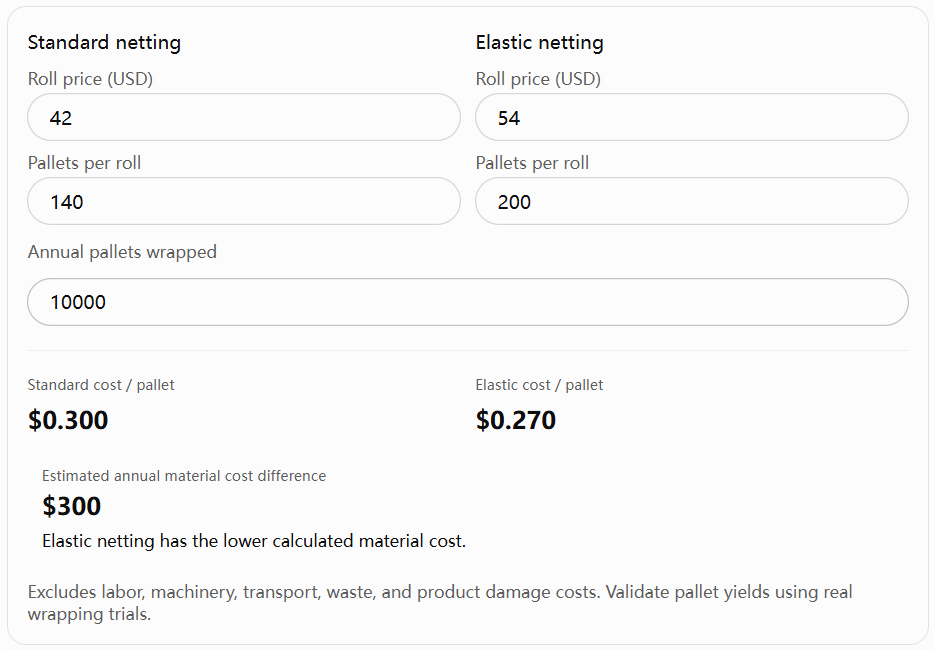
Standard netting costs $42 per roll and covers 140 pallets. A stretchable alternative costs $54 per roll and covers 200 pallets.
Illustrative calculation only — not actual factory quotations or guaranteed yields.
| Cost Factor | Standard Netting | Elastic Netting |
|---|---|---|
| Roll price | $42 | $54 |
| Pallets per roll | 140 | 200 |
| Material cost per pallet | $0.30 | $0.27 |
| Material cost for 10,000 pallets | $3,000 | $2,700 |
Illustrative Material Cost per 10,000 Pallets
Assumes equal wrapping performance and the hypothetical yields above.
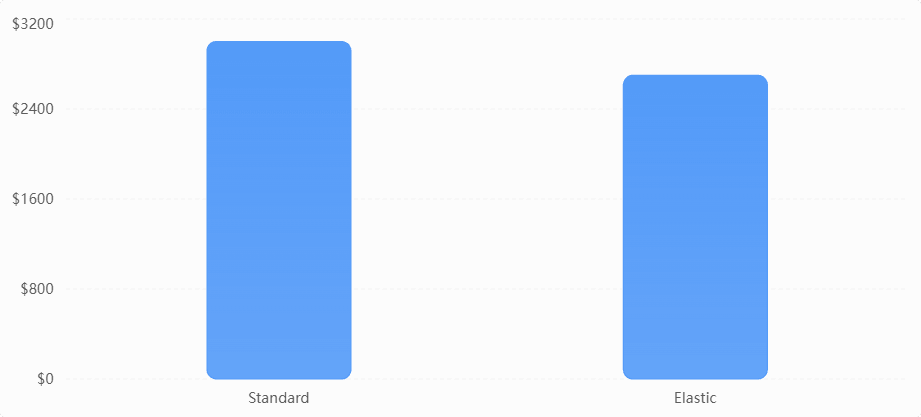
In this example, the stretchable product costs more per roll but less per pallet.
However, actual results may differ. Roll length, wrapping tension, mesh width, and load shape all affect usable coverage.
Calculate Your Own Packaging Costs
Use this calculator to estimate material cost per pallet based on your supplier’s quotation and your measured wrapping yield.
Consider Labor and Equipment Productivity
Material cost is only one component.
If a product requires additional wrapping passes, the operator may spend more time on each pallet.
Machine settings also affect productivity.
A netting grade that unwinds smoothly and maintains its width can help reduce interruptions. But an unsuitable grade may cause tearing or require frequent tension adjustments.
For large packing operations, even small changes in wrapping time can matter.
Evaluate Freight Damage and Waste
Damaged goods create costs beyond packaging materials.
They may lead to rejected shipments, rework, customer claims, and additional handling.
A more suitable net can help improve load containment. However, buyers should verify that improvement through real shipment data.
Compare similar pallets over a defined trial period. Record packaging consumption, wrapping time, and damage rates.
That provides stronger purchasing evidence than comparing roll prices alone.
Technical Specifications and Quality Control
Clear technical specifications help buyers compare suppliers fairly.
Without consistent measurements, two rolls described as identical may perform very differently.
A good quotation should identify both physical dimensions and relevant mechanical properties.
What Specifications Should You Request?
| Parameter | What to Confirm | Why It Matters |
|---|---|---|
| Material | HDPE, modified PE, or other specified grade | Affects mechanical behavior |
| Nominal width | Common examples include 300, 500, and 760 mm | Determines coverage |
| Roll length | Hand or machine roll specification | Affects order planning |
| Core diameter | Matching inside diameter | Ensures dispenser compatibility |
| Net weight | Net mass per unit area or length | Helps compare material usage |
| Mesh construction | Pattern and opening dimensions | Influences coverage and airflow |
| Elongation | Percentage under defined test conditions | Describes extension |
| Recovery | Recovery measured after specified stretching | Indicates elastic response |
| Breaking strength | Force and direction of testing | Helps assess resistance to failure |
| Roll packaging | Label, wrapping, and carton details | Supports storage and distribution |
These are specification examples. Available dimensions and materials vary by manufacturer.
Why Is Roll Width Retention Important?
Some mesh materials become narrower when stretched.
This can reduce vertical pallet coverage, even when the roll extends farther around the load.
If width decreases significantly, operators may need more wrapping passes.
That may offset expected material savings.
Buyers should therefore evaluate width retention and elongation together.
Quality Inspection Before Shipment
Factory quality control should focus on measurable consistency.
A practical inspection program may include dimensional checks, visual inspection, tensile testing, roll-weight verification, and winding assessment.
For recurring orders, the supplier should also identify production batches.
Buyers can request representative inspection reports and agreed acceptance criteria.
Avoid relying on an ISO certificate alone as evidence of a specific net’s strength. Quality management certification and individual product performance are different matters.
How to Choose the Right Pallet Netting for Your Business
Choosing a suitable specification starts with understanding the actual load.
A net that works well for vegetables may not provide sufficient containment for heavy industrial goods.
Similarly, a strong net may still be unsuitable when it applies excessive pressure to fragile products.
Start with Your Pallet Characteristics
Before requesting quotations, record the following:
- Pallet dimensions and maximum height.
- Total loaded weight.
- Product and packaging materials.
- Load shape and stacking pattern.
- Required airflow and temperature conditions.
- Transportation method and expected handling.
- Manual or automatic wrapping equipment.
These details help suppliers recommend realistic options.
Evaluate Sample Performance
Request samples of standard and stretchable grades when both are suitable candidates.
Use the same pallet design and comparable wrapping conditions.
Measure the material used per pallet. Check the wrapping time and observe how the net behaves around corners.
Then evaluate the completed pallets under suitable handling and transport conditions.
Use a Consistent Purchasing Scorecard
| Evaluation Factor | Suggested Weight |
|---|---|
| Load stability and containment | 30% |
| Product protection and ventilation | 20% |
| Cost per wrapped pallet | 20% |
| Machine compatibility and efficiency | 15% |
| Supplier consistency and documentation | 15% |
| Total | 100% |
This weighting is an example. You can adjust it according to your business.
Fresh produce exporters may place greater importance on ventilation. Industrial distributors may prioritize containment and consistent specifications.
The best purchasing decision should follow your performance requirements rather than a single advertised feature.
Working with a Pallet Netting Manufacturer
For distributors and large-volume buyers, the supplier relationship affects product quality, inventory planning, and future sales.
A manufacturer should provide clear specifications, production consistency, and practical technical support.
OEM and Wholesale Customization
Depending on manufacturing capabilities, buyers may request different roll widths, lengths, colors, core sizes, and packaging designs.
Private-label cartons and customized roll labels can also support distribution programs.
Before confirming an OEM order, discuss any minimum order requirements and tooling or packaging costs.
What Makes a Reliable Supplier?
Look for a supplier that can provide:
- Detailed product specifications.
- Representative samples for testing.
- Defined quality inspection procedures.
- Clear material and performance descriptions.
- Production and shipment planning information.
- Export packaging suitable for transportation.
- Consistent communication during repeat orders.
A factory should also explain the limitations of its products.
For example, a supplier shouldn’t promise that every stretchable net will prevent load movement.
The responsible approach is to recommend a grade, establish wrapping conditions, and validate the finished pallet.
What Information Helps You Receive an Accurate Quotation?
Send your manufacturer the intended material grade, roll dimensions, order quantity, packaging requirements, and destination market.
Include pallet photographs or wrapping videos when possible.
For automatic wrapping systems, provide the machine model and relevant operating requirements.
These details help avoid unsuitable samples and unnecessary specification changes.
Working from the same technical requirements also makes it easier to compare quotations from different suppliers.
Frequently Asked Questions
What Is the Main Difference Between Standard and Elastic Pallet Netting?
Standard pallet netting provides breathable containment with limited stretch and elastic recovery. Elastic versions are designed to extend under tension and recover afterward. This makes them more adaptable to irregular or settling loads, although actual performance depends on product specifications.
Is Elastic Pallet Netting Better for Fresh Produce?
It can be useful for fresh produce because the open mesh supports airflow, while elasticity helps the material follow uneven pallet shapes. However, standard netting may work equally well for uniform crates. The correct choice depends on the load and wrapping conditions.
Can Pallet Netting Be Used with Automatic Wrapping Machines?
Yes. Some standard and stretchable products are designed for machine application. However, compatibility depends on roll dimensions, core size, carriage design, and tension settings. Always confirm the machine requirements and complete a trial before placing a large wholesale order.
Does Stretchable Pallet Net Wrap Reduce Packaging Costs?
It may reduce material cost per pallet when its stretching properties allow greater usable coverage. However, the result isn’t guaranteed. Buyers should compare actual roll consumption, wrapping time, material waste, and load stability under the same packaging conditions.
What Is the Typical Stretch Percentage of Elastic Pallet Netting?
Stretch percentages vary by material formulation and construction. Some commercial products advertise around 15%–60% elongation. Buyers should request the manufacturer’s test method and supporting data because maximum elongation alone doesn’t establish suitability for a particular pallet load.
Is Standard Pallet Netting Suitable for Heavy Industrial Products?
It may be suitable for certain stable industrial loads, but product weight alone cannot determine wrapping requirements. Heavy or unstable goods may need additional straps, edge protection, or transport restraints. Finished pallet stability should be verified under expected handling and transport conditions.
Can Pallet Net Wrap Prevent Condensation During Transportation?
Open-mesh netting can support ventilation and moisture release compared with an unperforated film. However, it cannot guarantee that condensation will not occur. Temperature changes, humidity, product conditions, and cold-chain management also influence moisture formation.
What Should Importers Check Before Ordering Wholesale Pallet Netting?
Importers should confirm material specifications, roll dimensions, mesh construction, elongation, mechanical strength, and packaging requirements. Request samples and inspection documentation. It’s also important to verify production consistency, agreed lead times, minimum order quantities, and machine compatibility.
Conclusion: Choosing the Right Pallet Netting
Standard and elastic pallet netting both provide breathable packaging for palletized products. However, their mechanical properties make them suitable for different applications.
Standard netting is a practical starting point for stable, uniform loads that require ventilation and fixed containment.
Elastic netting offers greater flexibility when loads have uneven shapes or experience moderate settling. Its recovery properties can help maintain contact with the products.
Neither option is automatically better for every business.
The right choice depends on wrapping performance, load stability, packaging cost, equipment compatibility, and supply consistency.
For buyers, comparing actual results is more valuable than relying on product descriptions alone.
A well-planned sample trial can help identify the most suitable material before committing to a large order.
Looking for a Reliable Pallet Netting Manufacturer?
If you’re sourcing pallet netting for wholesale distribution, agricultural exports, or industrial packaging, choosing the right specifications is the first step.
At CANBON, we manufacture pallet netting and other industrial packaging products for overseas markets.
We can discuss your application requirements, roll dimensions, wrapping methods, order quantities, and available customization options.
Send us your pallet dimensions, load weight, packaging requirements, and estimated order quantity to request product recommendations, samples, and a factory quotation.
 English
 Russian
 Spanish
 Portuguese
 Arabic
 French
 Indonesian