
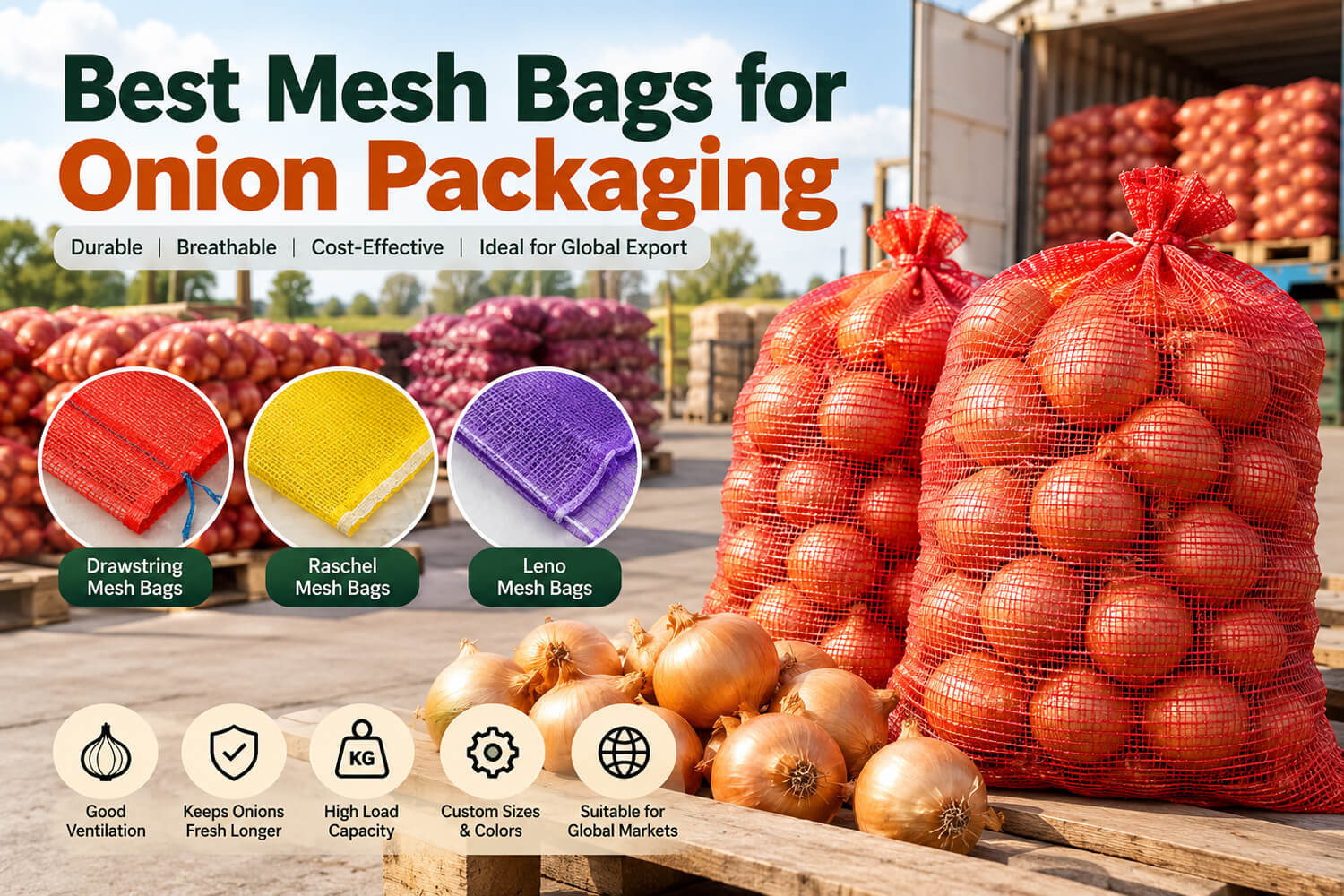
The best mesh bags for onion packaging combine good airflow, dependable strength, and the right size for your product. Raschel knitted bags are a practical choice for flexible packaging, while PP leno bags work well for firm, heavy-duty packs. Your final choice should depend on onion size, filling weight, packing equipment, and transportation conditions.
For agricultural distributors and produce exporters, the packaging bag is more than a low-cost supply item. It helps protect the onions you sell, supports smooth packing operations, and affects how customers see your products.
A weak bag can split during loading. A poorly designed closure can slow down packing. An unsuitable mesh construction may also limit airflow around stored onions.
These issues cost time and money, especially when you’re handling thousands of bags each day.
Fortunately, choosing suitable onion packaging doesn’t need to be complicated.
In this guide, we’ll compare the main mesh bag types, explain important technical specifications, and show you what to check before placing a wholesale order.
Whether you’re sourcing bags for a packing facility or building a distribution business, these practical guidelines will help you make a more informed buying decision.
Mesh Bags for Onion: What Makes a Good Packaging Bag?
A good onion mesh bag must do three things well: allow air to circulate, hold its intended load, and protect the onions during normal handling.
However, a bag that works perfectly for a small retail pack may not be suitable for a 25 kg export bag.
That is why buyers should look beyond appearance and unit price.
Breathability and Air Circulation
Onions need suitable ventilation during storage and transportation.
Even after harvesting, onions remain living produce. They continue to respire and release some moisture and heat.
If moisture builds up around the bulbs, the risk of quality problems can increase.
The open structure of a mesh bag allows air to move around the produce more freely than a sealed plastic bag.
Still, proper storage conditions remain essential. Mesh packaging alone cannot prevent spoilage.
Strength and Load Capacity
A filled onion bag may be lifted, moved, stacked, or transported several times before reaching its destination.
The bag must withstand these handling conditions without losing its contents.
Important strength factors include:
- Mesh construction and yarn quality
- Bag weight and material distribution
- Bottom seam strength
- Resistance to tearing and stretching
- Closure security
- Consistency between production batches
The rated capacity should reflect actual bag performance rather than the size printed in a product catalog.
For example, two bags may both be sold for 25 kg onions, yet perform differently when dropped or handled by machinery.
Suitable Size and Shape
A correctly sized bag holds the target quantity without excessive stretching.
It should also leave enough space for secure closing.
Oversized bags may cause poor handling and unstable stacking. Undersized bags can place too much pressure on the seams.
For buyers, the goal is to find a packaging specification that fits both the onion grade and the packing process.
Product Visibility
Mesh packaging makes the onions visible to buyers.
This is useful for wholesale markets, supermarkets, and agricultural distributors.
Retailers can inspect the produce without opening every bag, while suitable mesh colors can support attractive product presentation.
Key takeaway: A good onion bag balances ventilation, strength, filling efficiency, and appearance. No single specification is ideal for every market.
Best Mesh Bags for Onion Packaging
Different mesh constructions serve different packaging needs.
The most suitable design depends on your customer, target capacity, and packing equipment.
For most conventional onion packaging projects, three options deserve consideration.
Raschel Knitted Mesh Bags
Raschel bags are made using a knitted mesh construction.
Polyethylene, including HDPE-based yarn or tape, is commonly used for this product category.
The knitted structure can provide flexibility, helping the bag conform to the shape of the onions inside.
This makes raschel bags useful for many agricultural packaging applications.
Typical advantages include:
- Flexible mesh construction
- Good ventilation around the produce
- Lightweight packaging
- Multiple sizes and colors
- Options for drawstrings and labels
- Suitability for manual filling and selected machine-packing systems
A flexible bag is particularly useful when onion size varies within a shipment.
Instead of holding a rigid shape, the mesh can adjust to the contents.
However, buyers should never assume that all raschel bags offer the same strength.
Yarn specification, knitting pattern, bag weight, and seams can differ significantly between manufacturers.
For larger loads, request samples that match your intended capacity.
PP Leno Mesh Bags
Leno bags use a woven construction rather than a knitted one.
Polypropylene is a common raw material for these bags.
The crossing yarns create an open structure that combines ventilation with relatively stable dimensions.
Leno bags are often selected for onions, potatoes, and other agricultural products that need strong packaging.
Their main advantages include:
- Stable woven construction
- Limited stretching compared with many knitted designs
- Good handling characteristics
- Suitable options for heavier produce loads
- Compatibility with certain automated bagging systems
- Custom printed labels and drawstring closures
Leno packaging is often attractive to wholesalers who handle repeated loading and stacking.
The firmer structure can help maintain a more consistent bag shape.
However, construction quality remains important.
A heavier bag isn’t automatically stronger if the yarns or stitching are weak.
Tubular and Retail Net Bags
Small consumer packs have different requirements from bulk agricultural sacks.
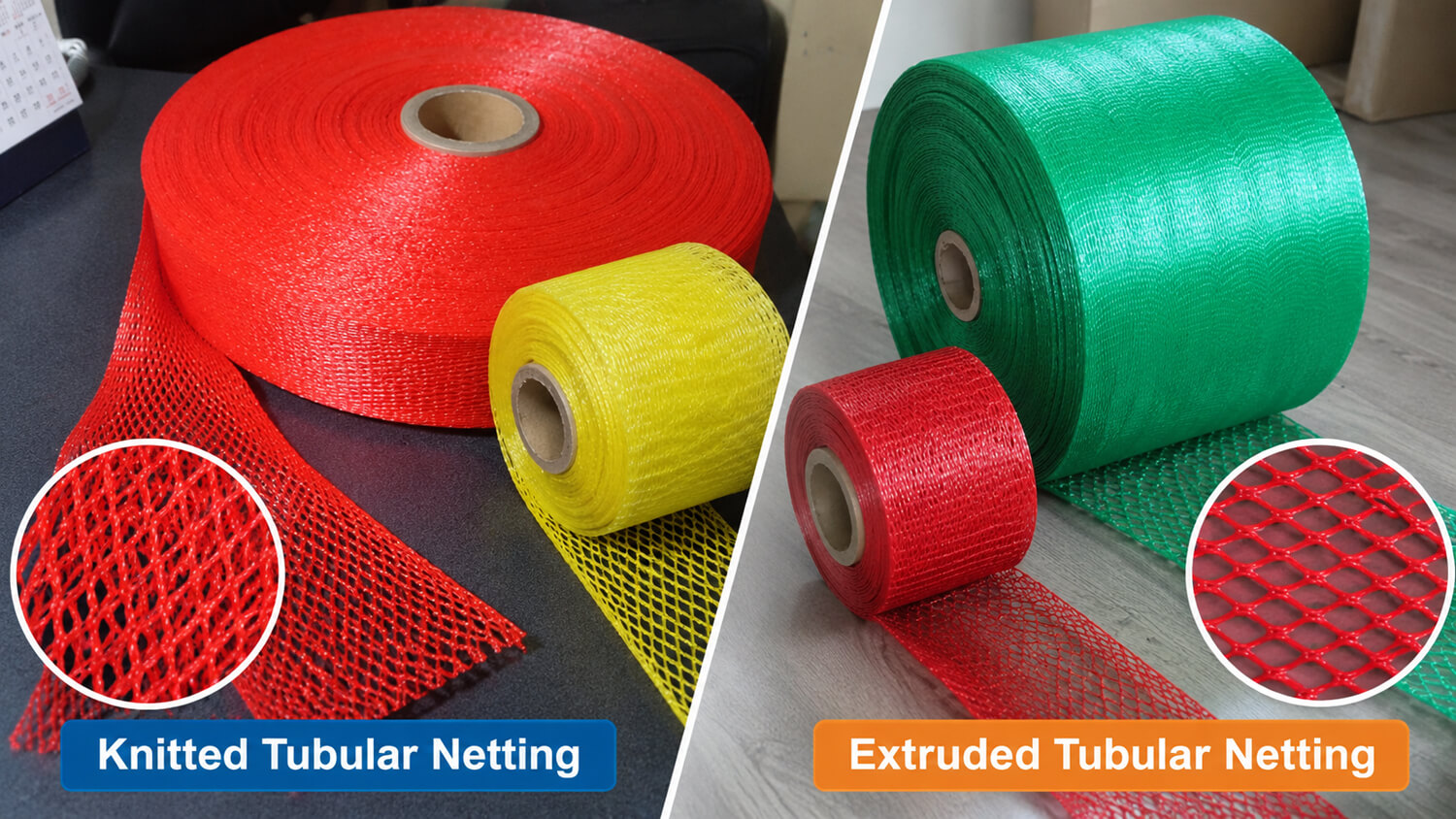
For retail onion packaging, tubular netting and small preformed mesh bags may offer a practical solution.
These formats are commonly used where the packing line is designed for smaller quantities.
Typical applications include:
- Small supermarket onion packs
- Promotional retail packs
- Private-label vegetable products
- Automated weighing and clipping operations
- Produce displays that need attractive labeling
Some systems use continuous netting supplied on rolls.
The equipment fills, cuts, and closes each package.
Other systems use ready-made mesh bags with printed bands or labels.
Before selecting a retail packaging format, confirm that it works with your filling and closing equipment.
Equipment compatibility often matters more than a small difference in bag price.
Recommendation: Choose raschel for flexible, general-purpose applications, leno when dimensional stability matters, and tubular netting for compatible retail packing lines. Always verify the finished design with samples.
Raschel vs. Leno Mesh Bags: Key Differences
Raschel and leno bags may look similar when filled with onions. However, their manufacturing methods affect how they behave.
Understanding these differences is especially important when purchasing large quantities.
Technical Comparison Table
| Fonctionnalité | Raschel Mesh Bags | Leno Mesh Bags |
|---|---|---|
| Construction | Knitted mesh | Woven mesh |
| Common material | PE / HDPE | PP |
| Flexibilité | Generally higher | Generally lower |
| Shape stability | Conforms to produce | Holds a more stable shape |
| Ventilation | Excellent with suitable mesh design | Excellent with suitable mesh design |
| Common applications | Onions, potatoes, citrus | Onions, potatoes, bulk produce |
| Load options | Light to heavy, depending on design | Light to heavy, depending on design |
| Common closures | Drawstring, sewn, clipped | Drawstring, sewn, wicketed |
| Branding | Labels and printed bands | Labels and printed bands |
| Machinery compatibility | Depends on format | Depends on format |
| Coût | Depends on specification and volume | Depends on specification and volume |
Which Construction Should You Choose?
If your business supplies onions to wholesale markets, a sturdy leno bag may be suitable.
If you need flexible packaging that follows the shape of different onion grades, raschel is worth considering.
Neither option should be selected based on its name alone.
For example, a heavy-duty raschel bag may perform better than a lightweight leno bag in a particular handling test.
Likewise, a well-designed leno bag can offer reliable performance at a competitive overall cost.
The real comparison should consider the finished bag specification.
Ask your supplier to provide the same information for both products:
- Finished bag dimensions
- Net weight per empty bag
- Recommended filling capacity
- Yarn or tape construction
- Bottom seam design
- Closure method
- Packing quantity per bale
- Sample strength test results
When comparing quotations, use the same fill weight and handling conditions.
This makes it easier to identify the option that delivers better value for your business.
Why Ventilation Matters for Onion Storage and Shipping
Ventilation is one of the main reasons mesh packaging is widely used for dry onions.
After harvest, onions must be properly cured and stored under suitable environmental conditions.
The storage system needs to manage moisture, temperature, and airflow.
If warm, humid air becomes trapped around the produce, condensation may form when that air meets a cooler surface.
Persistent surface moisture can create conditions that favor deterioration.
A ventilated bag allows air to pass through its openings.
However, this benefit depends on the whole storage and transport system.
How Mesh Packaging Supports Onion Quality
Open mesh provides several useful functions.
Moisture movement: Water vapor can escape more easily when surrounding air is suitable.
Heat movement: Airflow can help carry away heat from the packed onions.
Product inspection: Workers can identify visible damage or unsuitable produce without fully opening the package.
Ventilated storage: Open bags can support the airflow provided by a properly designed storage system.
Nevertheless, airflow should not be confused with guaranteed shelf life.
Storage temperature, relative humidity, onion variety, maturity, curing, and handling practices all influence quality.
For additional technical background, buyers can consult the UC Davis Postharvest Technology Center.
Airflow Through the Entire Pallet
A common mistake is choosing breathable bags but stacking them in a way that blocks the ventilation system.
Even an open mesh structure cannot help much if air has no clear path through the load.
For bulk shipments, consider:
- Pallet stacking patterns
- Clearance around storage walls
- Ventilation channels
- Air circulation through the center of the load
- Temperature changes during transportation
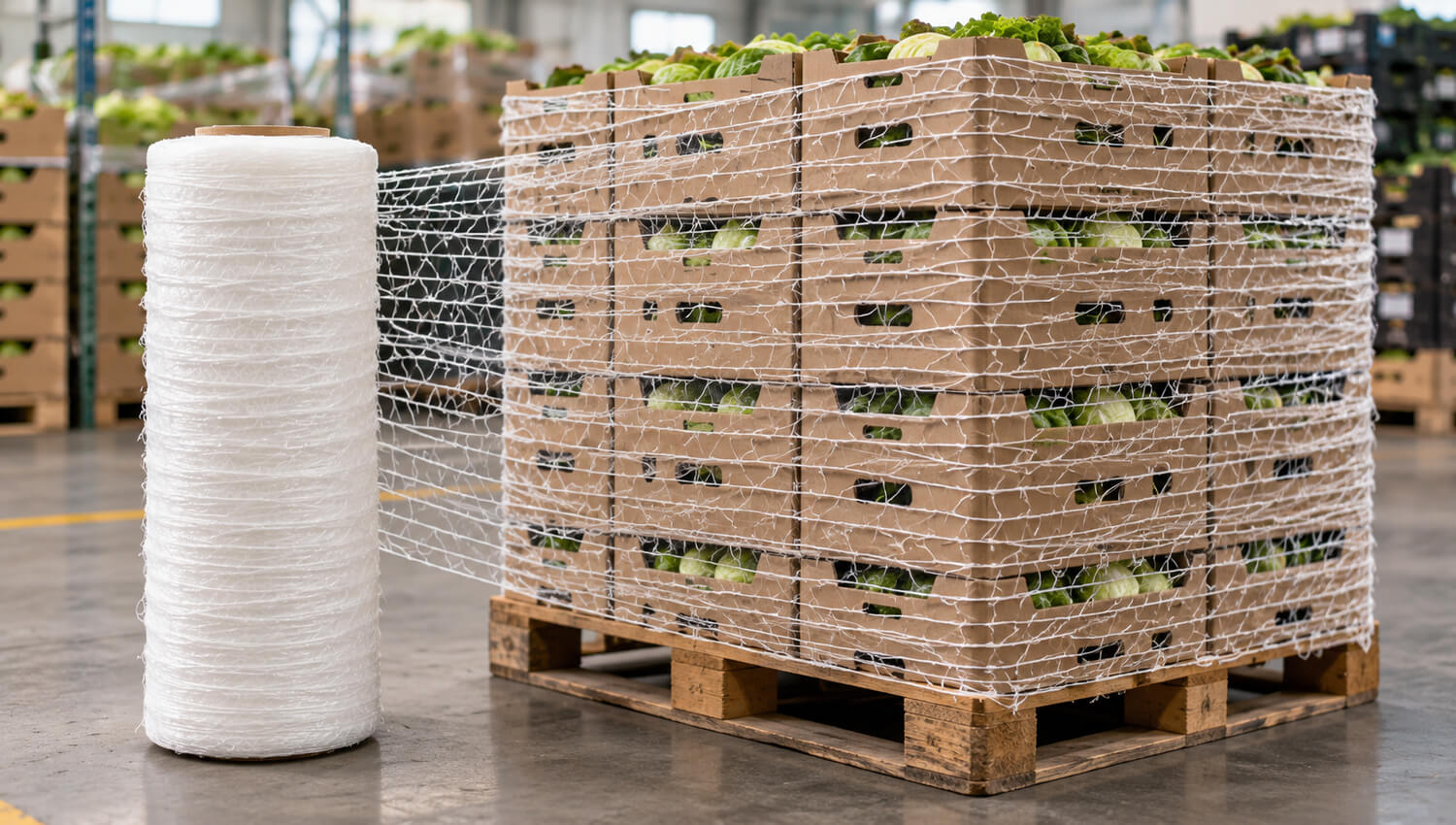
- The use of breathable pallet netting where suitable
Bag design and pallet arrangement should work together.
A properly ventilated pallet can be more valuable than simply choosing the bag with the largest visible openings.
Larger Mesh Openings Aren’t Always Better
Large openings provide substantial open area, but they may not suit every onion grade.
Small onions can press into wide openings.
An overly open or weak construction may also increase snagging during handling.
Smaller openings can improve containment, although they may change ventilation and the amount of material used.
The correct balance depends on your onions, packing method, and storage conditions.
Practical takeaway: Evaluate the complete packaging system. Mesh bags support ventilation, but they do not replace proper curing, climate control, or careful pallet handling.
Onion Mesh Bag Sizes and Weight Capacity Guide
Bag size is one of the most important details in a wholesale inquiry.
Yet it is also one of the easiest specifications to misunderstand.
A bag labeled for 10 kg does not automatically have the same dimensions as every other 10 kg bag.
The correct size depends on onion diameter, shape, packing density, and closure allowance.
Common Capacity Categories
The following table provides a practical starting point for choosing packaging.
These are illustrative sourcing categories, not certified capacity ratings. Dimensions must be confirmed through filling tests.
| Target Fill Weight | Typical Market Application | Suggested Construction |
|---|---|---|
| 1–2 kg | Small retail packs | Tubular or lightweight knitted mesh |
| 2.5–5 kg | Grocery and local distribution | Raschel or leno |
| 10 kg | Wholesale and produce distribution | Raschel or leno |
| 15 kg | Commercial agricultural supply | Reinforced raschel or leno |
| 20 kg | Bulk distribution | Tested heavy-duty raschel or leno |
| 25 kg | Export and wholesale handling | Tested heavy-duty mesh |
| 30 kg | Specialized bulk applications | Reinforced, load-tested construction |
Commercial manufacturers offer a wide range of designs and load capacities. These vary by bag type and production method.
How to Determine the Correct Bag Dimensions
Start with the desired net weight.
Then consider the average size of the onions.
Large onions leave more empty spaces between individual bulbs. Small onions can pack differently.
Next, check how much space is needed at the top of the bag.
For a sewn closure, enough material must remain above the filled produce to allow secure stitching.
For a drawstring closure, the neck must close without excessive stress.
Finally, test the finished bag.
A sample that looks large enough when empty may behave differently after filling.
Bag Sizing Example
Suppose you are purchasing 25 kg onion bags for export distribution.
You receive samples from two suppliers.
Both claim the same capacity, but one bag becomes tightly stretched after filling.
The other leaves enough space for a secure closure and maintains a manageable shape.
The second design may be better for your process, provided it also passes strength and handling tests.
You should compare the actual filled dimensions, not just the empty bag measurements.
For large orders, it is useful to approve a physical reference sample.
This gives your purchasing team and the manufacturer a shared standard for later production.
HDPE vs. PP: Choosing the Right Packaging Material
Mesh bag performance depends on construction as well as raw material.
Two common materials are high-density polyethylene (HDPE) and polypropylene (PP).
Both are polyolefin plastics used in agricultural packaging.
Neither material is automatically superior for every application.
HDPE Mesh Bags
HDPE is used in many knitted produce packaging designs.
Its properties make it suitable for producing lightweight yarns and tapes.
In raschel mesh bags, the knitting pattern can create a flexible finished product.
Advantages may include:
- Lightweight construction
- Flexible bag behavior
- Resistance to moisture absorption
- Suitability for different knitted mesh patterns
- Multiple color options
However, the finished strength depends on more than HDPE itself.
Yarn thickness, processing, knitting density, seams, and manufacturing consistency all matter.
PP Mesh Bags
PP is widely used in woven leno packaging.
It can be processed into tapes or yarns that form a stable mesh structure.
PP leno bags can be produced for both small produce packs and heavier agricultural loads.
Potential benefits include dimensional stability, efficient handling, and compatibility with certain industrial packing systems.
However, the performance of a PP bag depends on its construction and production quality.
A lightweight PP bag should not be compared directly with a reinforced HDPE bag without testing.
Material Selection Comparison
| Purchasing Criterion | HDPE-Based Mesh | PP-Based Mesh |
|---|---|---|
| Common construction | Knitted raschel | Woven leno |
| Water absorption | Low | Low |
| Shape behavior | Often flexible in knitted designs | Often more stable in woven designs |
| UV resistance | Depends on formulation and additives | Depends on formulation and additives |
| Food-contact suitability | Requires appropriate grade and documentation | Requires appropriate grade and documentation |
| Recycling considerations | Depends on local collection and design | Depends on local collection and design |
| Final strength | Depends on finished bag | Depends on finished bag |
What About Food-Contact Requirements?
Because mesh bags may touch onions directly, buyers should discuss food-contact requirements with their suppliers.
Regulations depend on the destination market and intended use.
For example, EU buyers may need documentation addressing applicable food-contact materials rules, including Regulation (EC) No 1935/2004 and, where relevant, Regulation (EU) No 10/2011.
You can review the official EU legislation through EUR-Lex.
Do not assume that every agricultural packaging bag automatically meets these requirements.
Request relevant declarations or test reports before placing an order.
Seven Essential Factors When Buying Onion Mesh Bags
The lowest unit price rarely tells the complete story.
For purchasing managers, a better approach is to compare the packaging cost against actual performance.
The following seven factors are especially important.
Material Consistency
Ask the supplier to confirm the polymer type and agreed material specification.
If recycled content is offered, clarify whether it is suitable and permitted for the intended use.
Different material formulations can affect strength, appearance, and compliance.
Bag Weight and Construction
The empty bag weight is a useful purchasing parameter.
A manufacturer may quote a bag weight in grams per piece.
However, a higher weight does not always mean better strength.
The yarn structure and how the material is distributed also influence performance.
Always compare weight alongside handling test results.
Mesh Opening Size
Mesh openings affect ventilation, product containment, and appearance.
The ideal opening should suit the onion grade.
Very large openings may be unsuitable for smaller bulbs.
Very dense mesh may use more material or change the airflow characteristics.
Ask for physical samples to evaluate the construction.
Seam Strength
The bottom seam carries considerable stress during handling.
Weak stitching can cause packaging failures even when the mesh material itself is strong.
Inspect the stitch pattern, thread condition, and seam consistency.
Closure Compatibility
Different filling operations use different closing methods.
Common options include sewn closures, drawstrings, and machine-applied clips.
The bag must suit the equipment or manual process used at your facility.
A mismatch can reduce packing speed and create unnecessary waste.
Production Consistency
A sample is only useful if mass production follows the approved specification.
Buyers should confirm acceptable tolerances for dimensions, weight, and other important characteristics.
These tolerances should be agreed upon before manufacturing begins.
Total Delivered Cost
Your true packaging cost includes more than the quoted bag price.
It may include freight, customs duties, packing losses, storage, labor, and damaged produce.
A simple comparison can help.
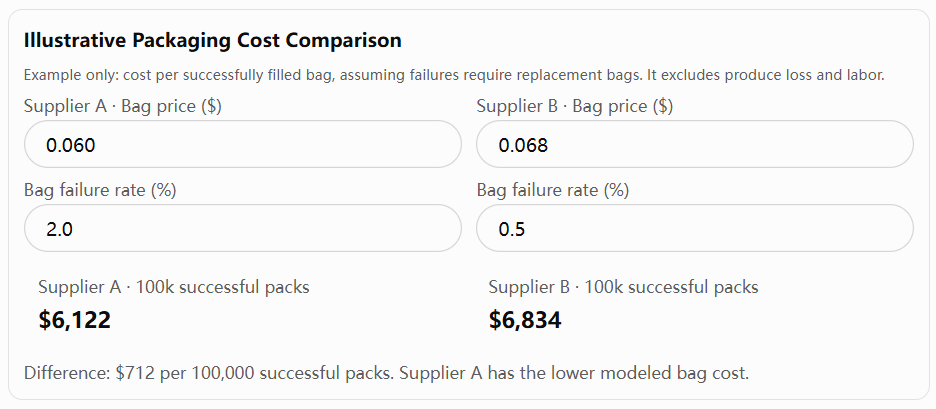
Even a small change in failure rate can affect the total cost of a large order.
The figures above are illustrative, not reported factory prices or measured industry failure rates.
Buying tip: Compare suppliers using a consistent specification sheet, a physical sample, and real packing trials.
Custom Mesh Bags for Onion Packaging
For many buyers, standard packaging is only the starting point.
Agricultural distributors, supermarket suppliers, and produce brands often need packaging that fits a specific product range.
OEM mesh bags allow buyers to define the appearance and technical features of the finished product.
Custom Colors
Popular produce packaging colors include red, orange, yellow, green, and purple.
Color can improve product presentation and help different grades stand out.
For example, a distributor may use one color for yellow onions and another for red onions.
However, color should support product identification rather than misrepresent the quality or condition of the produce.
If your business requires specific brand colors, provide a recognized color reference.
The manufacturer should confirm how closely the finished mesh can match it.
Custom Size and Bag Weight
Custom dimensions help buyers match packaging to local market preferences.
Some markets favor smaller consumer packs, while others use larger wholesale sacks.
You can also request a particular bag weight or construction.
However, weight reduction must be evaluated carefully.
Using less material may reduce unit cost, but it can also affect strength.
The correct approach is to test a proposed lighter bag before approving production.
Private Labels and Branding
Printed labels can improve identification and help your products stand out.
Depending on the packaging design, branding options may include:
- Printed label bands
- Sewn labels
- Product identification tags
- Barcodes and QR codes
- Retail-ready information panels
- Custom bale labels for warehouse handling
All label claims and product information should comply with the destination market’s requirements.
For exporters, traceability information can be especially useful.
Custom Closures
A closure should match the filling line and intended handling conditions.
Drawstrings can be convenient for certain manually filled products.
Sewn closures are commonly used for agricultural sacks.
Machine-compatible designs may support higher packing speeds.
Before choosing, confirm the closure method with your packing team.
Manufacturer’s specification advice: Treat custom packaging as an engineering project, not just a color change. Approve material, dimensions, bag weight, closure, labeling, and intended load together.
Quality Control and Packaging Tests
Quality control is essential when purchasing large volumes of agricultural mesh bags.
A sample order may look excellent, but the real requirement is consistent performance across production batches.
That consistency begins with a clear purchase specification.
Raw Material Inspection
Manufacturers should identify the intended material grade and check relevant raw material properties.
Consistent raw materials support predictable manufacturing performance.
For food-contact applications, the supplier should also maintain appropriate supporting documentation.
Dimensional Inspection
Finished bags should be measured against approved specifications.
Typical checks include length, width, and closure dimensions.
The supplier and customer should agree on measurement methods and tolerances.
A tolerance appropriate for a manually filled bag may not be suitable for a machine-fed product.
Bag Weight Inspection
Checking net weight per bag helps identify possible production inconsistencies.
For example, a significant change in average weight may indicate a difference in yarn specification or mesh construction.
However, bag weight is only an indirect quality indicator.
A properly designed strength test is still needed.
Strength and Handling Tests
A useful sample testing program should reflect the actual application.
Example Mesh Bag Quality Inspection Plan
| Inspection Item | Practical Test | Acceptance Basis |
|---|---|---|
| Matériau | Supplier records and material verification | Approved material specification |
| Dimensions | Measure finished bags | Agreed tolerances |
| Weight | Weigh sampled bags | Approved weight range |
| Mesh integrity | Visual inspection | No unacceptable holes or broken yarns |
| Bottom seam | Loaded handling test | No failure under agreed conditions |
| Closure | Fill and close sample | Secure closure and process compatibility |
| Drop resistance | Defined handling simulation | No unacceptable bag or seam failure |
| Printing | Visual and durability check | Approved artwork and legibility |
| Packing quantity | Bale count verification | Purchase order quantity |
A proper drop test should define the load, drop height, orientation, and number of repetitions.
These conditions must be agreed upon before testing.
There is no single universal drop-test result that proves every onion bag is suitable.
Sample Approval Before Mass Production
For new packaging specifications, we recommend a structured approval process.
First, receive representative samples.
Then fill them with your actual onions.
Test the bags under normal packing conditions.
Check how they behave during lifting, stacking, and closing.
Finally, approve a reference sample and record the agreed specifications.
This process can prevent expensive disputes after delivery.
For repeat purchasing, retain an approved sample for comparison with future batches.
How to Buy Wholesale Onion Mesh Bags from a Manufacturer
Buying directly from a manufacturer can be useful for businesses that need consistent packaging specifications.
It may also provide more opportunities for customization and long-term purchasing arrangements.
However, a reliable relationship requires clear communication from the beginning.
Prepare a Complete RFQ
A request for quotation should include enough technical information to avoid confusion.
At a minimum, provide the following details:
| RFQ Information | Example or Required Detail |
|---|---|
| Product | Raschel or PP leno onion mesh bag |
| Intended contents | Yellow onions, red onions, or other produce |
| Target capacity | For example, 10 kg or 25 kg |
| Dimensions | Required width and length, or sample reference |
| Matériau | HDPE, PP, or proposed alternative |
| Bag weight | Target grams per piece, if specified |
| Couleur | Red, orange, yellow, or custom |
| Closure | Drawstring, sewn, or machine-compatible |
| Branding | Plain, printed band, or custom label |
| Order quantity | Pieces required per order |
| Destination | Country and delivery location |
| Terms | Requested Incoterm and delivery requirements |
The more complete your RFQ, the easier it is to receive comparable quotations.
Ask About MOQ and Lead Time
Minimum order quantity depends on several factors.
Standard colors and sizes may be easier to source in smaller quantities, depending on the supplier’s stock and production plan.
Special materials, custom yarn colors, or unique printed labels may require larger production runs.
Lead time also varies.
It can depend on material availability, order volume, machine capacity, and the complexity of customization.
Avoid assuming that every supplier can offer the same schedule.
Instead, request separate estimates for sampling, production, and shipment preparation.
Confirm Packaging for Export
Empty mesh bags are lightweight, but their packed volume still affects freight costs.
Ask how the manufacturer prepares them for export.
Important details include bale dimensions, bale weight, number of bags per bale, and total shipping volume.
You should also confirm whether the export packing protects the bags from contamination and physical damage.
For container shipments, accurate packing information helps freight planning.
Evaluate the Supplier Beyond Price
A good supplier should be able to explain what is being quoted.
Ask practical questions about manufacturing consistency, sample approval, documentation, and quality controls.
Also clarify how the supplier handles nonconforming products.
A lower quotation is less attractive if technical details remain unclear.
For repeat buyers, communication and stable quality can be just as important as the first purchase price.
Procurement recommendation: Use a trial order to verify the approved design before committing to a large annual purchasing program.
Common Onion Packaging Mistakes to Avoid
Choosing the wrong packaging can affect more than the bag itself.
It may increase repacking work, slow down the filling line, or expose produce to additional handling.
Fortunately, many of these problems can be avoided during sample evaluation.
Selecting Bags Only by Price
Low unit cost is attractive when buying thousands of bags.
However, cheap packaging can become expensive if it fails frequently.
Calculate the total cost per successfully packed and delivered unit.
Include damaged bags, wasted packaging, and any extra labor required.
Ignoring Onion Size
A packaging design suited to large onions may not perform equally well with small onions.
Openings that are too large can create containment problems.
Bag dimensions may also need adjustment.
Always test with the onion grades you actually sell.
Overfilling the Bag
Overfilling places additional pressure on the mesh and closure.
It can also make bags difficult to handle.
Use controlled filling weights and leave enough space for a secure closure.
If the bag consistently becomes too tight, consider a different dimension or construction.
Forgetting About Packing Equipment
A bag that works well during manual filling may not feed smoothly through an automated machine.
Likewise, some closures require specific equipment.
Share machine requirements with the manufacturer before approving the design.
Assuming Mesh Prevents All Spoilage
Mesh helps support ventilation, but it cannot correct poor curing or unsuitable storage conditions.
Wet onions, excessive humidity, and poor temperature management can still cause major problems.
Evaluate packaging and storage practices together.
Skipping Production-Batch Inspections
One approved sample doesn’t guarantee that every shipment will match it.
For repeat orders, define inspection requirements and retain reference samples.
Check material, dimensions, weight, seams, closures, and other agreed features.
When a problem appears, clear specifications make it easier to identify the cause and agree on corrective action.
Questions fréquemment posées
What type of mesh bag is best for onion packaging?
Raschel knitted bags and PP leno bags are both suitable choices for onion packaging. Raschel bags offer flexibility, while leno bags generally provide a more stable shape. The best option depends on your filling weight, onion size, handling process, and machinery.
Are raschel mesh bags strong enough for 25 kg onions?
Some heavy-duty raschel bags are designed for 25 kg loads or more. However, capacity depends on yarn construction, fabric weight, seams, and closure quality. Always request a suitable sample and test it under your normal handling conditions before ordering.
What is the difference between PP leno bags and HDPE raschel bags?
PP leno bags use a woven mesh structure, while HDPE raschel bags commonly use a knitted structure. Leno bags usually have better dimensional stability, while raschel bags often provide greater flexibility. Strength and cost still depend on the individual product specification.
What size mesh bags should I use for 10 kg onions?
There is no single universal bag dimension for 10 kg onions. The required size depends on bulb diameter, grade, mesh construction, and closure method. Ask your manufacturer for sample dimensions, then fill the bags with your own produce to confirm suitability.
Can onion mesh bags be customized with our company logo?
Yes. Many manufacturers offer printed label bands, sewn labels, custom colors, and other branding options. You should provide your logo artwork, required information, label dimensions, and estimated quantity. Confirm the final artwork and physical samples before authorizing mass production.
Are onion mesh bags suitable for export packaging?
Yes, properly specified mesh bags are widely used for commercial onion distribution. However, the packaging must withstand its intended load and handling conditions. Exporters should also consider pallet stability, ventilation, destination requirements, and suitable transportation and storage conditions.
Do mesh bags help keep onions fresh for longer?
Mesh bags support airflow and help water vapor move away from the produce when surrounding conditions are suitable. This can reduce moisture-related risks compared with poorly ventilated packaging. However, shelf life also depends on curing, onion condition, storage temperature, humidity, and handling.
Can mesh onion bags be used with automatic packing machines?
Some leno, raschel, and tubular mesh formats are designed for automatic or semi-automatic packing systems. Compatibility depends on bag presentation, size, material behavior, and closure design. Buyers should provide equipment details and conduct a machine trial before placing a large order.
How can I compare wholesale onion mesh bag prices?
Request quotations based on identical specifications. Compare material, dimensions, bag weight, load capacity, printing, packing quantity, and Incoterms. You should also evaluate sample performance, freight cost, potential packaging failures, and the supplier’s ability to maintain consistent production quality.
What information should I provide when requesting a quotation?
Provide your target filling weight, onion grade, preferred mesh construction, dimensions, color, closure, label requirements, and estimated order volume. Include the destination country and any food-contact documentation requirements. A reference sample or product photograph can also help clarify your needs.
Conclusion: Choose Onion Mesh Bags Based on Performance and Value
Selecting suitable onion packaging is an important purchasing decision for growers, agricultural exporters, and produce distributors.
Raschel knitted bags offer flexibility and are useful for many general agricultural applications.
PP leno bags provide a stable woven construction and can be suitable for heavier or more structured packaging requirements.
Tubular mesh systems may be appropriate for smaller retail packs and compatible automated filling lines.
However, the most important decision is not simply choosing raschel or leno.
It is matching the finished bag to your onions, filling process, transportation conditions, and market requirements.
Before ordering, confirm the material, size, bag weight, closure, load capacity, and quality standards.
Then evaluate physical samples under realistic conditions.
 French
 English
 Russian
 Spanish
 Portuguese
 Arabic
 Indonesian