
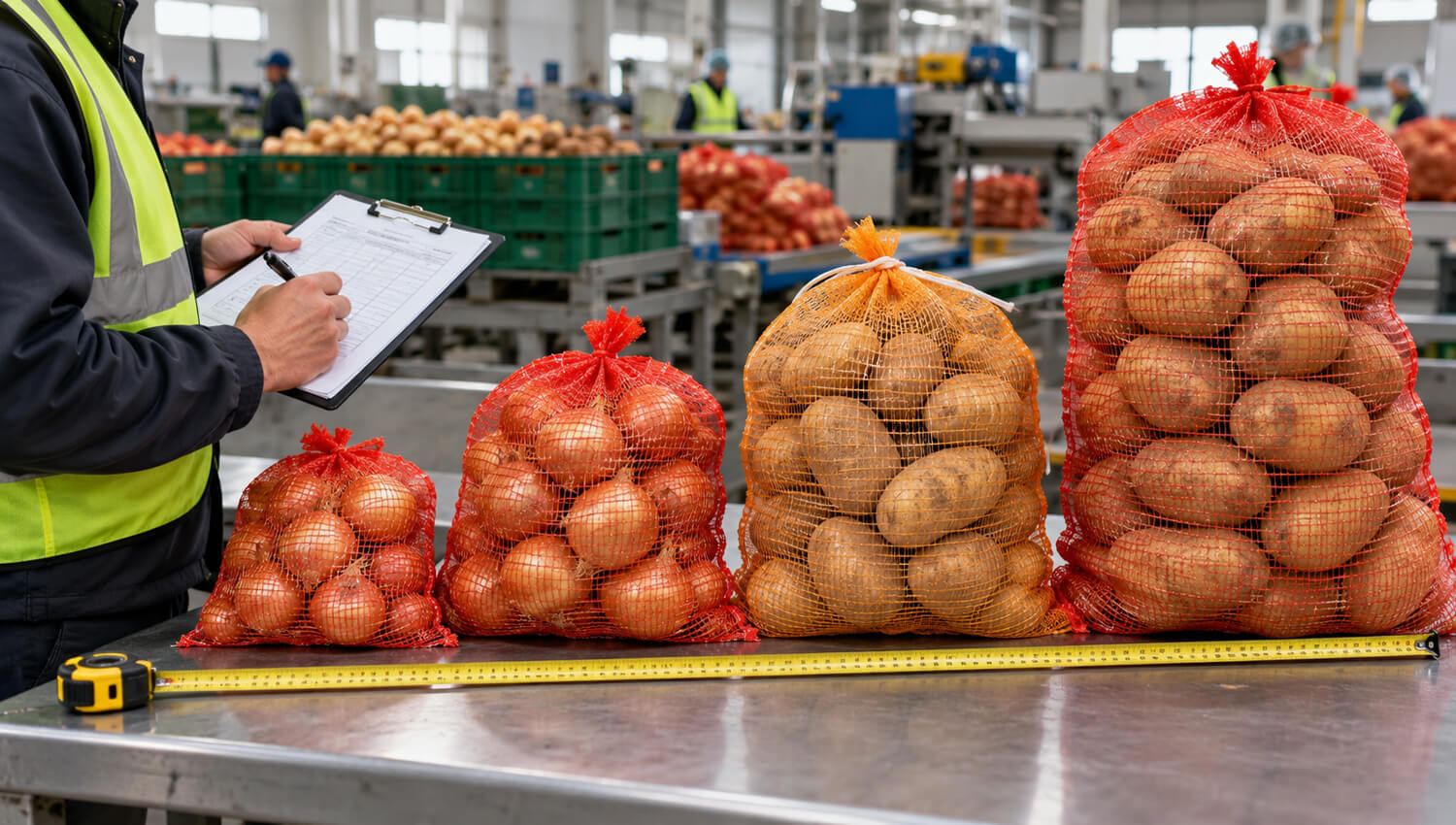
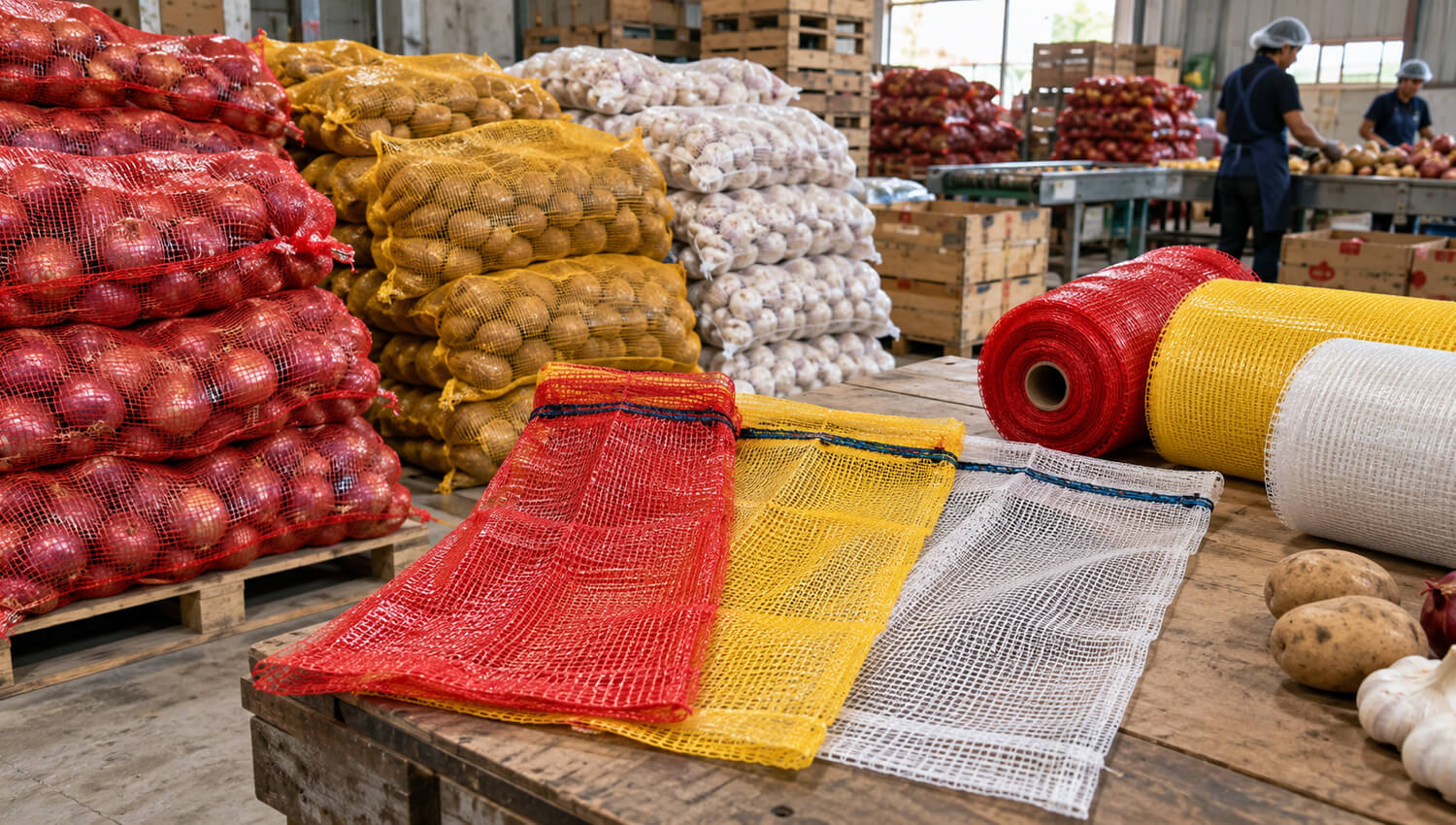
Choosing the right Raschel Mesh Bag Size starts with your product type, target filling weight, and packing method. For example, a 30 × 50 cm bag may suit 5 kg of produce, while a 50 × 80 cm bag may suit 25–30 kg. However, actual capacity depends on product shape, mesh stretch, closure space, and bag strength. Always test samples before ordering in bulk.
For agricultural importers and packaging distributors, the correct bag dimensions do more than hold a certain amount of produce. They help reduce material waste, support safe handling, and improve packing efficiency.
An oversized bag may use unnecessary material and allow products to move during transport. A bag that’s too small can make filling difficult, strain seams, or leave too little room for closing.
Both problems can increase costs.
This matters when you’re purchasing thousands of bags for onions, potatoes, garlic, citrus fruits, or other agricultural products. Even a small size error can affect your entire packing operation.
The Food and Agriculture Organization (FAO) explains that fresh produce packaging should match handling needs and allow suitable ventilation during storage and transport.
From a manufacturing and procurement perspective, choosing the correct size requires more than checking a product catalog.
You should consider the packed product’s shape, filling weight, mesh construction, bag dimensions, and intended handling conditions.
A well-chosen mesh bag can offer several important advantages:
- More consistent filling weights
- Easier bag handling and closure
- Better product visibility and airflow
- Less unnecessary packaging material
- More reliable packing-line performance
- Improved consistency across repeat orders
The goal isn’t simply to purchase a bag labeled 10 kg or 25 kg. It’s to choose a packaging specification that works reliably with your products and operations.
How to Choose the Right Raschel Mesh Bag Size?
Selecting the correct agricultural mesh packaging begins with understanding your actual packing requirements. Bags that look similar in a supplier’s catalog may perform differently once filled.
The following seven factors will help you make a practical buying decision.
Check Your Target Filling Weight
Start with the net weight you want in each bag.
Common retail and wholesale packing weights include 2.5 kg, 5 kg, 10 kg, 15 kg, 20 kg, 25 kg, and 30 kg. Larger formats may be used for specific products and handling systems.
However, a nominal 25 kg bag doesn’t automatically hold 25 kg of every product.
Identify the Product Type
Different agricultural products have different sizes, shapes, and packing densities.
Small potatoes may fit closely together. Large onions can leave more empty space between pieces. Garlic bulbs may need extra room because of their irregular shape.
These differences affect the dimensions required for the same net weight.
Measure the Actual Produce
Record the average product diameter and the size of the largest pieces.
Uniform produce is easier to pack consistently. Mixed-size produce may need more flexibility in bag width and length.
Consider the Filling Method
Manual filling and automatic packing equipment may require different bag constructions.
For automated lines, confirm the equipment manufacturer’s accepted bag width, length, opening, and closure specifications.
Allow Enough Closing Space
A bag must have sufficient material above the filled produce to support its intended closure.
Drawstrings, stitched closures, clips, and ties have different requirements.
Check Handling and Transportation
Consider how workers lift, stack, and transport the filled bags.
A larger bag isn’t always better, especially when manual handling is involved.
Request Filled Sample Testing
Before confirming a bulk order, ask your manufacturer to provide representative samples.
Fill them with your actual products and check the packed shape, closure, seams, and handling performance.
This final step often reveals issues that product dimensions alone cannot show.
Standard Raschel Mesh Bag Dimensions and Weight Capacities
Raschel mesh bags are available in many widths, lengths, and capacities. Some sizes are widely offered, but there isn’t one universal dimension chart that works for every product.
Manufacturers also use different knitting constructions and materials. This means two bags with identical flat dimensions may have different filling capacities.
The chart below provides a useful starting point for comparing common commercial offerings.
Mesh Bag Size and Capacity Comparison Chart
| Flat bag size (W × L) | Illustrative capacity | Typical application |
|---|---|---|
| 29 × 37 cm | 2.5 kg | Small retail produce packs |
| 30 × 50 cm | 5 kg | Potatoes and onions |
| 37 × 57 cm | 10 kg | Medium produce packaging |
| 40 × 60 cm | 15 kg | Wholesale vegetables |
| 51 × 77 cm | 25 kg | Bulk onions and potatoes |
| 50 × 80 cm | 30 kg | Agricultural distribution |
| 60 × 100 cm | 50 kg | Selected heavy-duty applications |
Reference examples compiled from published supplier size charts. These are not universal rated capacities or guaranteed specifications.
How to Interpret the Capacity Chart
The width refers to the bag measured flat, from one side to the other. The length generally refers to the flat bag’s overall length.
Actual usable dimensions may change after the bag is filled.
For example, a wide bag can expand around bulky onions, which reduces its available vertical length. That can leave less space at the top for closing.
Similarly, different mesh structures may have different stretch behavior.
This is why capacity charts should be used for initial selection rather than final approval.
Retail Packaging vs. Wholesale Packaging
Smaller bags are often useful for retail-ready produce.
They can support attractive product presentation, smaller purchase quantities, and easier shelf handling.
Larger bags are typically considered for farm collection, wholesale markets, and distribution centers.
However, larger formats must be checked against handling safety and transport requirements.
For international procurement, specify both dimensions and intended filling weight on your purchase order.
For example:
Raschel mesh bag, 51 × 77 cm, intended for 25 kg of graded onions, with sample-approved closure and construction.
That description gives your supplier a clearer production target than simply ordering “25 kg onion bags.”
Choosing Mesh Bag Dimensions for Different Agricultural Products
Different crops need different packaging solutions. Even when two products have the same total weight, their shapes and packing behavior can vary significantly.
As a result, an onion mesh bag may not perform exactly like a potato bag with the same measurements.
Onions
Onions are round and often have different bulb sizes. Medium and large bulbs leave empty spaces inside the bag. Choose enough width for the bulbs to settle naturally without making the package excessively loose.
Potatoes
Potatoes may be round, oval, or elongated. Smaller graded potatoes often pack more closely than large irregular varieties. Check the filled bag’s shape and whether its seams withstand lifting and stacking.
Garlic
Garlic bulbs are relatively light and have uneven surfaces. Smaller retail packs may be suitable, but opening size, mesh spacing, and closure details matter. The mesh should retain the bulbs without trapping or damaging them.
Citrus Fruits
Oranges and similar firm fruits need suitable ventilation and careful handling. Larger fruits may require wider bags, while fruit protection and transport distance can limit the practical weight per package.
Why Produce Diameter Matters
Product diameter is an important factor in packaging design.
Imagine two buyers ordering bags for 10 kg of onions.
One buyer packs smaller, uniform onions. The other handles large onions with wider size differences.
Although the target weight is identical, the second buyer may need a larger bag because the produce occupies more space.
This difference can affect filling speed, stacking, and bag appearance.
Match the Bag to the Supply Chain
A bag used for local wholesale distribution may have different needs from one shipped across international borders.
Longer supply chains involve additional handling, loading, unloading, and storage.
For this reason, consider the entire distribution process rather than the filling operation alone.
The FAO identifies open-mesh packaging as most suitable for relatively firm produce, while warning that flexible sacks provide limited protection from rough handling.
For delicate products, a rigid crate or other protective package may be more appropriate.
How Bag Width, Length, and Stretch Affect Filling Capacity
Understanding how mesh bag dimensions work can prevent costly purchasing mistakes.
When a manufacturer lists a bag as 50 × 80 cm, those measurements usually describe the bag laid flat.
They don’t represent the final dimensions after filling.
The physical shape changes as products enter the bag. Its width expands into a three-dimensional form, while part of its length is used to surround the contents.
Flat Width vs. Filled Width
Flat width is the distance across an empty bag lying on a level surface.
Filled width depends on the product shape, filling volume, and flexibility of the mesh.
For example, two products may expand the same bag differently.
Round onions may create a fuller shape, while some elongated potatoes may settle differently.
As a result, equal flat widths don’t guarantee equal filled volumes.
Overall Length vs. Usable Filling Length
The entire bag length cannot necessarily be filled with produce.
Part of the material may be needed for:
- Bottom seam construction
- Top closure or tying
- Drawstring or clip attachment
- Product movement during filling
- Safe handling without overstretching
This is especially important for automatic packing.
A bag that closes easily during a small trial might become difficult to seal when larger produce enters the packing line.
Why Stretch Behavior Matters
Raschel mesh is flexible, but its stretch depends on the yarn, knitting pattern, and manufacturing process.
A more flexible bag may accommodate irregular produce more easily.
However, greater stretch isn’t always desirable.
Excessive deformation can create an uneven filled package and affect stack stability.
Similarly, a construction with limited stretch may struggle to accommodate large products.
How to Measure Bags Consistently
When approving a bag sample, use a standard measurement method.
Lay the empty bag flat without deliberately stretching it. Smooth the material gently, then measure its width and length from clearly defined reference points.
Record whether the dimensions include seam and closure areas.
For repeat orders, suppliers and buyers should agree on dimensional tolerances before mass production.
The important point is consistency. A clearly defined measurement method reduces disagreements when shipments arrive.
Mesh Density, Material, and Bag Weight Explained
Bag dimensions are only part of a complete packaging specification.
Material type, mesh density, yarn construction, and finished bag weight also influence performance.
Two mesh bags with the same dimensions may have different strength, flexibility, ventilation, and material costs.
That’s why experienced purchasing teams evaluate the entire bag construction.
HDPE and Other Polyethylene Materials
Raschel bags are commonly made with polyethylene-based yarns or tapes. The exact resin and formulation can vary by manufacturer.
HDPE is often selected where strength and stiffness are important. Other polyethylene formulations may be used when greater flexibility is required.
The material should be selected according to the final product, manufacturing method, and intended use.
For direct food contact, ask your supplier for suitable material and compliance documentation for your destination market.
Don’t assume every mesh bag is food-contact compliant merely because it looks suitable for produce.
Open Mesh vs. Denser Mesh Construction
Mesh density describes how open or closely knitted the bag structure is.
An open construction allows greater visibility and can support airflow around the produce.
A denser construction may offer more coverage, depending on yarn design.
However, the relationship between mesh density and strength isn’t simple.
Yarn properties, knitting pattern, seams, and finished construction all affect performance.
Why Bag Weight Matters
Finished bag weight is another useful purchasing parameter.
It is typically measured in grams per empty bag.
A heavier construction may use more material, but higher weight alone doesn’t guarantee better strength.
The distribution of material and quality of manufacture are also important.
For example, a poorly sewn heavy bag may fail at the seam before the mesh itself breaks.
Balancing Ventilation and Product Protection
Ventilation is especially important for many fresh agricultural products.
The FAO advises that produce packaging must allow suitable airflow through individual packages and stacked loads.
However, an open mesh structure doesn’t replace proper storage temperatures, humidity control, or careful handling.
Your goal should be a balanced specification that provides enough strength while supporting airflow, product visibility, and efficient filling.
How to Calculate the Right Bag Capacity for Your Products
One of the most reliable ways to select packaging dimensions is to test them with the actual produce.
Weight alone cannot accurately predict how much space irregular agricultural products will occupy.
A practical selection method combines estimated filling volume with a physical sample test.
Estimate the Required Filling Volume
You can begin with a simple calculation:
Required Volume (L) = Target Weight (kg) / Bulk Density (kg/L)
Bulk density describes the mass of produce divided by the total space it occupies, including gaps between individual pieces.
It should be measured using a representative sample of the product.
For illustration, assume that a batch of graded onions has a measured bulk density of 0.60 kg/L.
The estimated loose-fill volume for a 10 kg package would be:
10/0.60=16.7 L
This is an illustrative calculation, not a standard density value for all onions.
Example Filling Volume Comparison
| Target fill weight | Assumed measured bulk density | Estimated loose-fill volume |
|---|---|---|
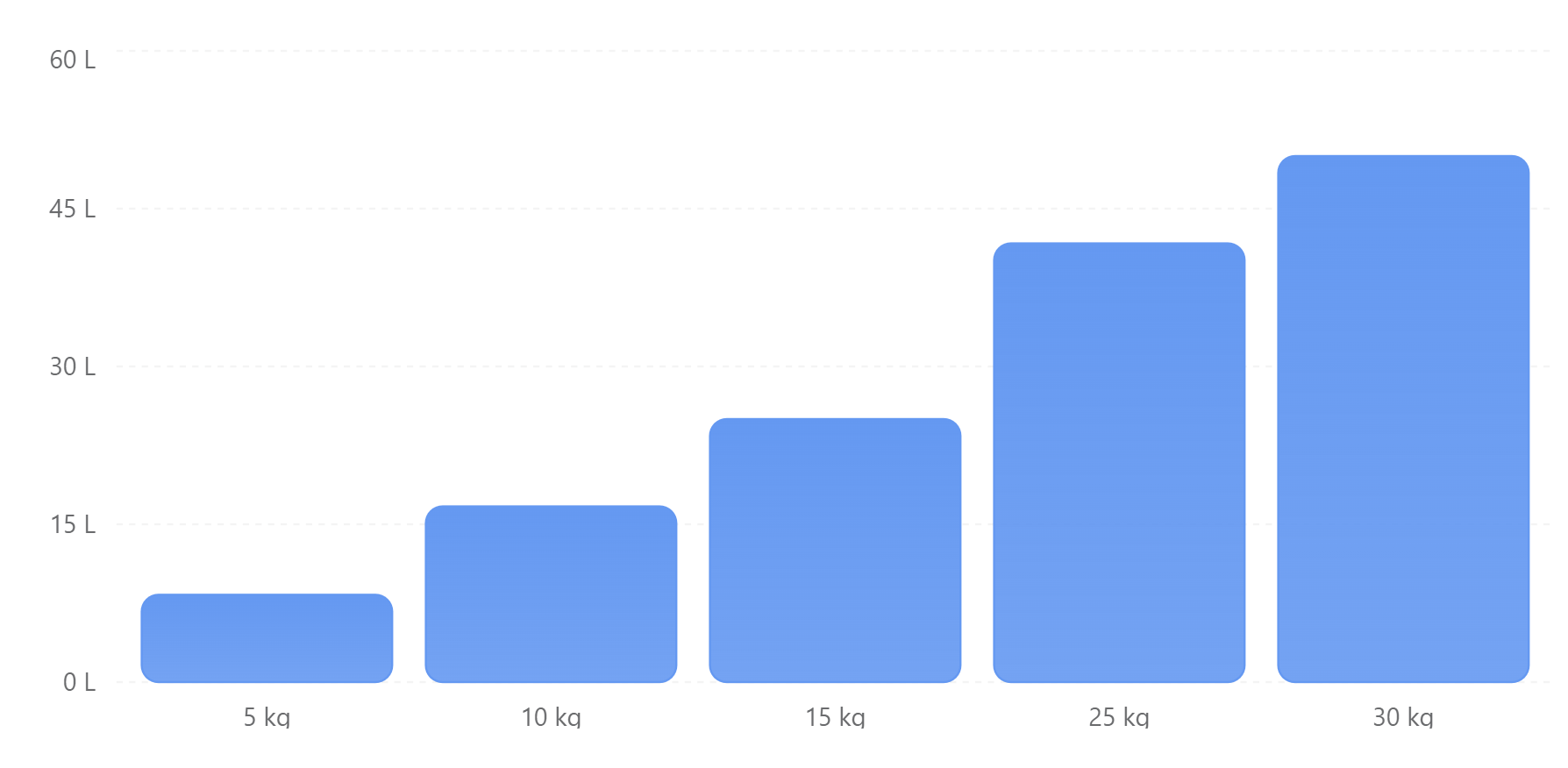
| 5 kg | 0.60 kg/L | 8.3 L |
| 10 kg | 0.60 kg/L | 16.7 L |
| 15 kg | 0.60 kg/L | 25.0 L |
| 25 kg | 0.60 kg/L | 41.7 L |
| 30 kg | 0.60 kg/L | 50.0 L |
Calculation example only. Actual bulk density differs by crop, variety, grading, and packing conditions.
Estimated Loose-Fill Volume by Packing Weight
Illustrative calculations using a constant bulk density of 0.60 kg/L.
Turn the Calculation Into a Sample Test
A volume estimate helps narrow your choices, but it doesn’t identify the perfect bag dimensions.
Flexible mesh changes shape when filled. It cannot be treated as a rigid rectangular container.
For this reason, test two or three nearby bag sizes.
Use representative produce, including the larger pieces normally found in a commercial batch.
Fill each sample to the target net weight, close it using the intended method, and observe how it performs.
The ideal bag should hold the required product without severe stretching, excessive empty space, or closure problems.
Evaluate Filled-Bag Performance
After filling, check the package’s actual height, width, handling stability, and seam condition.
Repeat the process with several samples rather than relying on one successful fill.
If the bag is intended for commercial packing machinery, test it at normal production speed.
A repeatable result is more valuable than a theoretical size estimate.
Matching Bag Sizes to Packing Machines and Warehouse Operations
The right packaging size must also work with your production equipment, warehouse layout, and shipping system.
A bag that fits the produce perfectly may still cause problems if it doesn’t match the packing line.
This is particularly important for importers supplying commercial farms and packing facilities.
Manual Filling Requirements
Manual packing operations offer more flexibility in bag dimensions.
Workers can adjust the bag opening, position the produce, and close the package by hand.
However, oversized bags may slow the operation because workers need to gather more material before closing.
Very narrow bags can also increase filling time, especially when packing large potatoes or onions.
A successful design should allow workers to fill and close the bag with minimal unnecessary handling.
Automatic Packing Machine Compatibility
Automatic packing machines require more consistent bag specifications.
Depending on the equipment, important parameters may include:
- Empty bag width and length
- Bag opening design
- Mesh stretching behavior
- Bag feeding and separation
- Closure system compatibility
- Finished bag shape
- Dimensional consistency between batches
Not every Raschel bag is suitable for every automatic packing machine.
Some equipment uses bags supplied on rolls, while other systems handle individual preformed bags.
Ask your machinery supplier to confirm compatible materials and dimensions before ordering.
Pallet Loading and Storage
Warehouse efficiency is another consideration.
Your filled bags must fit safely within the intended pallet arrangement.
Overfilled bags may create uneven stacks. Loosely filled bags can shift during transportation.
However, reducing bag size should never come at the expense of safe load distribution.
The FAO highlights that package size, shape, and loading arrangements influence handling and transport efficiency.
Calculate Your Total Packaging Demand
For bulk purchasing, estimate the number of bags needed using:
Bag Quantity = Total Produce Weight / Net Weight per Bag
For example, 20,000 kg of produce packed in 10 kg bags requires 2,000 filled bags before allowing for production rejects and spare packaging.
At 25 kg per bag, the same quantity requires 800 bags.
These figures affect material purchasing, filling operations, labor planning, and shipping preparation.
Rather than choosing the largest possible bag, evaluate the total packaging process.
Custom Raschel Mesh Bag Sizes for Wholesale and OEM Orders
Standard dimensions are useful for common applications, but they may not meet every customer’s requirements.
Custom manufacturing allows distributors and agricultural brands to specify packaging that better matches their products and operations.
For B2B purchasing, customization should begin with functional requirements rather than appearance alone.
Custom Width and Length
A manufacturer may be able to adjust the bag width and length to accommodate a particular crop or filling weight.
For example, a distributor might require a wider opening for large onions or a shorter finished bag for a specific packing system.
Before approving custom dimensions, confirm the manufacturer’s available production range.
Machine settings, knitting widths, cutting processes, and minimum order quantities may affect feasibility.
Color and Branding Options
Mesh bags are available in various colors, often including red, orange, yellow, green, purple, and natural-looking options.
Color may help buyers distinguish product categories or create a consistent brand presentation.
Additional branding options may include printed bands, labels, and customized packaging.
For example, a potato wholesaler might request a printed band containing the product name, packing weight, and required identification details.
The final label must follow the rules of the destination market.
Custom Closure and Reinforcement
Closure options can be important for different markets.
Depending on the manufacturer’s equipment, bags may be supplied with drawstrings, sewn ends, or constructions designed for particular closing methods.
Reinforced seams may also be considered for demanding applications.
However, reinforcement should be validated through testing rather than assumed to increase the load capacity by a fixed amount.
A Practical OEM Specification Sheet
| Parameter | Example purchasing specification |
|---|---|
| Product | Raschel mesh bag |
| Intended contents | Graded onions |
| Target net filling weight | 25 kg |
| Flat dimensions | 51 × 77 cm |
| Matériau | PE-based mesh, grade to be confirmed |
| Couleur | Rouge |
| Closure | Sample-approved drawstring or stitch |
| Finished bag weight | Agreed approved sample value |
| Dimensional tolerance | Agreed with supplier |
| Branding | Optional printed label |
| Quality requirements | Dimensional and filled-load tests |
| Commercial terms | MOQ, lead time, packing method, Incoterm |
Illustrative specification only. Final values should be negotiated and confirmed by an approved sample.
When requesting an OEM quotation, provide as much of this information as possible.
A clear specification makes it easier to compare supplier offers and reduces the risk of receiving unsuitable packaging.
Common Mistakes B2B Buyers Make When Selecting Mesh Bags
Mesh bags are relatively simple products, but choosing the wrong specification can create problems throughout a supply chain.
Many purchasing issues can be avoided with clearer specifications and better sample testing.
Buying Only by Nominal Weight Capacity
One common mistake is assuming that every bag advertised as 25 kg has the same dimensions and construction.
Different manufacturers may use different sizing methods.
Some suppliers recommend capacity based on onions. Others may base their recommendations on potatoes or different grades of produce.
For this reason, compare physical dimensions, material specifications, and sample performance rather than nominal capacity alone.
Ignoring Product Size Differences
Another mistake is testing packaging with small, uniform products when the actual commercial shipment contains mixed sizes.
A bag that works with small onions may be harder to close when filled with larger bulbs.
Always use samples that represent normal production conditions.
Choosing an Oversized Bag to Avoid Risk
Ordering a much larger bag may seem like an easy solution.
However, excess material can make closures awkward and leave produce moving inside the package.
It may also increase packaging material consumption.
A slightly larger bag may be appropriate when product sizes vary, but the decision should be based on testing.
Not Confirming Manufacturing Tolerances
Flexible knitted packaging can show dimensional variation.
If a buyer and supplier don’t agree on how bags are measured, different interpretations can lead to disputes.
Specify the required measurement method and acceptable tolerance.
For instance, a purchaser may agree on a particular width range rather than treating one nominal value as exact.
The appropriate tolerance depends on the application and manufacturing process.
Skipping Production Sample Approval
A photograph cannot show seam strength, closure performance, or dimensional accuracy.
Always approve a physical sample before purchasing large quantities.
If practical, retain a signed or clearly identified reference sample for future orders.
This provides a useful benchmark for production inspections.
A careful approval process reduces the risk of packaging problems reaching your customers.
Manufacturer’s Quality Control and Sample Testing Checklist
A reliable agricultural packaging supplier should be able to explain how it verifies bag dimensions, material quality, and construction consistency.
For B2B buyers, these checks help establish whether a product is suitable for repeated commercial orders.
Instead of requesting general quality promises, ask for measurable acceptance criteria.
Incoming Material Inspection
Quality control begins with the material used to manufacture the mesh.
Relevant checks may include resin identification, yarn or tape consistency, and agreed material specifications.
If the packaging will contact food, ask for applicable documentation and test reports.
The exact requirements depend on the destination market, product material, and intended conditions of use.
Dimensions and Finished Weight
Finished bags should be inspected against the agreed specification.
Typical inspection records may include width, length, empty bag weight, and closure construction.
Manufacturers should use consistent methods so the results can be compared across batches.
Seam and Load Testing
A bag’s intended filling weight should be verified through suitable performance testing.
Depending on the application, this may include filled-bag lifting, seam checks, and handling simulations.
Drop tests may also be considered where they reflect actual transport risks.
The test method, number of samples, load, and acceptance criteria should be agreed upon in advance.
Sample Approval Checklist
Pre-order inspection checklist
[ ] Flat width and overall length match the approved specification
[ ] Empty bag weight and knitting construction are consistent
[ ] Bag opening and closure work with the packing process
[ ] Actual produce fits at the target net weight
[ ] Seams and mesh remain intact during agreed handling tests
[ ] Product ventilation and visibility meet requirements
[ ] Color, labels, and printing match approved samples
[ ] Food-contact documentation is checked where applicable
Batch Consistency and Traceability
For repeat orders, ask whether the supplier records production batches and inspection results.
Traceability can help identify the source of quality issues and support corrective action.
If a supplier claims certification, request a valid certificate and confirm its scope.
A company-wide quality management certification does not automatically prove that every individual bag meets a particular load requirement.
For a long-term supply relationship, clear specifications, documented inspections, and repeatable sample performance provide a stronger foundation than broad marketing claims.
Questions fréquemment posées
What is the most common Raschel mesh bag size for onions?
Onion mesh bags are commonly offered for 5 kg, 10 kg, 15 kg, 20 kg, and 25 kg packing weights. For example, some suppliers list 51 × 77 cm bags for 25 kg applications. However, actual suitability depends on onion diameter, mesh construction, and available closure space. Request filled samples before confirming your order.
What size mesh bag is suitable for 25 kg of potatoes?
A 51 × 77 cm mesh bag is one commercially available starting point for 25 kg produce packaging. However, potato shape and grading affect filling volume. Test the bag with actual potatoes, checking its closing area, filled dimensions, and seam performance before placing a bulk order.
Can the same mesh bag be used for onions and potatoes?
Yes, a single mesh bag specification may suit both products when their filling volume and handling requirements are compatible. However, equal weights don’t always require equal bag dimensions. Buyers should test each product separately, especially when produce sizes vary or the bags are filled automatically.
What is the difference between a 10 kg and a 25 kg mesh bag?
The main differences are the intended filling capacity, physical dimensions, and potentially the required bag construction. A 25 kg bag generally needs more usable space than a 10 kg bag. Material weight, seam design, and strength should also match the intended application rather than relying on size alone.
How do I measure a Raschel mesh bag correctly?
Lay the empty bag on a flat surface without stretching it. Measure its width from side to side and its length using the agreed reference points. Confirm whether seams and closure sections are included. Always use the same method for sample approval and production inspection.
Can I order custom dimensions directly from a manufacturer?
Many agricultural mesh bag manufacturers offer customized widths, lengths, colors, and closure options. Availability depends on production equipment, order quantity, and material requirements. Provide the product type, target filling weight, intended dimensions, closure method, and annual purchasing volume when requesting a quotation.
Are larger mesh bags always more cost-effective?
Not necessarily. Larger bags may reduce the number of packages required for a given shipment, but they can increase individual bag material consumption and handling difficulty. Their cost-effectiveness depends on labor, transport, packing equipment, and product damage risks. Compare total operating costs rather than unit prices alone.
How can I verify whether a mesh bag can safely hold 30 kg?
Ask the manufacturer for a sample designed for the intended load. Fill it with representative produce and carry out agreed lifting, handling, and seam tests. Confirm that the test reflects your actual operating conditions. A manufacturer’s nominal 30 kg capacity should not replace physical performance validation.
Conclusion: Choose the Right Size with Confidence
Selecting the correct agricultural mesh bag is an important part of efficient packaging and distribution.
The right dimensions help ensure that your products fit securely, workers can handle bags efficiently, and packing equipment operates consistently.
For purchasing managers and packaging distributors, the selection process should begin with the actual product.
Start by identifying the crop, target filling weight, and average product dimensions.
Next, compare available bag sizes and construction options. Consider the material, mesh structure, closure method, and expected handling conditions.
Finally, validate your choice through physical sample testing.
Don’t rely entirely on an online size chart or a supplier’s nominal weight recommendation. Even bags with identical dimensions can perform differently because of their construction.
When evaluating manufacturers, request clear specifications and documented quality checks. Confirm production tolerances and retain approved samples for repeat orders.
These steps can reduce purchasing uncertainty and help establish a more consistent packaging supply.
 French
  English
  Russian
  Spanish
  Portuguese
  Arabic
  Indonesian